


If Teddy Transfers already fits your artwork and press workflow, keeping a familiar supplier has value. That workflow stops being enough when you need a different way to order cut-to-size transfers or lay out multiple designs on a gang sheet. The best Teddy Transfers alternative in 2026 is DTF2GO for decorators who need custom cut-to-size, ready-to-press DTF transfers; in-house DTF printing is the alternative if you want to make transfers yourself.
- For teddy transfers alternatives in 2026, choose DTF2GO when you need custom cut-to-size, ready-to-press DTF transfers.
- Choose gang-sheet ordering when several designs can share one print layout; check the usable print area before arranging artwork.
- Choose in-house DTF printing only if you want responsibility for printing, supplies and process control.
- Keep Teddy Transfers if your current output already passes your artwork, press and garment checks.
Why this matters
A transfer supplier is part of your production process, not just a place to upload artwork. The decision affects how you prepare files, separate designs, stage transfers and check a finished garment. For a print shop handling repeat logos alongside short-run designs, the right ordering format matters as much as the name on the invoice.
Start with the job that is hardest for your current workflow: individually placed logos, mixed designs on one sheet, or control over printing itself. Then compare a sample on the actual garment and press you use. A supplier switch based on an attractive product page alone does not tell you whether the transfer suits your production work.
Teddy Transfers alternatives at a glance
| Option | Best for | Standout feature or workflow | How it differs from Teddy Transfers |
|---|---|---|---|
| Teddy Transfers | Shops whose current orders already pass their checks | Your established ordering and press process | No switch or new supplier qualification is required |
| DTF2GO cut-to-size transfers | Decorators who want individual, ready-to-press transfers | Custom cut-to-size DTF transfers | Gives you a specified cut-to-size option to evaluate against your current orders |
| DTF2GO print-ready gang sheet | Shops arranging multiple designs on a sheet | Print-ready gang-sheet ordering | Moves layout planning into the order workflow |
| In-house DTF printing | Shops that want to produce their own transfers | Direct control of the printing process | Replaces supplier ordering with an internal production task |
| Screen printing | Shops choosing a different decoration process | Ink printed directly onto garments | Changes the production method rather than the transfer supplier |
These are not identical substitutes. The first two alternatives are DTF ordering formats; in-house DTF changes who makes the transfer; screen printing changes how the garment is decorated. Compare them against the same job before choosing one.
1. DTF2GO: best for cut-to-size, ready-to-press transfers
DTF2GO produces custom cut-to-size, ready-to-press DTF heat transfers for apparel decorators, promotional product businesses and print shops. That makes it the most direct supplier alternative here when your goal is to keep pressing transfers without producing them in-house. Use a current repeat design as your comparison job so you can judge both suppliers against the same artwork.
The brand cites a 9-color print system and coverage of 97% of all Pantone colors. Treat those as reasons to test a color-sensitive file, not as proof that every file will match without checking it. Substrate, artwork preparation and your press process still belong in the evaluation.
Where this option shines
- Cut-to-size transfers give you an individual-transfer ordering route for designs you plan to place separately.
- Ready-to-press transfers let your shop keep decoration at the heat press rather than add transfer printing to its own production work.
- A product listing for transfer samples gives you a way to evaluate a physical print before changing a repeat job.
Where this option falls short
- A supplier change still requires a fresh press and garment check; a color-coverage claim does not replace one.
- Individual transfers are not automatically the best layout for a job containing many different designs. Compare the gang-sheet route before preparing the file.
- The supplied details do not establish press settings for every garment, so use the instructions for the transfer and test your specific blank.
Best for: A decorator or print shop that wants finished, individually cut DTF transfers and intends to keep pressing garments in-house. Verdict: Choose it for a cut-to-size trial; qualify it on your own garments before moving repeat work.
| Dimension | Cut-to-size option | Teddy Transfers |
|---|---|---|
| Ordering format | A named individual cut-to-size DTF product | Compare the format of your current order |
| Transfer production | Supplier-produced, ready-to-press transfers | Confirm against the order you currently use |
| Color check | Test a color-sensitive file against the finished garment | Use the same file and garment as your baseline |
| Change required | New supplier qualification | Keep your existing process if it passes |
2. Gang-sheet ordering: best for several designs on one layout
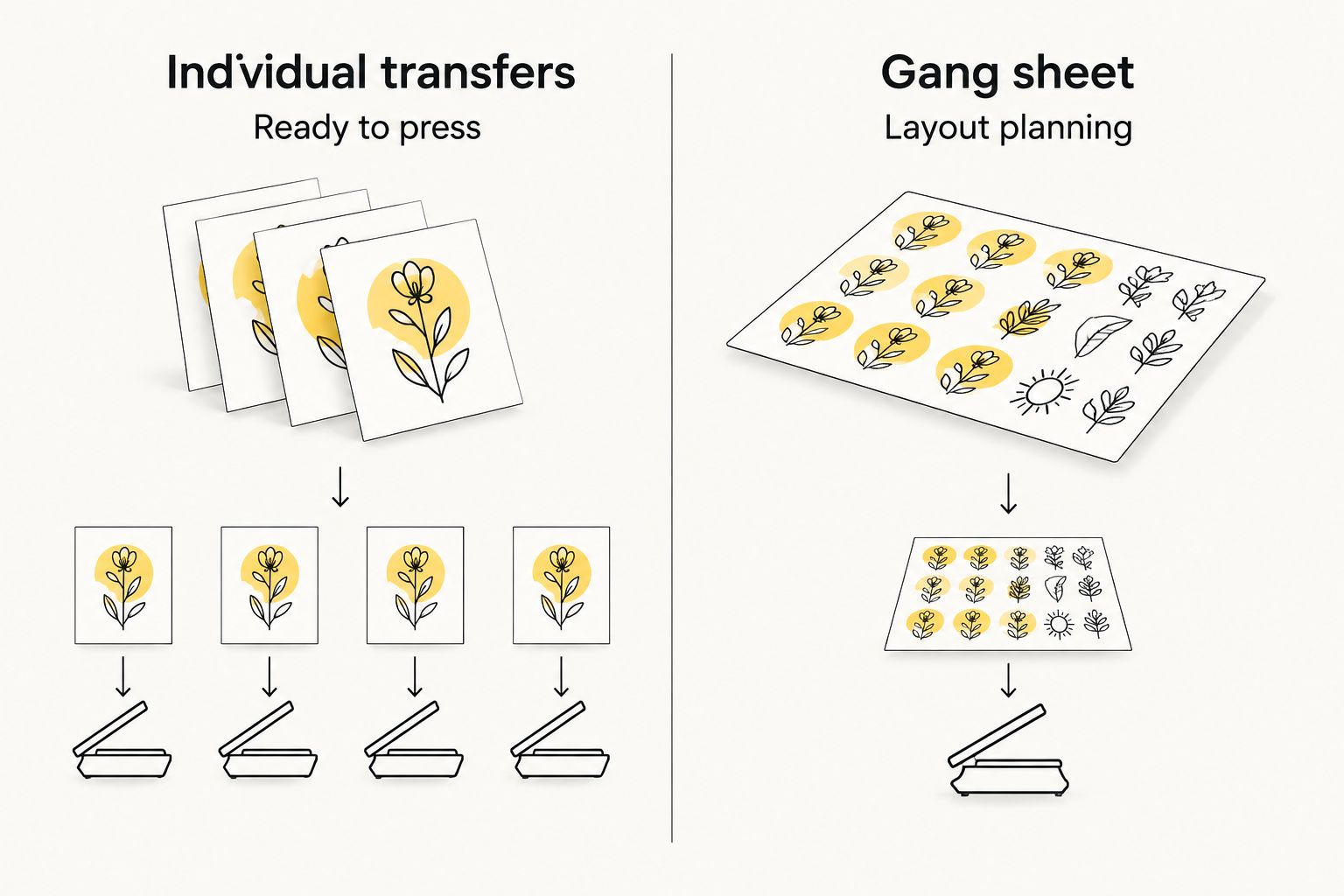
A print-ready DTF gang sheet is a different ordering decision from buying individual cut-to-size transfers. It suits a job where you can arrange several pieces of artwork on one layout and manage separation during production. If your team needs each design staged as an individual transfer, the extra layout and cutting work can outweigh the appeal of a shared sheet.
The sheet dimensions are not the same thing as usable print space. One supplied sample-product description discusses a 24-inch sheet with 21 inches of printable width; that is an example from that listing, not a specification for every gang sheet. Confirm the actual printable area for the product you order before packing artwork close to an edge.
Where gang sheets shine
- One layout can organize different designs for a job that calls for them.
- You can decide placement while preparing the artwork rather than after the sheet arrives.
- A shared layout gives you a clear file to inspect for spacing and missing designs before ordering.
Where gang sheets fall short
- Your team must plan the layout and account for separation between transfers.
- A full sheet is a poor fit when you need one design isolated and ready to stage without cutting.
- Layout errors become production errors if the file is not checked before submission.
Best for: A shop comfortable arranging and separating multiple designs. Verdict: Choose gang sheets for planned mixed-design work; use individual transfers when separation slows the press line.
| Dimension | Gang-sheet ordering | Teddy Transfers |
|---|---|---|
| Artwork preparation | Arrange designs together on a print-ready layout | Compare with your current file-submission process |
| Separation | Plan how individual designs will be separated | Check how your current orders arrive |
| Best comparison job | An order containing several different designs | Use that same order as the baseline |
3. In-house DTF printing: best for shops seeking print control
In-house DTF printing is a production alternative, not another transfer supplier. You take responsibility for printing the transfers before they reach the heat press. That gives you direct control of the print step, but it also makes print quality and process upkeep your shop's work.
Where in-house printing shines
- Your team can change the print workflow internally rather than submit each change to a supplier.
- You can inspect a transfer as part of your own print process before scheduling the garment press.
Where in-house printing falls short
- Printing and maintaining a repeatable process add work beyond pressing garments.
- Your shop must manage its own print supplies and troubleshoot output.
- Moving production inside does not solve weak source artwork or an inconsistent heat-press process.
Best for: A shop deliberately adding transfer production to its operations. Verdict: Choose it for print-process control, not as a shortcut around supplier qualification.
| Dimension | In-house DTF printing | Teddy Transfers |
|---|---|---|
| Who prints the transfer | Your shop | Your existing outside-supplier workflow |
| Process responsibility | Printing, supplies and press application | Your ordering checks and press application |
| Artwork changes | Managed in your own print workflow | Managed through your current ordering workflow |
4. Screen printing: best for a different decoration workflow
Screen printing belongs on this list only if you are willing to change methods. Instead of sourcing a DTF transfer to heat-press onto a garment, the shop prints ink directly onto the garment. Evaluate it as a production choice for a defined job, not as a one-for-one replacement for a cut-to-size transfer order.
Where screen printing shines
- It gives a shop with an established screen-print workflow another way to produce decorated garments.
- The comparison forces a useful question: do you need a new supplier, or do you need a different decoration method?
Where screen printing falls short
- It requires a different production process from pressing supplier-made DTF transfers.
- A shop set up only to press transfers cannot treat a screen-print job as a simple supplier switch.
Best for: A print shop that already uses screen printing or plans to add that process. Verdict: Consider it when the job warrants a method change; skip it when the requirement is simply another DTF supplier.
| Dimension | Screen printing | Teddy Transfers |
|---|---|---|
| Decoration method | Print ink onto the garment | Continue your current transfer workflow |
| Operational change | Different production process | Keep the process your team knows |
| Buying decision | Choose a method for the job | Qualify or retain a transfer supplier |
How to compare suppliers on an actual job
Use one finished garment as the standard for a 2026 supplier decision. Keep the artwork, blank, placement and press routine consistent while you compare the transfers. Changing all of them at once makes it harder to identify what caused a difference in the result.
- Pick a representative file. Use artwork your shop already knows how to inspect, preferably one with details or colors that matter to the customer. Check its final size before sending it to either supplier.
- Match the garment. Apply each transfer to the garment type used for the real job. A result on an unrelated blank does not settle the production decision.
- Record the press instructions. Follow the instructions supplied with each transfer instead of assuming that an old setting applies to a new material.
- Inspect placement and finish. Look at the result where the customer will see it: on the garment, after the transfer has been applied and the required finishing steps are complete.
- Repeat the job that matters. A single attractive sample answers whether you like that sample. A repeat design tells you more about whether the ordering format fits your routine.
For a gang-sheet trial, check every design in the submitted layout and decide who will separate the transfers before the press job begins. For individual transfers, check whether their delivered format fits the way your team sorts sizes, names or customer orders. These are workflow checks, not claims that one supplier has a defect.
A transfer sample is useful at this stage because it gives your press operator something physical to evaluate. It is not a substitute for testing your own artwork on your own blank. Keep the trial focused on the job you would actually move.


Why people switch from Teddy Transfers
The clearest reason to investigate a switch is a specific production requirement that your current order does not satisfy. For this comparison, that requirement is an individually cut, ready-to-press ordering route, a print-ready gang-sheet route, or control over printing transfers yourself. Each points to a different option; none establishes a fault with Teddy Transfers.
Write the requirement in terms your team can verify. Individual transfers must be ready for staging is testable. So is the artwork team must fit several designs into one approved layout. General dissatisfaction is not enough to tell you which alternative will fix the job.
Keep your existing supplier in the test rather than treating its past work as irrelevant. A familiar order that passes your artwork, garment and press checks is a meaningful benchmark. The new option earns the work only when its format or finished result better fits the requirement you set.
When staying with Teddy Transfers is the right call
Stay if your current transfers pass on the garments you sell and the ordering format fits how your shop prepares and presses jobs. Changing suppliers introduces a new file check, a new application check and a new routine for the team. Without a defined production gain, keeping a qualified process is the straightforward choice.
That does not prevent you from testing an alternative in 2026. Run a contained trial for the specific job your present workflow struggles to handle. If both options pass, choose the format that creates less handling for that job rather than declaring one supplier universally better.
FAQ
What is the best Teddy Transfers alternative in 2026?
DTF2GO is the best fit in this comparison for decorators seeking custom cut-to-size, ready-to-press DTF transfers. Test the same artwork and garment you use for a current job before changing suppliers.
Is a gang sheet better than individual DTF transfers?
A gang sheet is better when you want to arrange several designs on one layout and can separate them for pressing. Individual cut-to-size transfers suit a workflow that stages each design separately.
Can I replace a transfer supplier by printing DTF transfers in-house?
Yes, in-house DTF printing replaces supplier-made transfers with transfers produced by your shop. It also makes printing, supplies and process control your responsibility.
Is screen printing a direct substitute for DTF transfers?
No, screen printing is a different garment-decoration method, not another source of ready-to-press DTF transfers. Compare it when you are open to changing the production process.
How should I test a new DTF transfer supplier?
Use the same artwork and garment as a current job, then follow each transfer's application instructions. Inspect the finished garment and assess how the order fits your team's workflow.
When should I keep using Teddy Transfers?
Keep Teddy Transfers when your current orders pass your artwork, garment and press checks and the format fits your production routine. Switch only for a requirement another option demonstrably meets better.
One last thing
Choose the format before you choose the supplier. A cut-to-size transfer, a gang sheet and an in-house print can start with the same artwork but create different work for the team at the press. In 2026, the strongest alternative is the one that improves the job you actually run.


