


Lion DTF is a sound choice when its transfers are already approved on your press and fit your production workflow. It stops being enough when you need a supplier choice built around individually cut, ready-to-press transfers and print-ready gang sheets. The best Lion DTF alternative in 2026 is DTF2GO for apparel decorators who want those ordering formats; in-house DTF printing is the alternative when you need to control production yourself.
- For lion dtf alternatives in 2026, choose DTF2GO when you need cut-to-size, ready-to-press transfers or gang sheets.
- Keep Lion DTF if its transfers already pass your shop's press and garment checks.
- Choose in-house DTF printing only when controlling the print process matters more than buying finished transfers.
Why this matters
A transfer supplier is part of your production process, not just a source of printed film. Your decorators need artwork that arrives in a usable format, a transfer that works with the garments in the order, and instructions your press operators can follow. A supplier comparison should therefore start with the work you actually send out.
In 2026, the useful question is not whether one name is universally better than another. It is whether cut-to-size transfers, gang sheets, or control of the printing process removes a step from your current workflow. DTF2GO produces custom cut-to-size, ready-to-press DTF heat transfers for apparel decorators, promotional product businesses, and print shops. That stated focus makes it a direct option for shops buying transfers to press, rather than equipment to operate.
Judge Lion DTF alternatives against a real job: the same artwork, garment, placement, and pressing process. If a format changes how much cutting or sorting your team does, that difference matters even before you compare the finished prints.
Lion DTF alternatives at a glance
| Option | Best for | Standout feature or approach | How it differs from Lion DTF |
|---|---|---|---|
| Lion DTF | Shops whose current Lion DTF transfers have passed their own production checks | An existing, qualified supplier workflow | The benchmark; keep it if your current jobs already run cleanly |
| DTF2GO | Shops ordering ready-to-press transfers in cut-to-size or gang-sheet formats | A choice between individual transfers and print-ready gang sheets | Compare those formats with the Lion DTF ordering process your shop uses |
| In-house DTF printing | Shops that want to print their own transfers | Direct control of printing and preparation | Replaces an outsourced transfer order with an internal production task |
This is a workflow comparison, not a claim that one supplier produces a better print. No independent, like-for-like press or wash results are supplied for Lion DTF and the options here. Use your shop's approved artwork and garments to make that judgment.
1. DTF2GO: best for cut-to-size and gang-sheet orders
DTF2GO sells custom, ready-to-press DTF transfers to decorators and print shops. Its individual cut-to-size DTF transfers fit an order where the decorator wants separate pieces to sort and place. Its print-ready DTF gang sheet fits artwork your team has already arranged on a sheet.
Those are different production decisions. With individual transfers, evaluate how the pieces will be identified and staged for each garment. With a gang sheet, evaluate how your team will arrange designs, cut the sheet, and keep pieces matched to the work order. Neither format is automatically the better choice for every job.
Where DTF2GO shines
- A defined cut-to-size option. You can compare an individual-transfer order against the cutting and sorting your current workflow requires.
- A print-ready gang-sheet option. Shops that prepare their own layouts can keep that preparation step in-house while buying the printed transfers.
- A stated professional buyer. The offering is directed at apparel decorators, promotional product businesses, and print shops, not framed as a general consumer craft purchase.
Where DTF2GO falls short
- A supplier change still requires qualification. The inputs provide no side-by-side wash, color, or press results against Lion DTF. Do not move an approved customer job solely because the order format looks convenient.
- Print-ready sheets put layout responsibility on your shop. Check every design, size, and placement before submitting artwork.
- Buying transfers does not give you control of the printing process. If your requirement is to print internally, an outsourced supplier does not meet it.
Best for: A shop that already presses garments and wants to compare individually cut transfers with a gang-sheet workflow. Verdict: Buy for a controlled trial, then approve for production only after your own press checks.
DTF2GO vs. Lion DTF: what to check
| Production question | DTF2GO | Lion DTF |
|---|---|---|
| Individually cut transfers | An explicit cut-to-size product option | Check the format you currently order |
| Print-ready gang sheets | An explicit product option | Check how your current order is prepared |
| Press results on your garment | Qualify on your press | Use your recorded result as the benchmark |
| Artwork handoff | Check the submitted file and selected format | Compare with your established submission process |
Do not read an unverified cell as a limitation of Lion DTF. It is a prompt to check your current order, not an assertion about the competitor's catalog.
How to compare the formats on a live job
Use one approved design and a garment your shop routinely decorates. Keep the artwork, placement, and operator checks consistent so you can identify whether the ordering format actually improves the job. Record what happens at receiving, sorting, pressing, and final inspection; a clean print is not the only production outcome.
- Individual transfers: Check whether the delivered pieces are straightforward to match to garment sizes and work orders.
- Gang sheets: Check whether the layout makes cutting and sorting practical for your team.
- Pressing: Follow the instructions for each transfer and record the result on the garment you intend to sell.
- Approval: Compare the finished item with the customer's accepted artwork and your shop's existing standard.
The store catalog also lists a 31-inch gang sheet uploader and a 32-inch gang sheet builder. Those widths describe listed products, not a measured advantage over Lion DTF. Match the format to your artwork preparation process before treating sheet width as a benefit.
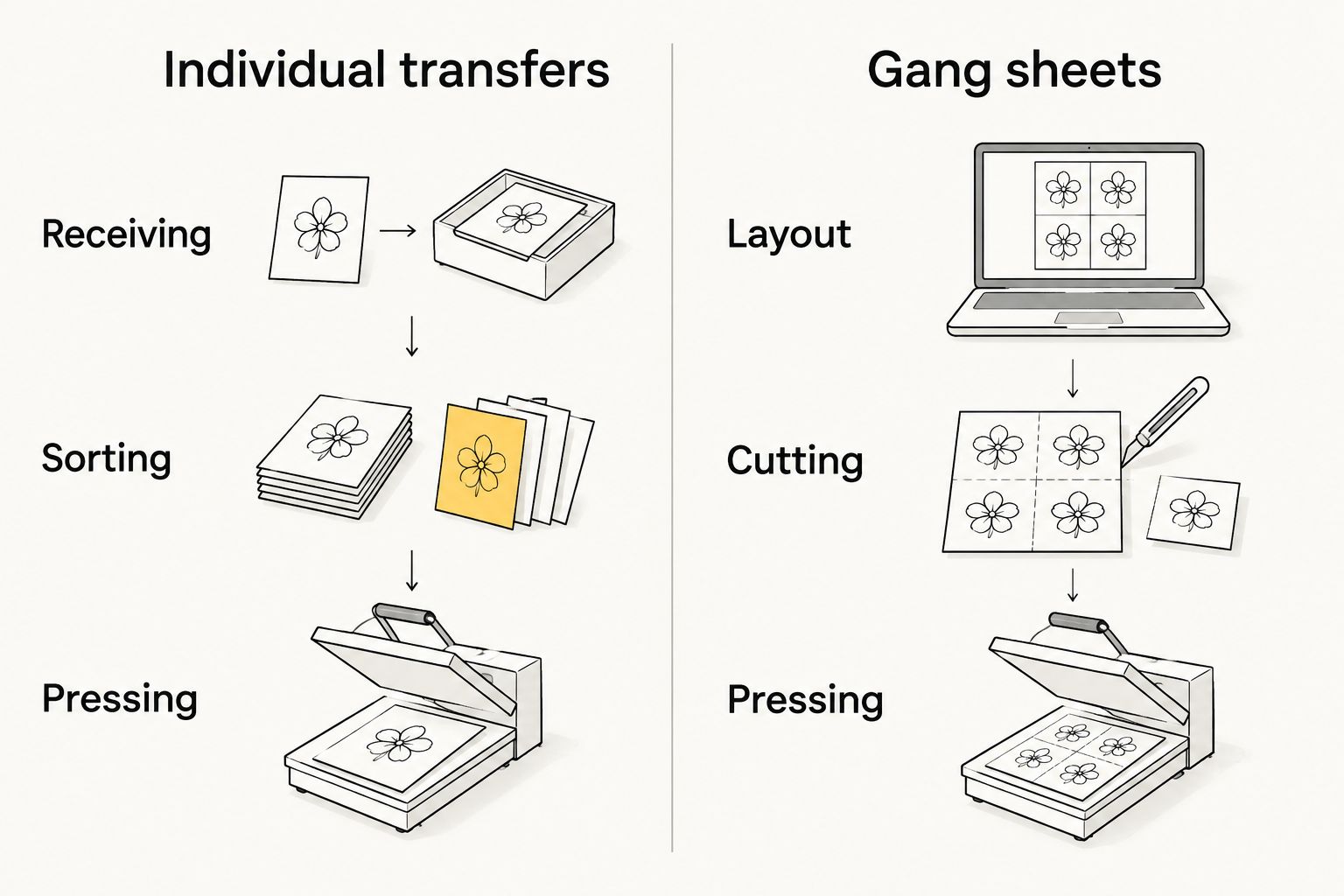
The product formats below are relevant to that comparison. A gang-sheet builder and a cut-to-size transfer order solve different preparation tasks; check the format rather than assuming both should be ordered for the same job.


2. In-house DTF printing: best for control of print production
In-house printing is an alternative to buying finished transfers, not another transfer vendor. Your shop takes responsibility for producing the transfers before anyone presses a garment. That distinction matters when control of print preparation is the reason you are looking beyond Lion DTF.
It also changes the comparison. An outsourced order asks whether a supplier can deliver the format your decorators need. An in-house process asks whether your team wants to own the printing work as well as garment decoration. If the problem is simply that individually cut pieces would be easier to handle, bringing printing inside does not directly address that decision.
Where in-house printing shines
- Direct process control. Your team handles artwork preparation and transfer production within its own workflow.
- Internal sequencing. You decide how print work fits alongside the garment orders already in production.
- One production chain. The same shop can oversee transfer creation and application.
Where in-house printing falls short
- More work stays with your team. Printing transfers becomes a production responsibility rather than a supplier handoff.
- It is not a like-for-like vendor swap. Evaluate equipment and operating requirements separately from the quality of a finished transfer order.
- It does not eliminate garment approval. You still need to check the pressed result against the job specification.
Best for: A print shop whose goal is to bring transfer production under its own control. Verdict: Hold unless that control is the reason for changing the workflow.
In-house printing vs. Lion DTF
| Production question | In-house DTF printing | Lion DTF |
|---|---|---|
| Who prints the transfer? | Your shop | Your supplier for orders placed with Lion DTF |
| Who manages print preparation? | Your shop | Check the responsibilities in your current order process |
| What does your press operator receive? | A transfer made internally | The transfers supplied for your order |
| What must you qualify? | Your internal print and press process | The supplied transfer on your press and garment |
These differences concern ownership of the work. They do not establish which transfer will look or wear better. Make that call from comparable finished garments, not from the location of the printer.
Why people switch from Lion DTF
There is no documented Lion DTF price change, service failure, or print-quality problem in the supplied information. The defensible reasons to consider a change in 2026 are changes in your requirements. Name the requirement first, then test whether another workflow meets it.
- Your team wants pieces supplied cut to size. Compare an individual-transfer order with the steps your decorators perform on their current orders.
- Your team prepares gang-sheet artwork. Compare the print-ready option with the way your existing supplier accepts and returns that work.
- Your shop wants to print transfers itself. Evaluate in-house production as a separate operational decision, not as evidence against Lion DTF.
- Your customer needs a newly approved result. Run the proposed transfer on the actual garment and check it against the accepted design before changing suppliers.
A switch should remove a named bottleneck or meet a named production requirement. Without one, changing a qualified supplier adds another process to learn without establishing a benefit. Keep your existing approval records as the baseline for any 2026 trial.
When staying with Lion DTF is the right call
Stay with Lion DTF when its transfers pass your checks, its ordering format works for your staff, and the jobs you take do not call for a different handoff. Familiarity alone is not a technical specification, but an approved press process is a practical asset. Preserve it until an alternative proves useful on a real order.
If you do test another supplier, separate the format decision from the print decision. First ask whether cut-to-size pieces or a gang sheet makes the order easier to stage. Then inspect the pressed garment. A better ordering experience does not excuse a result your customer has not approved; a good print does not automatically fix a workflow your operators struggle to manage.
FAQ
What is the best Lion DTF alternative in 2026?
DTF2GO is the best option here for decorators seeking custom cut-to-size, ready-to-press DTF transfers or print-ready gang sheets. Qualify the transfers on your own garments before changing an approved production process.
Is DTF2GO better than Lion DTF for gang sheets?
DTF2GO has an explicit print-ready gang-sheet option, but the supplied information does not establish a print-quality advantage over Lion DTF. Compare your current ordering process and press results on the same job.
Should I order individual DTF transfers or a gang sheet?
Order individual transfers when separately supplied pieces suit your sorting and placement workflow; choose a gang sheet when your team prepares the layout and handles cutting. Check both formats against the actual work order.
Can I replace a transfer supplier with in-house DTF printing?
Yes, in-house DTF printing replaces a supplier order with an internal printing task. It fits shops seeking control of transfer production, not shops that only need a different finished-transfer format.
How do I compare Lion DTF with another supplier?
Use the same approved artwork and garment, then check ordering, receiving, pressing, and the finished result. Record differences against your existing approved process rather than comparing catalog descriptions alone.
Do cut-to-size transfers eliminate every preparation step?
No, your team still has to identify the right transfer, position it, press it according to its instructions, and inspect the garment. Cut-to-size describes the supplied format, not the entire decoration process.
Should I leave Lion DTF if my current orders work?
No, keep a supplier whose transfers and order process meet your documented needs. Test an alternative when you have a specific format or production requirement your current workflow does not meet.
One last thing
The first question for a 2026 supplier trial is who does the cutting. If the answer changes how your operators stage an order, test cut-to-size transfers against a gang sheet before debating supplier names. If the answer does not change the job, keep your attention on the pressed result and the workflow you have already approved.


