


Choose DTF2GO if you want custom cut-to-size, ready-to-press DTF transfers for an apparel decorating workflow; choose Ninja Transfers if its transfers already meet your shop’s approval standards and changing suppliers would mean requalifying production. For 2026, the useful distinction is a documented cut-to-size offering versus an already-qualified supplier—not an unsupported claim that one prints better.
- DTF2GO vs Ninja Transfers comes down to cut-to-size workflow fit versus keeping an already-qualified DTF transfer supplier.
- Choose cut-to-size transfers when separating and sorting gang sheets creates unnecessary handling in your shop.
- Keep Ninja Transfers when your existing approved results meet the job requirements.
- Compare color, application, and finished garments before changing suppliers; equipment claims alone do not establish a winner.
Why this matters
DTF2GO is a fit for apparel decorators buying custom cut-to-size, ready-to-press DTF transfers. Its individual cut-to-size DTF transfers match that requirement directly. That is a product-format recommendation, not a claim of better adhesion or longer wash life.
Your supplier decision affects more than the image coming off the press. Artwork preparation, transfer separation, job sorting, application instructions, and garment approval all belong in the comparison. A transfer that looks good on film still needs to work on the actual blank.
For your 2026 purchasing decision, separate confirmed product fit from performance you need to establish on your equipment. Keep the first question simple: are you solving a handling problem, a finished-print problem, or neither?
At a glance
| Dimension | DTF2GO | Ninja Transfers |
|---|---|---|
| Best for | Decorators seeking custom cut-to-size, ready-to-press DTF transfers | Decorators whose existing Ninja workflow already passes approval |
| Transfer format | Cut-to-size transfers and a print-ready gang-sheet option | Confirm the required format before ordering |
| Standout feature | Custom cut-to-size delivery matches individual-transfer handling | Existing approved job history, if your shop has it |
| Workflow continuity | Treat a supplier change as a new production qualification | Keep an established process when its results remain acceptable |
| Color approval | Judge a pressed sample against the approved artwork | Use the same approval standard and garment |
| Application | Follow the instructions for the specific transfer | Follow the instructions for the specific transfer |
| Finished-garment durability | Establish results through garment testing | Establish results through garment testing |
| Pricing model | Confirm the order basis for the selected format | Confirm the order basis for the selected format |
The Ninja column gives a genuine reason to stay: your own approved production history. It does not claim a particular print system, transfer specification, or ordering feature. Likewise, the cut-to-size offering establishes workflow fit, not automatic performance superiority.
Cut-to-size wins when sheet separation is your bottleneck
Custom cut-to-size transfers suit jobs where you want individual pieces ready for placement rather than a sheet that still needs separating. The benefit is specific. You move the separation task out of your own production sequence.
That format fits a decorator sorting different graphics into job packets or preparing individual placements for an operator. It does not remove artwork checks, garment identification, or placement decisions. Ready-to-press describes the transfer’s role in the workflow; it does not mean every garment is automatically approved.
A gang sheet serves a different layout requirement. Multiple designs share a sheet, so your artwork preparation and downstream separation become part of the job plan. The print-ready DTF gang sheet provides a separate option to assess rather than treating cut-to-size as the only sensible format.
Choose the format around the work your shop needs to eliminate. Cut-to-size is the stronger fit when separation is the problem. A gang-sheet layout remains relevant when you want to organize multiple designs together and can handle the separation yourself.
An approved incumbent wins when you do not need to change
Ninja Transfers is the better choice for an existing customer whose approved transfers already meet the job specification and whose production process is working. That advantage comes from demonstrated fit inside that particular shop. It is not a universal ranking.
Changing suppliers introduces new work: reviewing instructions, approving the finished result, updating the job record, and confirming that operators can reproduce it. If your current process has no unresolved issue, a new supplier needs to solve a named problem before a change makes sense.
Do not confuse continuity with permanent commitment. Keep evaluating alternatives when you have a specific reason, such as a different transfer format or a recurring handling issue. But avoid changing a working production process just because another supplier has a more persuasive comparison page.
Keep the approved incumbent when the proposed switch has no defined production benefit. This recommendation favors Ninja only for shops with successful existing Ninja production—not for buyers who have yet to qualify either supplier.
Cut-to-size is a concrete feature, not a quality score
The clearest feature-level reason to consider the challenger is its custom cut-to-size offering. You can connect that feature to a task in your shop. You cannot use it to infer color accuracy, garment compatibility, or wash durability.
A useful feature comparison starts with the operator’s job. Does the operator receive an individual transfer, identify the garment, position the graphic, and press? Or does someone first separate a sheet and sort the pieces? Those are different handling sequences even when the finished artwork is identical.
The limitation is equally clear: cut-to-size does not correct an undersized logo, unwanted artwork background, or poorly planned placement. Those remain prepress decisions. A convenient format cannot rescue a file that was prepared incorrectly.
Treat transfer format as a workflow feature and finished-print quality as a separate approval gate. Combining those questions makes it too easy to declare a winner without examining the garment.
Existing job records beat a fresh sales claim
An established Ninja customer has a useful comparison asset: previous approved garments and the records used to produce them. That history gives you a reference for evaluating a challenger. Preserve it.
Your reference should identify the artwork, finished dimensions, garment, transfer source, and application instructions used. Include the customer’s approval requirement rather than relying on an operator’s memory. A comparison becomes more useful when everyone is judging the same target.
The disadvantage of staying with an incumbent is accepting a process that no longer fits your work. Existing approval does not answer a new requirement automatically. A different garment, placement, or artwork construction still deserves evaluation.
For 2026 repeat orders, use the approved job as the baseline, not as proof that every future job will behave identically. Continuity wins only while the actual requirement stays satisfied.
Neither supplier wins color without a pressed comparison
Color approval belongs on the finished garment. Film appearance and monitor appearance are not substitutes for examining the pressed result against your customer’s reference.
Build a comparison around 3 artwork types: a solid-color logo, fine-detail artwork, and a gradient. These are recommended test categories, not claimed supplier performance figures. They give you distinct things to inspect instead of letting one attractive sample stand for every job.
Use the same artwork dimensions for both suppliers. Then inspect the solid areas for the intended appearance, the fine details for legibility, and the gradient for visible transitions. Include a named brand color when that color is part of the customer’s approval standard.
The fair verdict is a tie until you have comparable results. Choose the supplier whose pressed sample meets the actual color requirement. Do not award color accuracy based on the number of inks mentioned in a sales description or a broad claim about printable colors.
Neither supplier wins application without your blank and press
Application is a system: transfer, garment, heat press, operator, and instructions. A comparison that changes several of those at once cannot tell you why the results differ.
Start with 2 garment blanks when your work includes light and dark apparel: one representative light blank and one representative dark blank. This is a proposed comparison set, not a claim that either supplier supports every fabric. Select garments that reflect the work you actually sell.
Use each supplier’s instructions for its own transfer. Do not force identical press settings merely to make the test look controlled; different instructions can be part of the product. Record the settings and peel procedure so another operator can reproduce the result.
Neither brand earns an application win from a generic temperature recommendation. Approve the transfer on the intended garment, and keep that approval separate from any broader assumption about fabric compatibility.
Finished-garment testing is an honest tie until results exist
Durability means the decorated garment continues to meet the customer’s requirements after use and care. A fresh print does not establish that result. Neither supplier deserves a wash-life claim without supporting evidence.
Keep the garment type, artwork, placement, and care procedure consistent across the comparison. Inspect the decorated area for edge lifting, cracking, appearance changes, and anything else the customer has named as unacceptable. Do not invent a universal pass threshold for every job.
Separate application defects from later wear. If the transfer fails during initial approval, correct the process or reject that combination before treating the garment as a durability specimen. Otherwise, you risk blaming a supplier for a setup that was never qualified.
Approve durability for the job you are selling, not for DTF as an entire category. Your 2026 supplier record should describe the tested garment and process rather than promise an unsupported lifetime.
Pricing models: compare the order basis and handling burden
For both suppliers, establish how the selected transfer format is ordered before making a commercial comparison. Confirm whether the quote concerns individual transfers, a sheet layout, or another clearly defined unit. Different units make headline comparisons unhelpful.
An individual-transfer order ties the purchasing decision to the pieces you need. A sheet-based order ties it to the prepared layout and the work needed to separate that layout. Those are format tradeoffs; they are not claims about either supplier’s current billing terms.
Predictability comes from a defined order specification. Flexibility comes from choosing a format that suits the mix of artwork on the job. Neither matters much if the order requires unplanned sorting, rework, or a second approval round.
Compare the same finished requirement and include your handling work. Confirm current commercial terms directly rather than assuming a format name establishes the pricing model.
Make the supplier decision with one controlled pilot
Use 1 pilot job before moving a recurring order. Pick a job that represents your normal production rather than a design selected only because it is easy to print. The objective is a repeatable approval, not a dramatic demonstration.
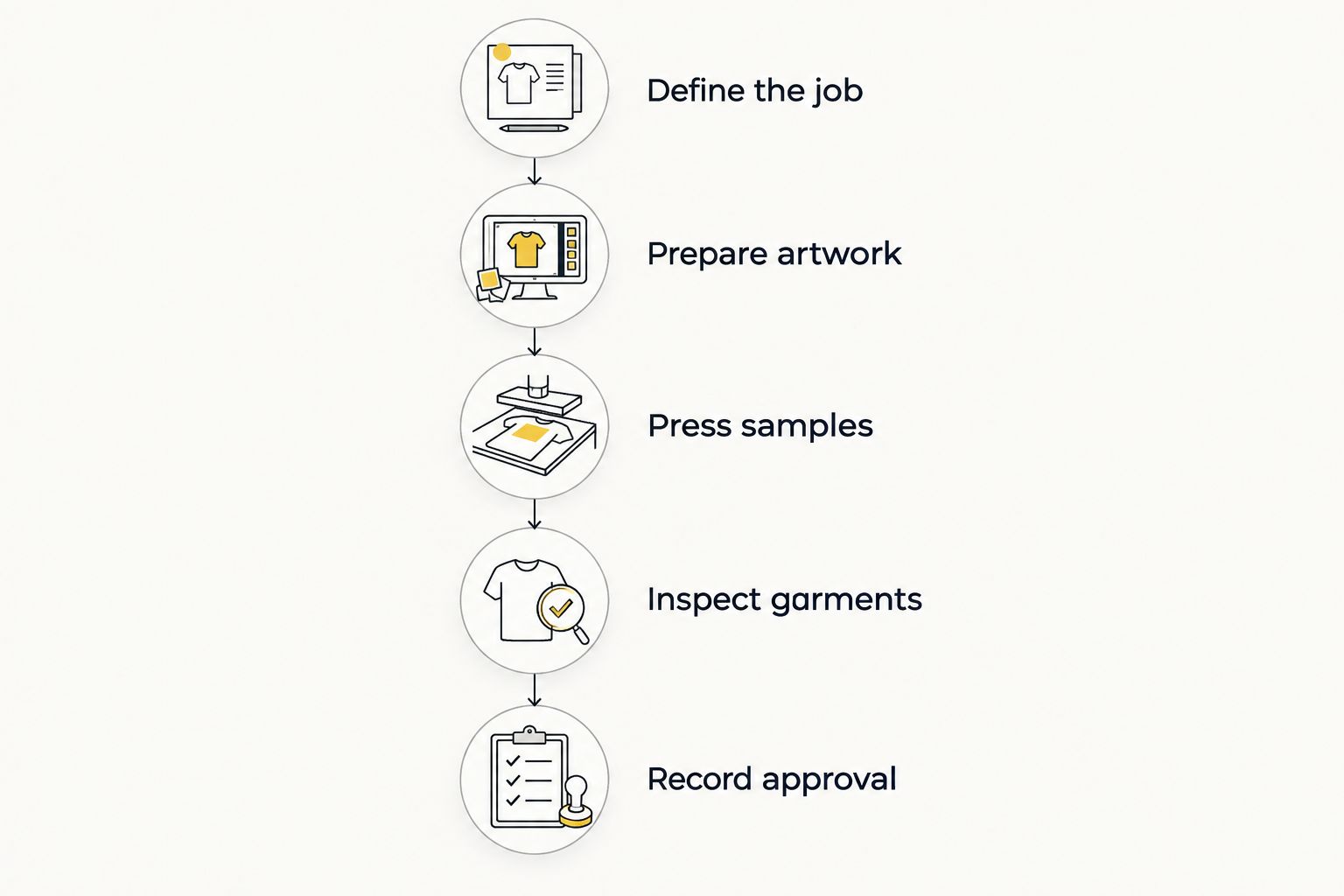
Follow this sequence:
- Define the job. Identify the artwork, placement, garment, and customer approval requirement.
- Prepare artwork. Use matching finished dimensions and the same source design for the comparison.
- Press samples. Apply each transfer according to its own instructions and record the process.
- Inspect garments. Review color, detail, placement, adhesion, and care results against the job requirement.
- Record approval. Keep the accepted sample and production notes together.
A failed comparison should identify the failed requirement. Write down whether the issue involved artwork, application, appearance, or care. A simple rejection without that detail does not help you choose the next supplier or correct the next run.
Final verdict: choose the workflow that passes your job
Choose DTF2GO if you need individual ready-to-press transfers
Best for: apparel decorators, promotional product businesses, and print shops seeking custom cut-to-size transfers. The offering matches that production requirement directly. Qualify color, application, and garment performance before extending the recommendation beyond format fit.
Choose Ninja Transfers if your existing production is approved
Best for: current Ninja customers with accepted garments and a repeatable process. Keep that supplier when the process meets the requirement and a switch solves no named problem. Reassess when the job changes or an alternative addresses a specific handling need.
| Dimension | Winner |
|---|---|
| Cut-to-size workflow fit | DTF2GO for the stated individual-transfer requirement |
| Continuity of approved Ninja production | Ninja Transfers for an existing qualified workflow |
| Standout format feature | Cut-to-size when separation is the bottleneck |
| Existing production records | Ninja Transfers when your shop has approved job history |
| Color approval | No winner before comparable pressed samples |
| Application | No winner before qualification on the intended blank |
| Finished-garment durability | No winner before comparable garment testing |
| Commercial fit | The order format and terms that match the finished job |
FAQ
Is DTF2GO better than Ninja Transfers?
DTF2GO is a fit when you need custom cut-to-size, ready-to-press DTF transfers. Ninja Transfers is the stronger continuity choice when your shop already has approved results and a repeatable process; neither gets a blanket quality win from that distinction.
Should I switch from Ninja Transfers if my current prints look good?
Keep Ninja Transfers if your current process meets the job requirements and a switch solves no specific problem. Evaluate a challenger when you need a different format or want to address a documented production issue.
Are cut-to-size transfers better than gang sheets?
Cut-to-size transfers are better suited to workflows where separating a sheet is unwanted work. Gang sheets suit a different layout approach, so choose around artwork preparation, sorting, and separation rather than assuming one format prints better.
Which supplier produces more accurate colors?
Choose the supplier whose pressed sample meets your approved color reference. Compare matching artwork on the intended garment instead of judging film appearance or treating equipment descriptions as proof of color accuracy.
Can I use the same heat-press settings for both suppliers?
Use the instructions for each specific transfer rather than assuming the settings are interchangeable. Record the application and peel procedure alongside the approved garment so your operators can repeat it.
Which DTF transfers last longer after washing?
A durability winner requires comparable garment testing. Keep the artwork, garment, application record, and care procedure defined, then judge the result against the customer’s actual acceptance requirements.
What should a print shop compare before changing DTF suppliers?
Compare transfer format, artwork handling, pressed color, detail, application, and finished-garment care results. Run a representative pilot job and retain the approved sample before moving recurring production.
One last thing
A supplier change is a production change, even when the artwork stays the same. Keep an approved garment with its application record, not just a photo of the transfer. For 2026 reorders, that physical reference gives the next operator something concrete to match.


