


Choose DTF2GO if you want custom, cut-to-size, ready-to-press DTF transfers; choose DTFTransfers.com if its transfers already meet your approved production standard and you want to keep that established workflow. This 2026 comparison puts individual cut-to-size DTF transfers against the practical reasons to keep an incumbent supplier—not an unsupported ranking of print quality.
- DTF2GO vs DTFTransfers.com comes down to cut-to-size preparation versus keeping an already approved production workflow.
- Choose DTF2GO for custom, ready-to-press DTF transfers supplied cut to size.
- Choose DTFTransfers.com when your existing transfers already pass your garment, artwork, and production checks.
- Compare finished garments and handling requirements before changing suppliers.
Why this matters
Your transfer supplier affects more than the image on the shirt. Transfer format determines what happens between receiving the order and loading the heat press: separating designs, identifying placements, sorting jobs, and checking artwork against the production ticket.
A supplier change also introduces a new approval task. You need to confirm that the transfer works with the actual garment, artwork, and application instructions before treating it as a production replacement.
The better supplier is the one that fits your approved job from receipt through pressing. For a 2026 purchasing decision, compare those tasks directly rather than treating a product description as proof of finished-garment performance.
At a glance
The table below separates a stated product format from conditional reasons to retain an existing supplier. An incumbent advantage applies only when your shop already has satisfactory results with that supplier.
| Dimension | DTF2GO | DTFTransfers.com |
|---|---|---|
| Best for | Decorators, promotional product businesses, and print shops seeking custom cut-to-size transfers | Shops whose existing transfers already meet their approved production standard |
| Cutting and preparation | Custom transfers supplied cut to size and ready to press | Keep the current format if its preparation requirements already suit your shop |
| Repeat production | Evaluate as a replacement against your approved job | Prefer the incumbent when repeat results already meet your standard |
| Existing artwork | Submit final-size artwork and approve the printed result | Retain the existing route when the same artwork already prints acceptably |
| Press control | Follow the instructions for the transfer being applied | Follow the instructions for the transfer being applied |
| Color and durability | Approve on the intended garment; format alone does not establish performance | Approve on the intended garment; incumbent status alone does not establish performance |
| Standout decision point | Cut-to-size, ready-to-press preparation | Continuity of an already approved workflow |
| Pricing model | Check the current charging basis for the custom transfer order | Check the current charging basis for an equivalent order |
DTF2GO is the clearer fit when you want cut-to-size preparation
DTF2GO DTF transfers are best for decorators who want custom artwork supplied cut to size and ready to press. That is the clearest supported reason to choose the brand in this comparison.
Cut-to-size preparation matters when you want individual designs ready for sorting and placement rather than a sheet that your team must separate. The distinction is operational. It does not, by itself, establish better color, softer hand feel, or longer wash life.
Consider what your team receives and what it must do next:
- Cut preparation: Determine whether any separation work remains before placement.
- Job sorting: Identify each design, garment placement, and required quantity.
- Press placement: Match the transfer to the production ticket before application.
The benefit is a format that matches an individual-transfer workflow. The limitation is equally clear: cut-to-size does not eliminate artwork approval, garment testing, or press setup.
Do not assume that every job needs the same format. A shop comfortable separating designs from a sheet can evaluate a print-ready DTF gang sheet as a different preparation route, without confusing that format decision with a supplier-quality verdict.
DTFTransfers.com wins continuity when your repeat job is already approved
Choose DTFTransfers.com for repeat production when its existing transfers already satisfy your shop's acceptance criteria. This is a genuine reason to keep an incumbent supplier, not a claim that its transfers outperform another brand.
An approved workflow gives you a reference point. You know which artwork was ordered, which garment was used, and which application instructions produced an acceptable result.
Switching suppliers means checking those relationships again. Even when the new transfer looks good before pressing, you still need to approve the finished garment and document the application process.
The incumbent's advantage is continuity. Its limitation is that yesterday's approval does not automatically cover a different fabric, redesigned logo, or new placement.
For repeat jobs in 2026, keep a reference garment and the corresponding production record. Compare a proposed replacement against that reference, not against memory or a photograph viewed on a different screen.
DTFTransfers.com wins artwork continuity when the file already works
An existing, approved print route has an advantage when you are reproducing the same artwork on the same garment. Keep DTFTransfers.com for that job if the current result already meets the customer's approved standard.
This recommendation concerns your established file-to-print result. It does not assume any particular upload tool, accepted file format, proofing service, or artwork support from either supplier.
When evaluating a replacement, send the same final-size artwork. Avoid changing the supplier, artwork dimensions, and garment at the same time; otherwise, you lose a clear basis for comparing results.
Inspect the features that matter to the job:
- Small lettering must remain readable in the finished print.
- Fine outlines must match the approved artwork's appearance.
- Intended transparent areas must remain free of unwanted artwork.
- Placement dimensions must fit the garment and production ticket.
Continuity is useful, but it has a boundary. If the existing print does not meet the artwork requirement, staying with the incumbent is not a solution; compare new printed results against a corrected approval standard.
Both suppliers need transfer-specific press control
Neither supplier name replaces application instructions. Use the time, temperature, pressure, and peel procedure specified for the exact transfer you are applying.
Do not carry settings from an incumbent transfer into a replacement trial by default. A comparison is meaningful only when each transfer is applied according to its own instructions on the intended garment.
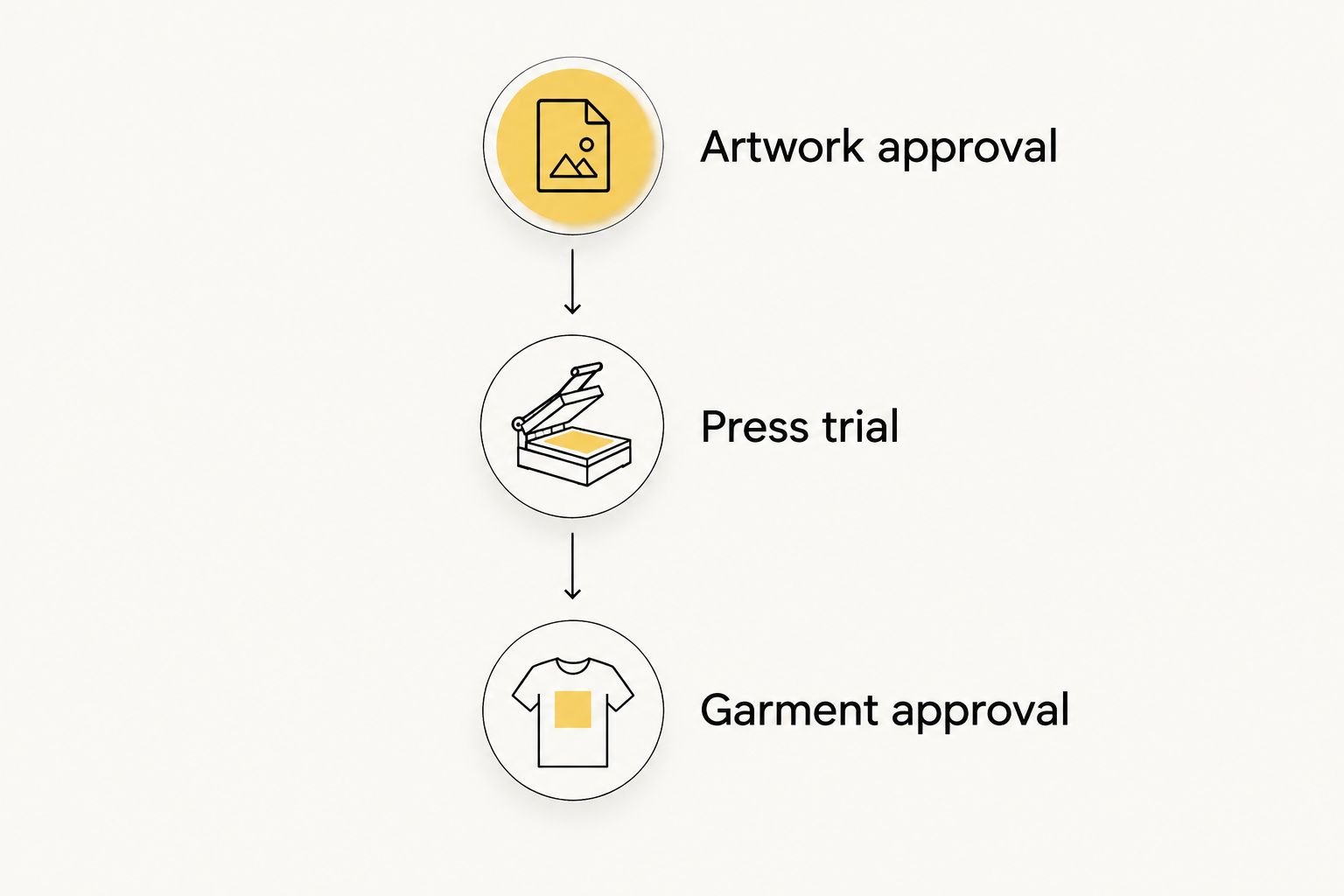
Keep the evaluation in 3 stages:
- Artwork approval: Confirm the design and final placement size before ordering.
- Press trial: Apply the transfer using its specified procedure and inspect the result.
- Garment approval: Check the finished garment before releasing the job to production.
These stages are a recommended approval process, not a claim about either supplier's performance. Their purpose is to separate file issues, application issues, and finished-garment issues instead of treating every problem as a printing defect.
For a 2026 supplier trial, record the instructions alongside your observations. That record gives your press operator a usable production reference instead of a vague note that the sample looked acceptable.
Neither supplier earns a color or durability win from format alone
A ready-to-press transfer describes preparation, not a measured color or wash-performance result. An established supplier relationship is also not proof that every new job will meet the same standard.
Judge color on the pressed garment and durability under the relevant care instructions. A screen preview, loose transfer, and finished garment are different comparison objects.
Use 2 sample garments per supplier as a practical starting point: retain one as the appearance reference and use the other for your care evaluation. This is a recommended comparison setup, not a certified durability test or a promised service life.
Check color against the customer's approved reference under consistent lighting. Inspect solid areas, gradients, small text, and the edges of the printed design, then assess hand feel on the garment rather than through the carrier film.
After care evaluation, compare the used garment with the retained reference. Record visible changes rather than assigning an unsupported wash-life number.
The same standard applies to both options. Neither earns a performance win until the finished result passes the checks relevant to your job.
Cut-to-size preparation and incumbent continuity solve different problems
The standout difference is the decision each option supports. Custom cut-to-size transfers address preparation before pressing; an approved incumbent workflow addresses continuity across repeat orders.
If your problem is separating and organizing transfers, evaluate the cut-to-size route. If your problem is reproducing an already approved order without introducing a new supplier trial, retain the existing route while testing alternatives separately.
Neither choice removes the need for production control. Ready-to-press does not mean ready-to-approve, and familiar does not mean suitable for every new garment.
For 2026 purchasing, write the problem on the job ticket before comparing suppliers. That prevents a preparation decision from becoming an unsupported claim about quality, speed, or durability.
Pricing: compare the charging basis and the work left in your shop
Compare equivalent orders before deciding which purchase structure suits your production. Match artwork dimensions, quantities, transfer format, and the work required after receipt.
For DTF2GO, check the current charging basis for the custom transfer format you intend to order. For DTFTransfers.com, check the current basis for the matching order rather than assuming both purchases are calculated the same way.
A unit-based quote and a sheet-based quote require different comparisons. If an order is billed by individual transfer, relate it to the usable pieces your job needs; if it is billed by sheet, relate it to the usable designs in the layout and any separation work.
Those are purchasing models to verify, not assigned pricing policies for either supplier. Do not compare unlike order formats and call the difference a supplier advantage.
Include your shop's actual preparation work in the decision. Record cutting, sorting, and placement preparation without inventing a labor-saving estimate.
Final verdict: choose the format or retain the approved workflow
Choose DTF2GO if you want custom cut-to-size transfers
Best for: an apparel decorator, promotional product business, or print shop seeking individual ready-to-press DTF transfers. Choose this route when cut-to-size preparation matches how your team organizes and presses jobs.
Approve the result on your own garment before replacing an established production standard. The supported reason to choose it is the transfer format—not an unproven claim about competitor performance.
Choose DTFTransfers.com if your existing job already passes
Best for: a repeat-order print shop with an approved transfer, artwork file, garment, and application procedure. Keep this route when those results meet the customer's requirements and continuity is the immediate priority.
Evaluate a replacement separately. An alternative earns the production order by passing your acceptance checks, not merely by offering a different preparation format.
| Dimension | Winner |
|---|---|
| Cut-to-size preparation | The stated cut-to-size option |
| Approved repeat production | DTFTransfers.com, when it is your satisfactory incumbent |
| Existing artwork continuity | DTFTransfers.com, when the current file-to-print result is approved |
| Press control | Tie: use transfer-specific instructions |
| Color and durability | No winner without a finished-garment comparison |
| Standout decision point | Cut-to-size for preparation; incumbent for continuity |
| Pricing model | Choose after matching the order and charging basis |
FAQ
Is DTF2GO better than DTFTransfers.com in 2026?
DTF2GO is the clearer choice for custom cut-to-size, ready-to-press DTF transfers. DTFTransfers.com is the better continuity choice when its existing transfers already meet your approved production standard.
Should I switch suppliers for a repeat shirt order?
Keep the approved supplier for the repeat order unless a replacement has passed your acceptance checks. Compare the same artwork and garment before changing production.
Are cut-to-size transfers better than gang sheets?
Cut-to-size transfers suit individual-transfer preparation, while gang sheets suit workflows that include separating designs. The format decision does not establish which printed result has better color or durability.
Can I use the same heat press settings for both suppliers?
Use the instructions for each exact transfer rather than assuming the settings are interchangeable. Follow the specified time, temperature, pressure, and peel procedure.
How do I compare the suppliers' pricing?
Compare the current charging basis for equivalent artwork sizes, quantities, and transfer formats. Include the actual cutting and sorting work required in your shop.
Which supplier has better wash durability?
A durability winner requires a finished-garment comparison under the relevant care instructions. Retain an appearance reference and record changes after your care evaluation.
What should a print shop check before approving a new transfer?
Check artwork accuracy, placement size, application instructions, finished appearance, and care performance. Use the intended garment rather than treating a loose transfer as production approval.
One last thing
Keep an approved finished garment, not just the artwork file. The file records what you requested; the garment records what the customer accepted.
Label that reference with the supplier, transfer format, garment identification, and application procedure. For your next reorder or supplier trial, it becomes the comparison standard that a screen preview cannot replace.


