


Choose DTF2GO if you want custom cut-to-size, ready-to-press DTF transfers for apparel production; choose DTF Sheet if your shop has already qualified its transfers on your garments and wants to preserve that established workflow. This 2026 comparison separates a documented cut-to-size option from the production checks that should decide any supplier switch.
- DTF2GO vs DTF Sheet: choose DTF2GO for custom cut-to-size, ready-to-press DTF transfers.
- Choose DTF Sheet when its transfers already meet your shop’s documented garment and application requirements.
- Compare gang sheets by usable layout and preparation work, not sheet width alone.
- Qualify color, application and wash performance before switching transfer suppliers.
Why this matters
DTF2GO is a fit for apparel decorators who want custom DTF transfers delivered cut-to-size and ready-to-press. Its individual cut-to-size DTF transfers address a specific production requirement: receiving separate transfers rather than separating designs from a gang sheet yourself.
That distinction matters at the press. A transfer order is not finished production; you still need to identify the correct design, position it, apply it correctly and inspect the garment. Choose the format that fits those tasks, not the supplier with the strongest headline.
For a 2026 supplier decision, compare the same artwork, intended dimensions and garment. Keep the acceptance criteria fixed. Otherwise, a different fabric, changed file or altered press procedure turns a supplier comparison into a comparison of unrelated jobs.
At a glance
| Dimension | DTF2GO | DTF Sheet |
|---|---|---|
| Best for | Decorators seeking custom cut-to-size, ready-to-press transfers | Shops retaining an already-qualified DTF Sheet workflow |
| Standout feature | Custom cut-to-size transfer offering | Existing production fit, when your shop has established it |
| Individual-transfer preparation | Cut-to-size format removes sheet separation from your preparation | Confirm the supplied format against your preparation requirements |
| Gang-sheet workflow | Print-ready gang-sheet page and named uploader and builder products | Confirm layout, upload and separation requirements |
| Color approval | Approve a physical transfer on the intended garment | Apply the same physical approval standard |
| Application and durability | Qualify using the supplied transfer instructions | Qualify using the supplied transfer instructions |
| Repeat-order continuity | Qualify before replacing an established supplier | Retain when an existing qualified process remains acceptable |
| Pricing model | Check the current order basis for the selected format | Check the current order basis for the selected format |
The table is a purchasing guide, not a measured performance ranking. A documented product format supports a format recommendation; it does not establish better adhesion, faster delivery or longer wash life. Keep those decisions tied to your own production approval.
DTF2GO wins when cut-to-size is your purchasing requirement
The strongest reason to select this supplier is straightforward: its stated business is producing custom cut-to-size, ready-to-press DTF heat transfers for apparel decorators, promotional product businesses and print shops. That matches a shop that wants individual transfers prepared before they reach the production bench.
Best for: decorators who want separate transfers for garment-by-garment handling. Individual pieces let you organize work by artwork, placement or customer order without first separating the designs from a combined sheet. You still need to count, sort and position them accurately.
The advantage is format, not an asserted speed gain. No universal time saving applies to every shop: a well-organized gang-sheet operation has different preparation needs from a decorator handling many unrelated customer designs.
The tradeoff is less involvement in a shared-sheet layout. If arranging multiple designs yourself is part of your production method, compare the gang-sheet route before choosing individual pieces. Cut-to-size is useful when separation is work you want removed, not when layout control is the priority.
Before ordering, specify the intended dimensions and placement for each design. Do not treat the visible artwork size and its surrounding carrier film as interchangeable measurements. Your operator needs a clear finished graphic size to judge placement consistently.
DTF Sheet wins when it is already your qualified incumbent
Choose DTF Sheet for continuity when your shop has already approved its transfers for the job. This is a genuine reason to retain a supplier, but only for a shop with an established DTF Sheet process. Familiarity alone is not qualification.
Best for: production teams repeating an approved garment and artwork combination. If the transfer, application instructions and finished result already meet your acceptance standard, replacing the supplier introduces another variable into an otherwise controlled job.
The benefit belongs to your established process, not an assumed competitor feature. Your operators know the instructions they have approved, and your production records define what an acceptable result looks like. Preserve those records when evaluating an alternative.
The limitation is equally clear: approval does not automatically transfer to another garment or graphic. A successful chest logo on one blank does not establish the result of a large solid design on a different fabric.
For a new shop without an approved supplier, this continuity advantage disappears. Select on documented order requirements and physical qualification instead. Neither a familiar brand name nor a comparison-page ranking replaces that work.
Gang-sheet fit comes from the layout, not the headline width
The supplied product catalog names a 31-inch DTF Gang Sheet UPLOADER, a 32-inch DTF Gang Sheet BUILDER and a 32-inch Dynamic Gang Sheet. Those are product names, not proof that every ordering route has the same printable area, file requirements or finishing workflow.
The print-ready DTF gang sheet page is relevant when you already have a prepared sheet file. Confirm its current requirements before exporting your artwork; do not assume the dimensions in another product title apply to that upload route.
Best for: decorators who deliberately combine designs into a shared production layout. A gang sheet gives you a way to group repeat graphics or different designs. It also leaves separation and job identification as tasks to account for before pressing.
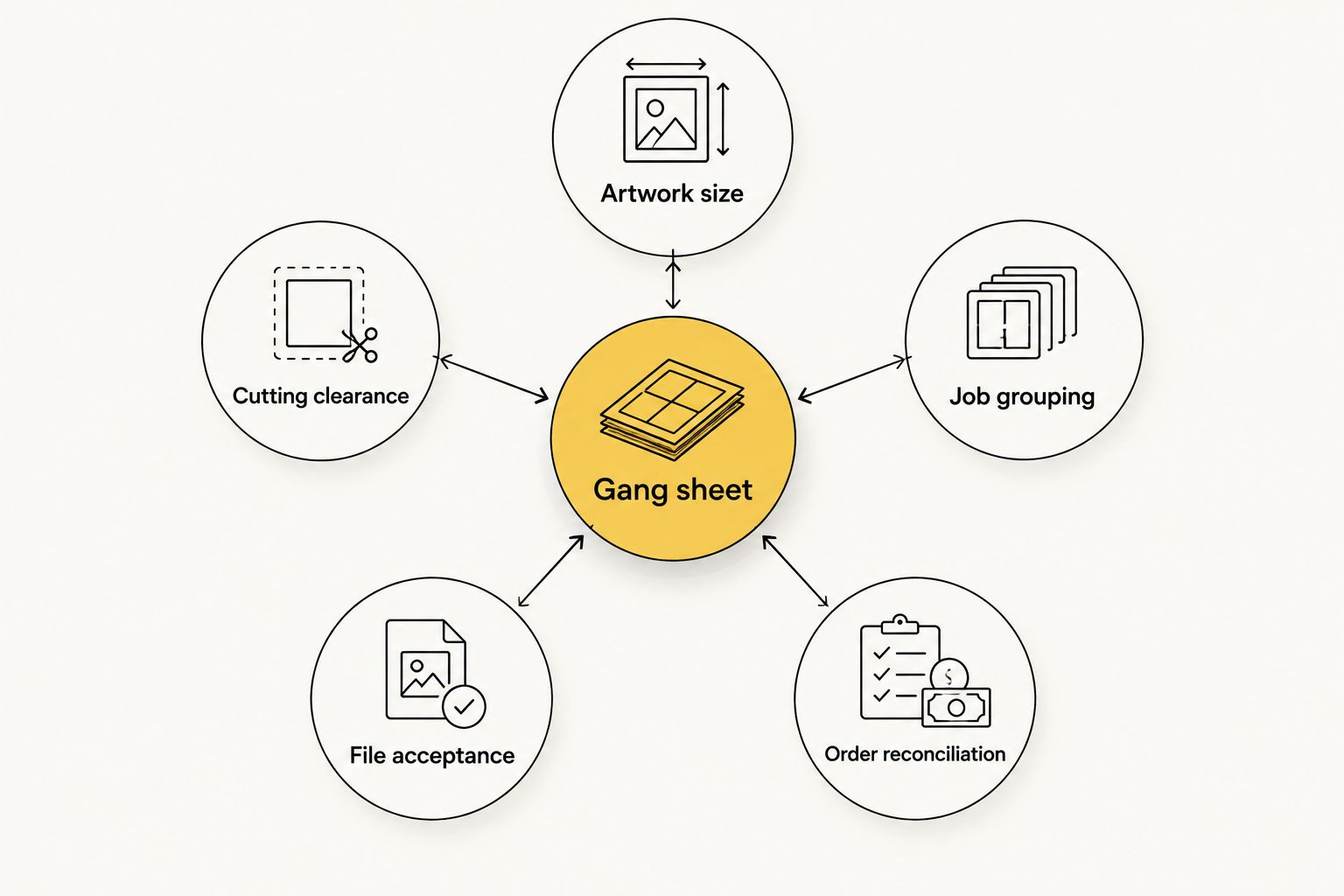
Use these checks when comparing either supplier’s gang-sheet option:
- Artwork size: preserve each design’s intended finished dimensions.
- Cutting clearance: leave space to separate the carrier without cutting through neighboring artwork.
- Job grouping: arrange designs so operators can identify the correct customer and placement.
- File acceptance: follow the selected product’s current upload requirements.
- Order reconciliation: compare the received designs with the approved job list.
For your 2026 comparison, submit equivalent artwork requirements to both suppliers. Compare the resulting workflow rather than assigning a winner from a width label. A larger named sheet is not, by itself, evidence of a better usable layout for your job.
Both suppliers need the same physical color approval
Color approval is a tie in the buying process: require a physical result from either supplier. This is not a claim that the transfers produce identical color. It is the same acceptance standard applied to both options.
Best for: decorators handling customer logos, repeat merchandise or other color-sensitive artwork. Define the approved reference before you judge the print. A screen preview is not the garment that your customer receives.
Compare transfers on the intended garment color and under consistent viewing conditions. Include the artwork features that matter to the order: solid fills, fine lettering, gradients or photographic detail. A sample that omits the difficult parts of the design does not answer the production question.
Use the same source file for each supplier. Record any artwork changes requested during preparation, because a changed file prevents a clean comparison. Approve the finished garment rather than treating an attractive transfer on its carrier as final sign-off.
The drawback is the extra approval work before production. The benefit is a decision anchored to your customer’s actual requirement. Do not award a color winner until you have comparable physical results.
Both suppliers must pass garment and application qualification
A ready-to-press transfer still needs correct application. Follow the instructions supplied for the specific transfer, including the stated press procedure and peel method. Do not transplant another supplier’s settings simply because both products use DTF technology.
Application and durability remain unranked until the finished garments are qualified. A clean-looking initial press does not establish the garment’s performance after use and laundering. Treat appearance at application and performance after washing as separate checks.
Best for: any shop accepting responsibility for finished apparel. Use the actual blank intended for production, not a convenient substitute. Fabric composition, garment construction and the placement area belong in the job record.
Build the qualification sequence around these steps:
- Prepare artwork: use the approved file at its intended size.
- Select garment: use the production blank and intended placement.
- Apply transfer: follow the supplier’s specific instructions.
- Inspect result: check placement, edges, visible detail and unwanted marks.
- Wash garment: follow the garment and transfer care instructions, then inspect again.
Keep the comparison controlled. If you change the file, garment and press procedure between samples, you lose the ability to identify the source of a difference. Record observations separately from assumptions about why they occurred.
In 2026, your approval record should still answer the basic question: does this combination meet the customer’s requirement? A supplier name is not an application procedure, and a product description is not a completed garment test.
Pricing models: compare the order basis without ignoring labor
Compare complete jobs, not isolated sheet labels. Check how each selected ordering route calculates the order: by individual transfer, selected sheet dimensions or another stated basis. Use the current ordering page to establish that basis rather than assuming both suppliers calculate it identically.
Individual-transfer ordering aligns the purchase with separate designs. Sheet-based ordering aligns it with a shared layout. The practical tradeoff is between managing individual pieces and managing the layout, separation and identification work associated with a combined sheet.
Account for your shop’s preparation work separately from the supplier’s order calculation. Receiving, counting, separating, sorting and correcting a file are different tasks. Include only tasks that actually apply to your process; do not assign an invented labor allowance to make one option look better.
For a fair 2026 purchasing comparison, hold artwork, intended dimensions, quantities and destination constant. Review the current order terms for both suppliers before committing. A comparison with different order scopes does not tell you which route fits the job.
Neither pricing model earns an automatic win. Choose the ordering basis that matches how your shop organizes and produces the garments, then confirm the complete order before purchase.
Final verdict: choose the workflow you can defend
Choose DTF2GO if you want custom transfers delivered cut-to-size
Named profile: the apparel decorator who wants individual ready-to-press DTF transfers. The stated offering directly matches that requirement. Select the cut-to-size route when you want separation handled before the transfers reach your bench, then qualify the finished result on your production garments.
This recommendation does not extend to an unsupported claim about delivery, durability or comparative color performance. Its basis is the documented format. Your acceptance test determines whether that format also meets the job’s quality requirements.
Choose DTF Sheet if your repeat job is already approved there
Named profile: the print-shop production lead maintaining an established DTF Sheet process. Retain the incumbent when its approved transfers and your existing procedure meet the current job requirement. Change suppliers to solve a defined problem, not merely because another ordering format exists.
Reopen qualification when the garment, artwork or requirement changes. An incumbent deserves credit for an approved process, but not permanent approval for unrelated work.
One-glance scorecard
| Dimension | Winner |
|---|---|
| Custom cut-to-size requirement | DTF2GO: documented fit |
| Existing qualified DTF Sheet workflow | DTF Sheet: continuity for that shop |
| Gang-sheet layout fit | Decide from the actual order requirements |
| Physical color approval | Tie: require the same approval standard |
| Application and durability | Tie: require garment qualification |
| Repeat-order continuity | The already-qualified supplier |
| Pricing model | The order basis that fits your production method |
FAQ
Is DTF2GO better than DTF Sheet for custom apparel transfers?
DTF2GO is the documented fit when your requirement is custom cut-to-size, ready-to-press DTF transfers. Choose DTF Sheet instead when your shop already has a qualified process there and the repeat job remains unchanged.
Which supplier should I choose for gang sheets?
Choose the supplier whose current gang-sheet requirements fit your approved layout and production method. Compare finished artwork dimensions, separation clearance and file acceptance rather than relying on sheet width alone.
Should I switch from DTF Sheet for a repeat customer order?
Keep DTF Sheet when its transfers already meet your documented requirements for that repeat order. Qualify an alternative before switching, and identify the specific production problem the change needs to solve.
Are cut-to-size transfers better than gang sheets?
Cut-to-size transfers are better when you want separate pieces without separating a combined sheet yourself. Gang sheets fit shops that want to group artwork in a shared layout and handle separation as part of preparation.
Can I use the same heat-press settings for both suppliers?
Use the instructions supplied for each specific transfer rather than assuming the settings are interchangeable. Record the application procedure used during qualification and repeat it for the approved job.
How do I compare the ordering models in 2026?
Compare the current order basis for equivalent artwork, dimensions and quantities. Account separately for preparation tasks your shop actually performs, including sheet separation and job sorting.
How do I decide which transfer supplier prints better color?
Approve physical transfers on the intended garment against the same color reference. Use identical source artwork and consistent viewing conditions so the comparison evaluates the print rather than different files or garments.
One last thing
Record the garment alongside the transfer approval. The useful record is not simply that a supplier passed; it is that a particular artwork, blank, placement and application procedure produced an accepted result. That record gives your next repeat order a production reference rather than a memory.
Before your next 2026 supplier comparison, write down the reason for changing: cut-to-size handling, layout requirements or a failed acceptance check. A specific requirement produces a defensible choice. A general search for the better brand does not.


