


DTF Office is a reasonable choice when its transfers already fit your shop’s production workflow. That stops being enough when you need a specific ordering format and your current process does not deliver it. The best DTF Office alternative in 2026 is DTF2GO for custom cut-to-size, ready-to-press transfers; in-house DTF printing is the alternative when you need direct control of production.
- For dtf office alternatives in 2026, choose DTF2GO when you need custom cut-to-size, ready-to-press transfers.
- Choose a print-ready gang sheet when your artwork is already arranged for printing.
- Keep DTF Office if its transfers and ordering process meet your shop’s requirements.
- Choose in-house DTF printing only if your shop wants to take on the printing process.
Why this matters
A transfer supplier affects work well before a design reaches the heat press. You need an ordering format that fits the art you receive, a transfer you can apply consistently, and a clear way to check color against the approved design. For an apparel decorator, promotional product business, or print shop, those are production decisions rather than a contest over which supplier has the longest feature list.
The most useful 2026 comparison starts with the work on your bench. Are you receiving separate logos that should arrive cut to size? Are you sending a completed gang-sheet layout? Or do you want your staff to print the transfers? Pick the route first, then evaluate the supplier within it.
DTF Office alternatives at a glance
| Option | Best for | Standout feature or trade-off | How it differs from DTF Office |
|---|---|---|---|
| DTF Office | Shops whose current transfers meet their requirements | An established ordering workflow for your shop | The baseline: keep it if the output and process work |
| DTF2GO cut-to-size transfers | Decorators who want separate, ready-to-press designs | Individual cut-to-size transfer format | Select this format if it fits your job better than your current order |
| DTF2GO print-ready gang sheet | Shops that prepare their own sheet layouts | Submit artwork as a gang sheet | The shop controls how designs are arranged on the submitted sheet |
| In-house DTF printing | Shops that want to print transfers themselves | Direct control of the printing process | Printing becomes part of your shop’s workflow |
The table compares ordering and production routes, not unverified claims about DTF Office’s equipment, turnaround, or transfer quality. DTF Office could still meet your needs. Check its current options against the exact job you plan to move.
A cut-to-size order and a gang-sheet order solve different handling problems. With cut-to-size transfers, the designs arrive as individual pieces. With a print-ready gang sheet, your shop prepares the layout and works from that sheet. Neither format is automatically better: the right choice depends on whether you want the supplier to provide separate transfers or your team to manage the sheet layout.
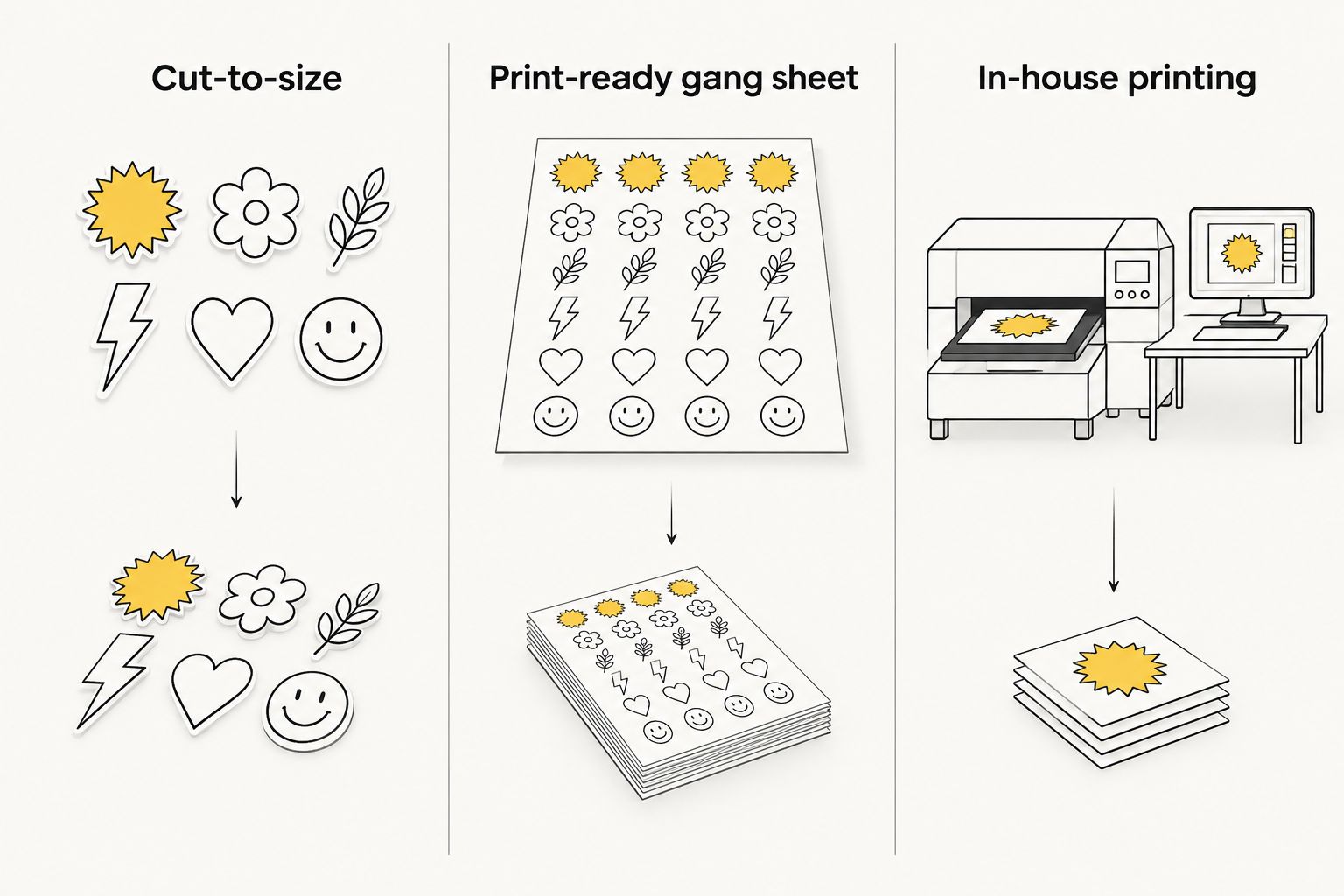
1. DTF2GO: best for cut-to-size, ready-to-press work
DTF2GO produces custom direct-to-film transfers for apparel decorators, promotional product businesses, and print shops. Its individual cut-to-size DTF transfers are the clearest fit when your job calls for separate designs rather than a sheet your staff must divide. Best for: shops that want printed transfers ready for their pressing workflow.
That is a format recommendation, not a blanket claim that every DTF Office order should move. If your current supplier already delivers the size, color, and application result you need, a change creates work without solving a production problem. Compare identical artwork on the blanks you actually decorate before moving a recurring job.
Where DTF2GO shines
- Cut-to-size ordering: Separate transfers fit jobs where individual placement matters.
- Ready-to-press supply: The shop can focus on decorating garments rather than producing the transfer film.
- Gang-sheet choice: A second ordering route exists for shops that prepare print layouts themselves.
- Color discussion: The brand describes a 9-color print system and claims coverage of 97% of Pantone colors. Treat those as supplier claims; approve a physical print against the color your customer expects.
Where DTF2GO falls short
- It does not remove the need for a heat press or an application check. Your staff still has to follow the instructions supplied for the transfer and test the intended blank.
- Supplier printing limits direct shop-floor control. If you need to adjust and print transfers during production, an outside transfer order cannot replace an in-house printer.
- Cut-to-size is not the layout your shop already built. If your team has finished a gang sheet, submitting that sheet is the more direct route.
| Decision point | DTF2GO cut-to-size transfers | DTF Office |
|---|---|---|
| Order format | Individual cut-to-size transfers are offered | Check the format available for your job |
| Artwork check | Review the size and color of each design before approving production | Apply the same review to a comparable order |
| Application check | Test on the intended blank using the supplied instructions | Test on the same blank using its supplied instructions |
| Production responsibility | Supplier produces the transfer; your shop applies it | Compare where printing and application sit in your current process |
Verdict: Choose DTF2GO for cut-to-size work when separate, ready-to-press transfers solve a handling problem in your shop. Hold the supplier switch until a like-for-like sample passes your color, placement, and application checks.
2. Print-ready gang sheets: best for shops that build the layout
A print-ready gang sheet puts the arrangement decision in your hands. The print-ready DTF gang sheet is the relevant route when your artwork is already laid out as a sheet rather than as separate transfer requests. Best for: print shops and decorators with a repeatable artwork-layout process.
Do not confuse this with cut-to-size ordering. On a gang sheet, you decide how the submitted designs sit together. Check each design’s dimensions, orientation, spacing, and final artwork before submission. An error repeated across the layout remains an error even when the transfer itself prints cleanly.
Where a print-ready gang sheet shines
- Your team retains control of the submitted layout.
- Multiple designs can share a prepared sheet.
- The format suits a shop that already checks artwork as part of production intake.
Where a print-ready gang sheet falls short
- Layout becomes your responsibility. The supplier cannot know that a logo was placed at the wrong size for a particular garment.
- The sheet still needs handling at the press. If separate pieces are essential to your workflow, cut-to-size is the clearer request.
- A completed layout does not replace a physical color and application check.
| Decision point | Print-ready gang sheet | DTF Office |
|---|---|---|
| Artwork arrangement | Your shop submits an arranged sheet | Compare the submission route available for your order |
| Size review | Check every design in the final sheet file | Check every design in the file you submit |
| Press workflow | Plan how your team will work from the printed sheet | Compare with how your current transfers arrive |
Verdict: Choose a print-ready gang sheet when your team already owns layout and preflight. Skip this route when separate transfers are the requirement you are trying to solve.
3. In-house DTF printing: best for direct production control
In-house printing is an alternative to outsourcing transfers, not another transfer supplier. Your shop takes responsibility for printing and preparing the transfers before pressing them onto apparel. Best for: an operation that specifically wants transfer production inside its own workflow.
That control has a corresponding obligation. Staff must manage artwork, printing, consumables, and process checks instead of sending a finished file to a supplier. If your actual bottleneck is applying transfers to garments, bringing transfer printing inside does not remove that application step.
Where in-house printing shines
- Your team can make printing decisions as part of its own production schedule.
- Artwork corrections can feed directly into your printing workflow.
- The shop controls the process used to produce its transfers.
Where in-house printing falls short
- Printing adds work before a transfer reaches the press.
- Your team becomes responsible for keeping the print process consistent.
- It does not eliminate artwork approval, garment testing, or press setup.
| Decision point | In-house DTF printing | DTF Office |
|---|---|---|
| Who prints | Your shop | An outside supplier fulfills the transfer order |
| Process control | Your team manages transfer production | Your team specifies and checks the ordered output |
| Work before pressing | Your team prints and prepares the transfer | Your team receives and checks the supplied transfer |
Verdict: Choose in-house printing only when owning transfer production is the goal. Skip it if you want to concentrate staff time on artwork preparation and garment decoration.
How to compare samples before switching
In 2026, the cleanest supplier comparison is the same design on the same intended blank. Start with artwork your shop already knows well: a fine detail, a solid color area, and a color that needs customer approval. Submit the same approved file and specify the same finished dimensions wherever the ordering process allows.
Check the delivered transfers before pressing. Is the design the intended size? Are fine elements present? Does the printed color match the approval standard closely enough for this job? Do not use a screen alone as the final color reference; inspect the physical output under the conditions your customer uses to approve it.
Next, apply the transfers according to each supplier’s own instructions. Use matching blanks and a consistent press setup, but do not assume the suppliers specify identical settings or peel methods. Record the instructions alongside each result so a difference in application does not masquerade as a difference in printing.
Finally, inspect the decorated garments for placement, edges, and the look of the design on the actual fabric. Keep the approved sample with the job record. A supplier change should be based on the result your shop can reproduce, not on a photograph or an unsupported claim about print quality.
For the two outsourced formats discussed here, the relevant product listings are:


Why shops switch from DTF Office
A good reason to switch in 2026 is a documented mismatch between the order you need and the process you currently use. For example, a shop working from individual logo placements needs a straightforward way to order separate transfers. A shop with finished sheet layouts needs a submission route that fits that artwork. Neither case proves DTF Office lacks the format; it tells you what to verify before replacing it.
A second reason is an approved sample that performs better for your particular job. Define better before ordering: the required dimensions, the accepted color reference, the intended garment, and the finished appearance at the press. If both suppliers pass, the switching case depends on the workflow rather than an assumed quality gap.
Do not switch because another supplier claims broader color coverage or uses a different print system. Those claims can inform what you ask to test, but the approved transfer is the production standard. The same rule applies to a gang sheet: a compelling format matters only if your staff can preflight it reliably and use it efficiently at the press.
When staying with DTF Office is the right call
Stay with DTF Office if its current transfers pass your job checks and its ordering process fits your team. Familiarity has practical value when staff know how to prepare files, inspect incoming transfers, and repeat an approved press result. A 2026 supplier comparison should preserve that working baseline, not discard it for a feature your jobs do not require.
You can also keep DTF Office for established work while testing a different format on a separate job. That separates a supplier evaluation from a live production change. The right alternative is the one that fixes a measured workflow problem without introducing an untested application process.
FAQ
What is the best DTF Office alternative in 2026?
DTF2GO is the best fit here for decorators seeking custom cut-to-size, ready-to-press transfers. If your goal is to print transfers yourself, evaluate in-house DTF production instead.
Is a cut-to-size transfer better than a gang sheet?
A cut-to-size transfer is better when you need designs supplied as separate pieces. A gang sheet fits a shop that prepares and checks its own sheet layout.
Does DTF2GO offer a print-ready gang-sheet option?
Yes, DTF2GO has a print-ready DTF gang-sheet product. Check the completed layout and each design’s size before submitting artwork.
Should I switch from DTF Office if my current transfers work?
No. Keep DTF Office when its transfers and ordering process meet the requirements of your jobs; test an alternative against a specific unmet need.
How do I compare two DTF transfer suppliers?
Submit the same approved artwork at the same intended size, then apply each transfer to matching blanks using its own instructions. Judge the physical color, detail, placement, and finished appearance.
Is in-house DTF printing an alternative to ordering transfers?
Yes. In-house DTF printing gives your shop control of transfer production, but it also makes your staff responsible for printing and process checks.
What should a print shop check before ordering a gang sheet?
Check the final layout, design dimensions, orientation, and artwork before submission. A correctly printed sheet will still reproduce mistakes in the file you approved.
One last thing
For a 2026 supplier test, save the press instructions with each finished sample. If you compare prints without recording how each was applied, you cannot tell whether a different result came from the transfer or the press process. Set that control before deciding whether to move a recurring job.


