


No—DTF transfers cannot be used on every fabric. Cotton, polyester, and many blends are suitable candidates, but heat sensitivity, surface coatings, dye migration, and stretch can prevent a successful application. For 2026 production, approve the exact garment and transfer combination before committing a customer order.
- Can DTF transfers be used on any fabric? No—fiber content, coatings, heat tolerance, and stretch determine compatibility.
- Cotton and polyester are common DTF substrates; nylon and coated fabrics need specific compatibility checks.
- DTF2GO supplies ready-to-press DTF transfers for apparel decorators; qualify the garment before production.
- A successful peel does not establish wash durability. Inspect, stretch, and wash the decorated test garment.
Can DTF transfers be applied to all fabric types?
DTF works across many fabric types, not all fabric constructions or finishes. A fiber label helps you screen the garment, but it does not establish whether the adhesive will bond or whether the fabric will survive the required press cycle.
Use this comparison to identify the checks each substrate needs. These are screening decisions, not blanket approvals for a particular transfer formula.
| Fabric or construction | Useful characteristic | Main limitation | Best for | Approval decision |
|---|---|---|---|---|
| Cotton jersey | Common substrate for heat-applied decoration | Moisture, finishes, and surface texture affect results | Everyday decorated T-shirts | Test the actual blank |
| Polyester | Common in performance apparel | Heat sensitivity and dye migration require attention | Performance garments with confirmed transfer compatibility | Check color and heat response |
| Cotton-polyester blends | Combine familiar apparel fibers | Blend composition does not reveal every finish or dye behavior | Mixed-fiber shirts and sweatshirts | Approve each garment style |
| Nylon | Used in lightweight outerwear | Coatings and adhesive compatibility complicate bonding | Outerwear explicitly approved for the transfer | Require specific compatibility guidance |
| Spandex blends | Stretch with the wearer | Fabric extension can exceed the decoration's flexibility | Stretch garments with a qualified design and transfer | Test extension and recovery |
| Fleece, canvas, and denim | Offer varied garment and accessory applications | Pile, texture, seams, and thickness affect contact | Flat, accessible decoration areas | Confirm even contact |
| Waterproof or coated fabric | Adds functional surface properties | Treatments can resist adhesion or suffer heat damage | Applications approved by the garment manufacturer | Do not assume compatibility |
If a transfer lifts, separate a substrate problem from a pressing problem before changing settings. The guide to troubleshooting DTF transfers that are not sticking covers that next diagnostic step.
Why this matters
A print that looks correct at the press can still fail in use. Edge lifting, dye discoloration, restricted stretch, and visible press marks are different defects, and each calls for a different correction.
For your 2026 production workflow, treat fabric approval as a job requirement rather than a transfer supplier's general promise. DTF2GO produces custom, ready-to-press DTF transfers; the garment, its finish, and your application process still determine the finished result.
Approve the decorated garment, not just the transfer. That distinction keeps an attractive first impression from becoming your only quality check.
Cotton: a common starting point, not automatic approval
Cotton T-shirts are familiar substrates for DTF decoration. A smooth, accessible print area supports contact between the transfer adhesive and the garment, while cotton's fiber identity alone does not reveal softeners, treatments, or surface irregularities.
Check the actual blank before pressing. A seam under the platen, a damp garment, or a textured surface introduces a different application condition from a flat, dry test panel.
Best for: everyday shirts with a flat decoration area. The limitation is simple: approval of one cotton shirt does not approve every cotton garment, color, or finish you purchase.
Polyester: check both heat response and dye migration
Polyester requires separate checks for the garment and its dyes. Heat can leave unwanted marks or distortion, while dye migration can discolor the decoration after application, particularly when the transfer lacks suitable protection for that substrate.
Inspect light areas of the artwork against the garment color. Do not approve a dark jersey solely because the transfer adhered and the carrier released cleanly.
Best for: performance apparel with confirmed transfer compatibility. The trade-off is a more demanding approval process: the transfer's application requirements must fit the garment's heat tolerance, and the decoration must resist unwanted color contamination.
Blends and stretch fabrics: evaluate the finished construction
A cotton-polyester blend needs evaluation as that specific garment, not as an average of its fibers. Surface treatments, knit structure, dyes, and any elastane content all affect the conditions your decoration must tolerate.
Stretch fabrics introduce another requirement: the decoration must move appropriately with the garment. A large solid graphic creates a different feel and movement pattern from separated lettering or an open design.
Best for: garments whose normal movement matches the qualified transfer and artwork. The limitation is that adhesion alone does not establish comfort, recovery, or performance during wear.
Nylon and coated fabrics: require explicit compatibility
Do not treat nylon as interchangeable with polyester. A nylon garment can have a coating or finish that changes adhesive behavior, and the appropriate transfer must also work within the garment's permitted application conditions.
Ask the transfer supplier about the exact substrate and disclose any water-repellent, waterproof, or other functional treatment. If you cannot establish a compatible application process, choose a different blank or decoration method.
Best for: specifically approved outerwear applications. The drawback is that an apparently smooth surface can still be unsuitable for the adhesive or press cycle.
Fleece, denim, canvas, and delicate fabrics need separate checks
Fleece pile and coarse woven surfaces change how a transfer contacts the fabric. Thick seams, pockets, and layered construction can also prevent even pressure across the decoration area.
Delicate fabrics introduce a different concern: the garment can lose its appearance before the transfer reaches an acceptable bond. Silk, heat-sensitive synthetics, leather, and synthetic leather are not automatic approvals just because a transfer can attach to them.
Best for: accessible, stable areas that pass both appearance and adhesion checks. Avoid promising compatibility with a delicate or finished material until its manufacturer and your test process support the application.
Why DTF fabric compatibility varies
The fiber name is only the starting point. Evaluate these factors together before choosing a production setting:
- Heat tolerance: The garment must tolerate the transfer's specified application conditions without scorching, glazing, shrinking, or distortion.
- Surface finish: Water-repellent treatments, coatings, and other finishes can interfere with adhesive contact or change under heat.
- Dye behavior: Garment dyes can migrate into a decoration. A clean initial print does not settle that question.
- Stretch and recovery: The print must tolerate the movement expected at its placement without unacceptable cracking, lifting, or distortion.
- Surface structure: Pile, coarse texture, seams, and pockets change contact across the print area.
- Adhesive compatibility: A press setting cannot make every adhesive suitable for every substrate. Confirm the transfer's intended applications first.
These checks also explain why changing the shirt color or switching blank suppliers can require another approval. A matching fiber label does not prove that the dye, finish, construction, and heat response stayed the same.
How do you test whether a DTF transfer suits a fabric?
Use a complete garment whenever construction affects the print area. A loose fabric swatch cannot reproduce a nearby zipper, pocket seam, lining, or uneven garment panel.
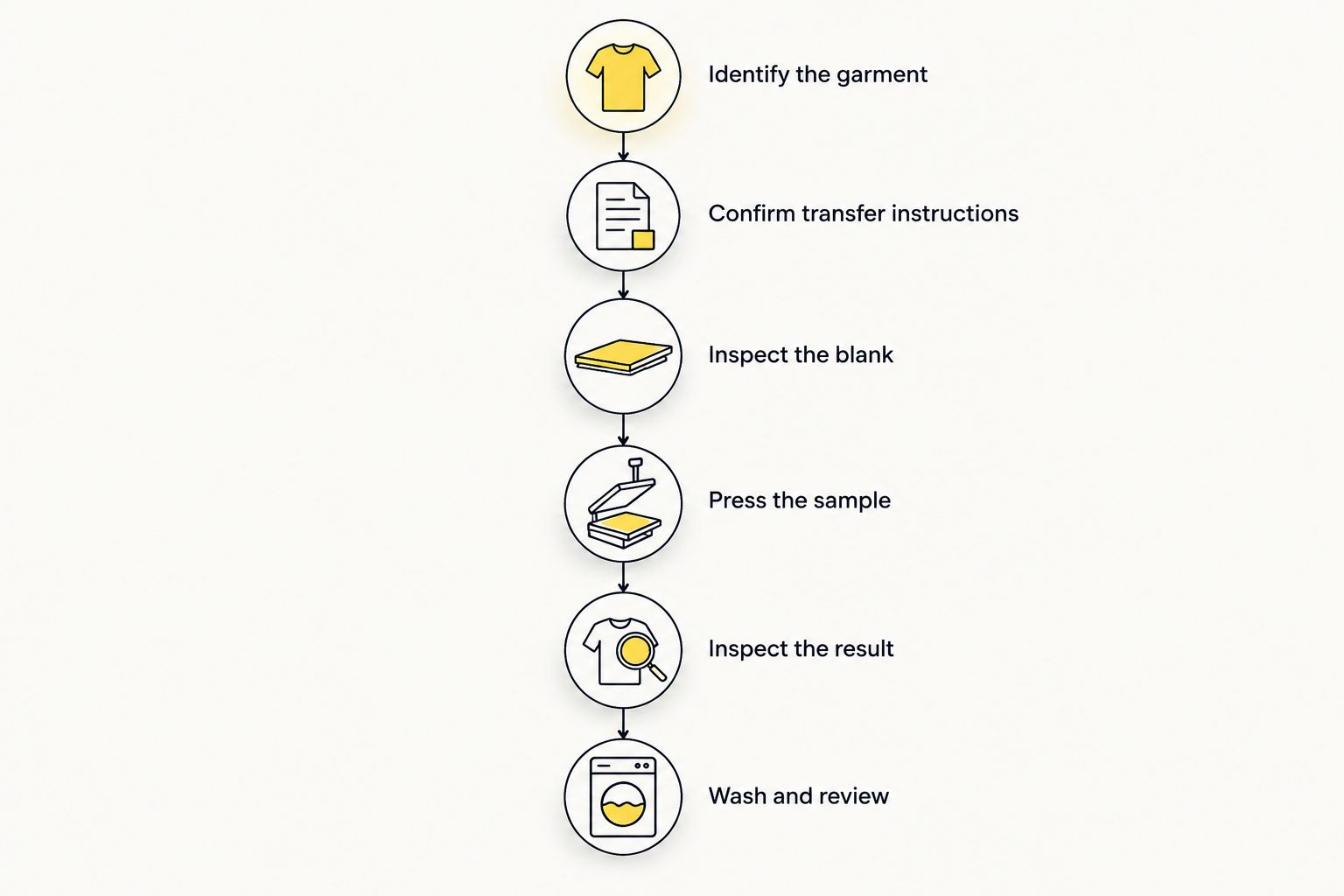
- Identify the garment. Record the blank style, color, fiber content, care instructions, and known finishes. Confirm whether the manufacturer permits heat-applied decoration.
- Confirm transfer instructions. Obtain the supplier's substrate guidance, application settings, peel method, and any finishing instructions. Do not substitute generic internet settings.
- Inspect the blank. Check the intended print area for seams, coatings, pile, contamination, and access to the platen. Resolve contact problems before applying the transfer.
- Press the sample. Apply the transfer using the specified process and suitable equipment. Keep the garment relaxed rather than stretching it onto the platen.
- Inspect the result. Check adhesion, edges, detail, garment appearance, and color. After cooling as instructed, assess the decoration under normal garment movement.
- Wash and review. Follow the applicable care guidance, then inspect the decoration and garment again. Approve production only after the test meets the job's acceptance requirements.
Keep a 2026 test log with the garment identity, transfer used, application settings, and inspection outcome. Photograph defects under consistent lighting so a later production check has a useful reference.
Change one variable at a time when diagnosing a failure. Increasing heat, pressure, and dwell together makes it harder to identify the cause and can damage an otherwise usable garment.
What counts as a failed fabric test?
Reject an application that lifts at the edges, loses detail, shows unacceptable dye contamination, or damages the garment. Also reject a decoration that interferes with the intended movement or leaves an unacceptable change in surface appearance.
Do not rescue a failed sample by repeatedly pressing it until it looks acceptable and then treat that sequence as a production recipe. Confirm the correction against supplier guidance and repeat the complete qualification process.
Can you use the same press settings on every fabric?
No—one press recipe does not establish compatibility across every fabric. Follow the instructions for the specific transfer, then confirm that the garment tolerates those conditions.
Lowering temperature without supplier guidance can compromise bonding; raising it can damage the blank or worsen dye problems. If the application requirements and garment limits do not overlap, change the transfer or garment rather than forcing the combination.
Does a clean peel mean the transfer will survive washing?
No—a clean peel confirms release, not long-term garment performance. Adhesion, stretch behavior, dye stability, and wash performance need their own checks.
Inspect after the supplier's required cooling and care intervals, then wash according to the applicable instructions. Record the outcome rather than treating a smooth peel as the final approval.
Is the fabric label enough to approve a production order?
No—the fiber label does not identify every coating, dye, or construction issue. Use the label to begin the evaluation, then check the garment manufacturer's decoration guidance and the transfer supplier's compatibility instructions.
For repeat orders in 2026, retain the approved blank style and color in your job record. Recheck substitutions instead of assuming that another garment with the same fiber content will behave identically.
Choosing ready-to-press transfers for the approved garment
DTF2GO is best for apparel decorators buying custom, ready-to-press DTF transfers. Once you qualify the blank, Individual Cut-to-Size DTF Transfers fit a workflow built around separately handled designs.
The cut-to-size format removes the task of separating designs from a gang sheet. Its limitation is not the format itself: you still need a compatible substrate, an appropriate press process, and a finished-garment inspection.
Keep your approved sample with the job information. It gives the press operator a physical reference for placement, appearance, and acceptable results rather than leaving those decisions to memory.
FAQ
Can DTF transfers be used on any fabric?
No—DTF transfers cannot be used on every fabric. Cotton, polyester, and many blends are common candidates, but heat tolerance, coatings, dyes, stretch, and adhesive compatibility determine whether a specific garment is suitable.
Do DTF transfers work on cotton shirts?
DTF transfers work on many cotton shirts when the transfer and application process suit the garment. Test the actual blank because finishes, texture, moisture, and construction affect the result.
Can I apply DTF transfers to polyester jerseys?
DTF transfers can be applied to compatible polyester jerseys. Check the transfer supplier's guidance and test for garment damage and dye migration before approving production.
Can I press a standard DTF transfer onto nylon?
Do not assume a standard DTF transfer is suitable for nylon. Confirm compatibility with the specific nylon fabric and any coating, then qualify the complete application.
Will a DTF transfer stretch with leggings?
A DTF transfer must be tested against the movement expected from the leggings. Adhesion alone does not prove that the decoration will stretch, recover, or remain comfortable during wear.
Can I use DTF transfers on waterproof jackets?
Do not approve DTF on a waterproof jacket without garment and transfer compatibility guidance. Surface treatments can interfere with adhesion, and heat can affect the material or finish.
Does DTF2GO remove the need to test my garment?
No—buying ready-to-press DTF transfers does not remove garment qualification. Test the actual blank, application process, and finished decoration before releasing the order.
One last thing
The garment color belongs in your compatibility record, not just your order details. The same style in another color presents a different dye condition, even when the fiber label remains unchanged.
Make that a firm rule in your 2026 approval process: a blank substitution triggers a compatibility review. A retained, washed sample is a more useful production reference than a note that simply says the transfer stuck.


