


Best overall for an approved velvet or velour job: PRINT & CUT DTF Transfers. Best for initial fabric trials: DTF Transfers Samples. Best for repeat layouts after approval: 31" DTF Gang Sheet UPLOADER. This 2026 guide ranks ordering formats, not unverified fabric-performance claims; every recommendation depends on testing your exact garment.
- The best DTF transfers for velvet and velour must pass garment-specific heat, pile, adhesion, and wash checks.
- DTF2GO cut-to-size DTF transfers suit decorators ordering individual designs after fabric approval.
- Choose DTF Transfers Samples for initial screening, then validate your actual production artwork.
- Choose the gang sheet uploader for approved, print-ready layouts—not as a fix for fabric incompatibility.
Why this matters
Velvet and velour have a raised pile. Heat and pressure affect that surface as well as the transfer, so a print that sticks is not automatically an acceptable finished garment.
Your first decision is fabric suitability, not sheet format. Start with the garment's fiber content, care instructions, and decoration guidance; the guide to DTF compatibility across fabric types provides a broader starting point.
DTF2GO cut-to-size DTF transfers are best for decorators who want individual ready-to-press designs after approving their velvet or velour garment. A different ordering format does not remove the need for that approval.
What makes the best DTF transfers for velvet and velour
Use these criteria to choose your 2026 production route:
- Fabric compatibility: Confirm the garment's fiber composition and whether its supplier permits heat-applied decoration.
- Application compatibility: Check the transfer's current pressing instructions against the garment's restrictions. Do not invent a lower-temperature recipe.
- Pile preservation: Inspect the fabric outside the graphic for flattening, gloss, and a visible press boundary.
- Artwork coverage: Evaluate the actual design footprint, not just its colors. Solid coverage changes the feel of a plush surface.
- Finished-garment performance: Check adhesion, appearance, movement, and laundering before approving production.
- Ordering fit: Choose samples for screening, cut-to-size transfers for individual designs, or a gang sheet for prepared layouts.
Velvet and velour DTF options at a glance
These options serve different production stages. Their order reflects the default route for an approved job, followed by initial testing and repeat-layout ordering.
| Item | Best for | Standout feature | Key limitation |
|---|---|---|---|
| PRINT & CUT DTF Transfers | Individual production designs | Custom cut-to-size, ready-to-press format | Cutting format does not establish velvet compatibility |
| DTF Transfers Samples | Initial fabric screening | A sample format for hands-on evaluation | A sample does not replace testing the final artwork |
| 31" DTF Gang Sheet UPLOADER | Repeat print-ready layouts | An upload route for prepared gang sheets | Requires layout preparation and fabric approval first |
1. PRINT & CUT: best DTF transfers for individual designs
PRINT & CUT DTF Transfers are custom cut-to-size, ready-to-press transfers. Choose this format when you want individual designs rather than arranging a complete gang sheet yourself.
For velvet and velour, the relevant advantage is order preparation—not a different heat tolerance or adhesive claim. Use the format after your garment and final artwork pass the application trial.
PRINT & CUT DTF Transfers pros:
- Suits individual artwork and placement-specific orders.
- Provides a cut-to-size format for organizing designs at the press.
- Separates the ordering decision from gang-sheet layout work.
PRINT & CUT DTF Transfers cons:
- Does not establish compatibility with a particular pile or fiber blend.
- Does not prevent pressure marks outside the printed area.
- Still requires a final-artwork test on the production blank.
Best for: Decorators ordering individual chest logos, sleeve graphics, or other defined placements on approved garments.
Verdict: Buy after fabric and artwork approval; wait if the garment remains untested.
2. DTF Transfers Samples: best for initial fabric screening
DTF Transfers Samples provide a starting point for evaluating a transfer on your chosen fabric. Use a sample to inspect the application process and finished surface before preparing a production order.
Keep the scope narrow. A successful sample establishes what happened with that sample, on that blank, under those recorded conditions; it does not approve every design or every velvet garment.
DTF Transfers Samples pros:
- Gives you a physical transfer for an initial application trial.
- Supports inspection of pile changes around the press area.
- Helps separate fabric damage from artwork-specific problems.
DTF Transfers Samples cons:
- Sample artwork does not necessarily match your production design's coverage.
- A successful result does not establish compatibility with other garment colors or fiber blends.
- Final production artwork still needs its own approval.
Best for: Shops evaluating an unfamiliar velvet or velour blank before committing artwork to production.
For a new fabric in 2026, start here rather than treating a large production order as your test. Ask for the current application instructions before the sample reaches the press.
Verdict: Buy for screening; hold production until the actual design passes.
3. Gang Sheet UPLOADER: best for approved repeat layouts
The 31" DTF Gang Sheet UPLOADER is the print-ready gang-sheet ordering option. Choose it when you already have a prepared layout and an approved garment-decoration combination.
A gang sheet groups artwork for ordering. It does not mean the entire sheet belongs on the garment in a single press application; prepare individual transfers and placements according to the supplied instructions.
31" DTF Gang Sheet UPLOADER pros:
- Suits an existing print-ready gang-sheet workflow.
- Groups prepared artwork into a sheet layout.
- Provides a distinct ordering route for repeat production files.
31" DTF Gang Sheet UPLOADER cons:
- Requires correct layout preparation before upload.
- Does not resolve pile crushing or garment heat restrictions.
- Mixed designs still need appropriate garment and placement checks.
Best for: Print shops repeating approved graphics with prepared gang-sheet files.
Do not read the product's width as a recommended graphic size for velvet apparel. Graphic dimensions belong to the garment, placement, and approved proof—not the ordering sheet.
Verdict: Buy for validated repeat work; wait while the fabric or artwork is still changing.
How this ranking works
This 2026 ranking prioritizes ordering fit, preparation requirements, and the point at which each format enters your workflow. It is not a laboratory ranking of velvet adhesion, wash life, or press-mark resistance.
PRINT & CUT takes the default production slot because its individual cut-to-size format matches a defined design order. Samples take the screening slot, while the uploader serves prepared layouts; none receives an automatic fabric-compatibility endorsement.
Approve velvet and velour before running production
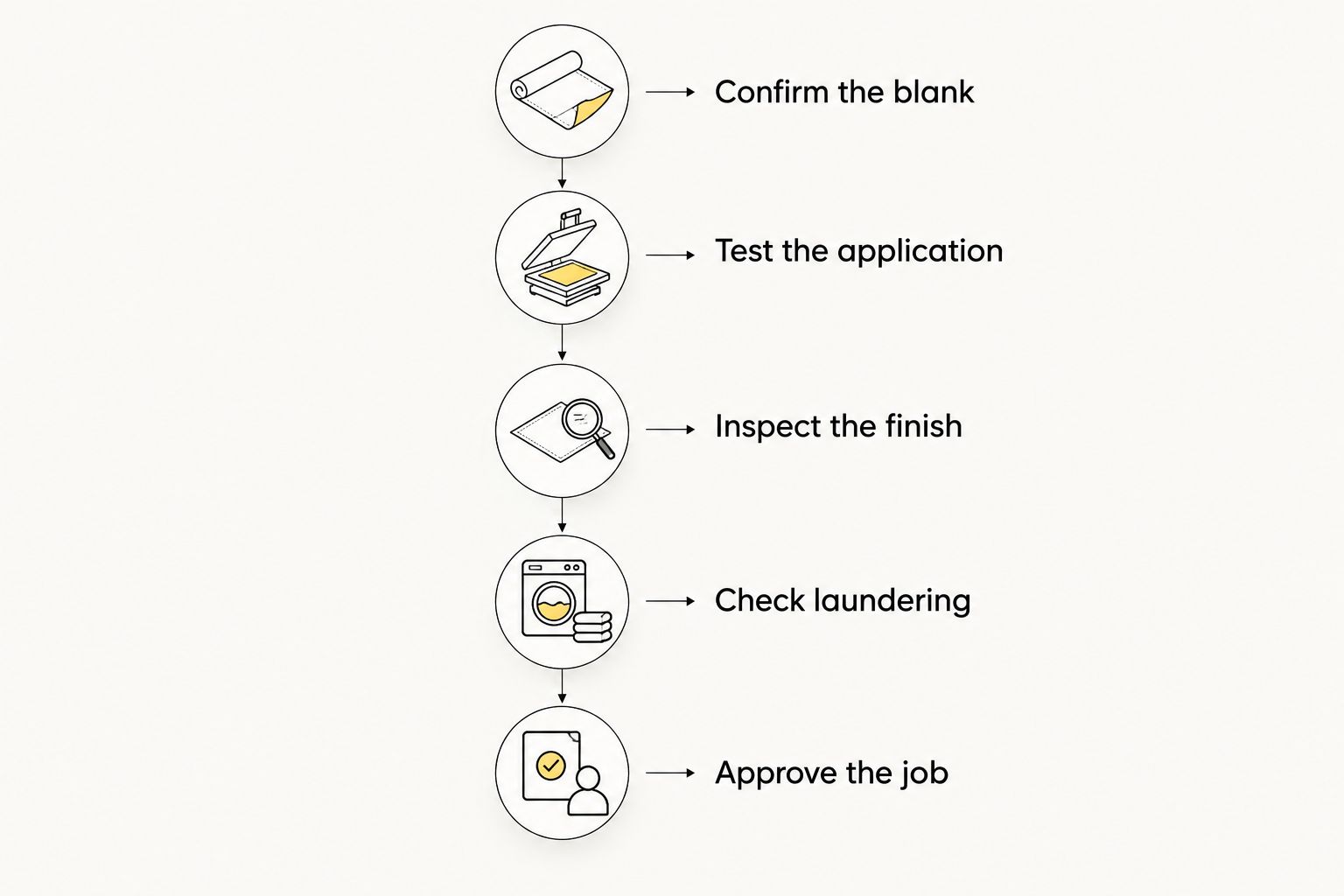
Use a written qualification sequence. Your objective is to establish that the garment tolerates the application and that the finished decoration meets your customer's requirements.
Confirm the blank
Record the garment supplier, style, color, fiber composition, and care instructions. Velvet and velour describe fabric constructions and surfaces, not a single fiber chemistry.
Ask the garment supplier about heat-applied decoration. If the garment guidance conflicts with the transfer's required application conditions, hold the job instead of improvising settings.
Test the application
For a controlled trial, prepare 3 matching swatches: 1 unpressed control and 2 application samples. These are suggested test quantities, not a durability standard or a guarantee of production consistency.
Keep the control outside the press. Apply the transfer to the other swatches using the supplier's instructions, recording the temperature in °F, dwell time in seconds, peel method, and the press's pressure setting.
Inspect the finish
Compare each application sample with the unpressed control after the required cooling and peeling steps. Look beyond the transfer edge.
Check for a rectangular press footprint, crushed pile, gloss, discoloration, and adhesive outside the artwork. View the fabric from different angles because pile direction changes how light reflects from the surface.
Check laundering
Follow the garment and transfer care instructions, resolving any conflict before production. Inspect the decoration after laundering for edge lift, cracking, color change, and an unacceptable change in hand feel.
Use your customer's actual acceptance requirements. Do not convert a short shop trial into an unsupported wash-life claim.
Approve the job
Retain the approved sample and its application record. Repeat the qualification when the blank, color, artwork coverage, transfer specification, or application setup changes.
For your 2026 job records, include the approval date and the exact garment identification. A note that says only velvet is not specific enough to reproduce the job.
Design for the pile, not just the proof
A digital proof shows artwork, not the finished relationship between a transfer and raised fibers. Review coverage and placement on the actual garment before the customer signs off.
- Compare solid and open artwork: A solid printed area covers the pile beneath it. Open areas leave more of the original surface exposed.
- Check the intended movement: Evaluate the garment in its normal use, especially across fitted or stretch areas.
- Inspect placement conditions: Seams, pockets, and nearby hardware affect how the garment sits on the press.
- Show the finished sample: Obtain approval for the decorated surface, not only for the uploaded file.
Avoid promising that a graphic will feel invisible on velvet. DTF adds a printed layer, and the customer's acceptance depends on the finished combination of fabric, design, and application.
Problems that should stop a velvet DTF job
A failed trial is useful evidence. Stop and identify the cause before repeating the same process across customer garments.
| Observation | What to investigate | Production decision |
|---|---|---|
| Visible rectangle outside the graphic | Pile compression and garment tolerance | Hold until the finish is acceptable |
| Edges lifting after application | Application conditions and transfer instructions | Hold until adhesion passes |
| Fabric discoloration | Heat tolerance and possible dye movement | Hold and consult the suppliers |
| Unacceptable stiffness | Design coverage and customer expectations | Revise artwork or decoration approach |
| Damage during laundering | Care compatibility and application record | Hold until the cause is resolved |
Do not treat extra heat or pressure as a universal repair. Those changes affect the fabric as well as adhesion, and velvet's visible surface is part of the finished product.
Which velvet and velour DTF option should you choose?
For an unfamiliar garment, choose DTF Transfers Samples first. For an approved garment with individual designs, choose PRINT & CUT DTF Transfers; for an approved print-ready layout, choose the gang sheet uploader.
The default 2026 production choice is cut-to-size transfers after qualification—not bulk ordering before qualification. DTF2GO supplies DTF transfers for decorators and print shops; your garment trial determines whether a particular velvet or velour job belongs in that workflow.
FAQ
What's the best DTF transfer option for velvet and velour?
PRINT & CUT DTF Transfers are the default ordering choice for individual designs after the exact garment passes testing. Start with samples when the fabric is unfamiliar, and use a gang sheet for approved print-ready layouts.
Can I put DTF transfers on any velvet garment?
Do not assume every velvet garment accepts DTF transfers. Check the fiber composition, garment decoration guidance, and transfer instructions, then test the exact blank before production.
What temperature should I use for DTF transfers on velour?
Use the transfer supplier's current application instructions only when they are compatible with the garment's restrictions. There is no single temperature recommendation that establishes suitability for every velour construction.
Will a DTF transfer flatten the pile on velvet?
Heat and pressure can flatten velvet's pile, including areas outside the graphic. Compare a pressed sample with an unpressed control and reject a visible press footprint when it fails the customer's finish requirements.
Is a gang sheet better than cut-to-size transfers for velour?
A gang sheet is better for prepared layouts, while cut-to-size transfers suit individual design orders. Neither ordering format establishes better adhesion or greater fabric heat tolerance.
Can I use UV-DTF transfers instead of apparel DTF on velvet?
Do not substitute UV-DTF for apparel DTF without explicit supplier approval for that textile application. Choose the transfer system by its intended application, not by the similarity of its name.
Does a successful sample approve my whole velvet order?
A successful sample approves only the tested combination and acceptance criteria. Validate the final artwork and repeat testing when the garment, color, application setup, or other material conditions change.
One last thing
Judge the blank area beside the graphic as carefully as the graphic itself. A sharp logo does not rescue a garment with a visible press rectangle.
Keep an unpressed control with the approved decorated sample. That comparison makes pile damage easier to spot than judging a finished garment from memory.


