


Best production default: DTF2GO cut-to-size DTF transfers. Best for bond evaluation: DTF Transfers Samples. Best for prepared layouts: 31" DTF Gang Sheet UPLOADER. If you want DTF transfers ranked by adhesive bond strength in 2026, require comparable test results—not a ranking based on sheet format. The recommendations below rank buying workflows, not measured adhesive strength.
- For DTF transfers ranked by adhesive bond strength, require matched fabric, application conditions, and documented test results.
- DTF2GO cut-to-size DTF transfers suit decorators who want individual ready-to-press graphics.
- DTF Transfers Samples are the starting point for checking adhesion on your actual blanks.
- Gang sheet format does not establish stronger adhesion; qualify the transfer-and-fabric combination before production.
What makes the best DTF transfers for adhesive bonding?
Judge the applied transfer, not just the film in your hand. Use these criteria before choosing a production format:
- Fabric compatibility: Evaluate the exact blank, including its finish and construction—not just its fiber label.
- Application control: Follow the transfer supplier’s instructions for temperature, time, pressure, and peeling.
- Edge adhesion: Inspect small lettering, corners, and narrow details for lifting after application and laundering.
- Wash performance: Keep laundering conditions consistent and record when defects appear.
- Repeatability: Confirm that the result repeats across garments rather than approving a single successful press.
- Production fit: Choose individual transfers or gang sheets according to artwork preparation and press-room handling.
A convenient ordering format is not evidence of a stronger adhesive bond. Keep those decisions separate in your 2026 purchasing process.
DTF transfer options at a glance
| Rank and option | Best for | Standout feature | Key limitation |
|---|---|---|---|
| 1. PRINT & CUT DTF Transfers | Individual ready-to-press production | Cut-to-size transfer format | Format alone does not establish bond strength |
| 2. DTF Transfers Samples | Initial adhesion evaluation | A sample product for hands-on assessment | A sample does not qualify every fabric or production design |
| 3. 31" DTF Gang Sheet UPLOADER | Shops with prepared gang sheet files | Print-ready gang sheet ordering route | Layout preparation remains part of your workflow |
| 4. 32" DTF Gang Sheet BUILDER | Shops choosing a gang sheet builder route | A builder-based gang sheet option | Sheet dimensions do not predict adhesive performance |
The 31-inch uploader and 32-inch builder names identify different ordering formats. Do not treat those dimensions as adhesive specifications or assume that nominal sheet width equals usable printable width.
Why this matters
A transfer that releases cleanly from its carrier has passed an application step, not a durability qualification. Edge lifting after laundering, separation during wear, and cracking within the printed layer are different observations; record them separately.
DTF2GO sells custom ready-to-press DTF transfers for apparel decorators, promotional product businesses, and print shops. For those buyers, the useful question is whether a transfer performs on the intended garment under the shop’s actual application process—not whether its product name sounds stronger.
Your 2026 approval record should connect the transfer, blank, artwork, press settings, and care procedure. Without that connection, a successful sample is difficult to reproduce or troubleshoot.
1. PRINT & CUT DTF Transfers: best for individual production
PRINT & CUT DTF Transfers are the cut-to-size option for custom apparel graphics. Choose this format when you want individual ready-to-press transfers rather than a gang sheet that still needs separation.
DTF2GO cut-to-size DTF transfers are best for apparel decorators who want individual ready-to-press graphics. That is a workflow recommendation, not a claim that cutting changes adhesive chemistry.
PRINT & CUT DTF Transfers pros:
- Individual format supports sorting graphics by garment or order.
- Cut-to-size preparation removes gang sheet separation from your press-room workflow.
- Custom transfers suit jobs built around specific artwork and placements.
PRINT & CUT DTF Transfers cons:
- Individual preparation does not prove stronger adhesion than a gang sheet.
- Every new blank still needs an application check before production approval.
Best for: Decorators prioritizing individual graphics and straightforward job staging.
Keep a labeled approved garment beside the job ticket. Compare production pieces against that reference for edge condition and placement, while remembering that visual agreement does not replace laundering checks.
Verdict: Buy for individual production after the transfer passes your garment-specific evaluation.
2. DTF Transfers Samples: best for initial bond evaluation
DTF Transfers Samples provide a starting point for handling and pressing a transfer before selecting a production workflow. Use a sample to examine application behavior on the blank you intend to decorate.
A sample is an evaluation tool, not a universal approval. A result on a cotton tee does not establish the same result on a coated jacket, and a broad graphic does not represent every fine-detail logo.
DTF Transfers Samples pros:
- Supports hands-on inspection instead of judging from product photography.
- Gives your press operator an opportunity to follow the application instructions.
- Helps identify questions about edge adhesion before a customer job enters production.
DTF Transfers Samples cons:
- Sample artwork does not necessarily represent your production design.
- Results apply to the tested blank and process, not every garment category.
Best for: Shops evaluating a transfer-and-garment combination before committing to production.
For a new 2026 purchasing decision, separate sample approval from production-artwork approval. Check the sample first, then repeat the evaluation with the customer’s actual graphic and placement.
Verdict: Buy for initial evaluation; hold production approval until the actual job is checked.
3. 31" DTF Gang Sheet UPLOADER: best for prepared layouts
31" DTF Gang Sheet UPLOADER is the print-ready gang sheet ordering option. It suits a workflow in which your artwork team prepares the sheet layout before submission.
The 31-inch designation describes the named product format. It does not establish a bond-strength advantage, a guaranteed printable area, or compatibility with every fabric.
31" DTF Gang Sheet UPLOADER pros:
- Fits a workflow centered on a prepared gang sheet file.
- Keeps layout preparation with the team creating the artwork.
- Provides a gang sheet alternative to ordering individual cut-to-size graphics.
31" DTF Gang Sheet UPLOADER cons:
- Your team must prepare and check the layout before submission.
- Sheet separation and job sorting remain production tasks.
Best for: Print shops with a repeatable print-ready layout process.
Leave enough separation between designs for your chosen cutting and handling method. Inspect the actual artwork at its intended output size; a layout that fits the sheet still needs readable details and correct dimensions.
Verdict: Buy when prepared layouts fit your operation; hold any stronger-bond claim without matched testing.
4. 32" DTF Gang Sheet BUILDER: best for a builder-based workflow
32" DTF Gang Sheet BUILDER is the builder-based gang sheet option in the product catalog. Choose this route when you want to prepare the gang sheet through the builder rather than start with a print-ready sheet file.
Keep the adhesive decision separate from the layout decision. A wider named format does not make the transfer bond more strongly to a garment.
32" DTF Gang Sheet BUILDER pros:
- Provides an alternative to the print-ready uploader route.
- Organizes the purchase around a gang sheet rather than individual transfers.
- Gives shops another layout workflow to assess against their artwork process.
32" DTF Gang Sheet BUILDER cons:
- Layout still needs checking before submission.
- Gang sheet handling does not remove garment-specific qualification work.
Best for: Decorators selecting a builder-based ordering process.
Before approving a layout, check graphic dimensions, quantities, and separation. Do not use sheet utilization as a substitute for checking whether the applied graphic meets the job’s requirements.
Verdict: Buy for the builder workflow; skip it as a shortcut to stronger adhesion.
How to compare adhesive performance in your shop
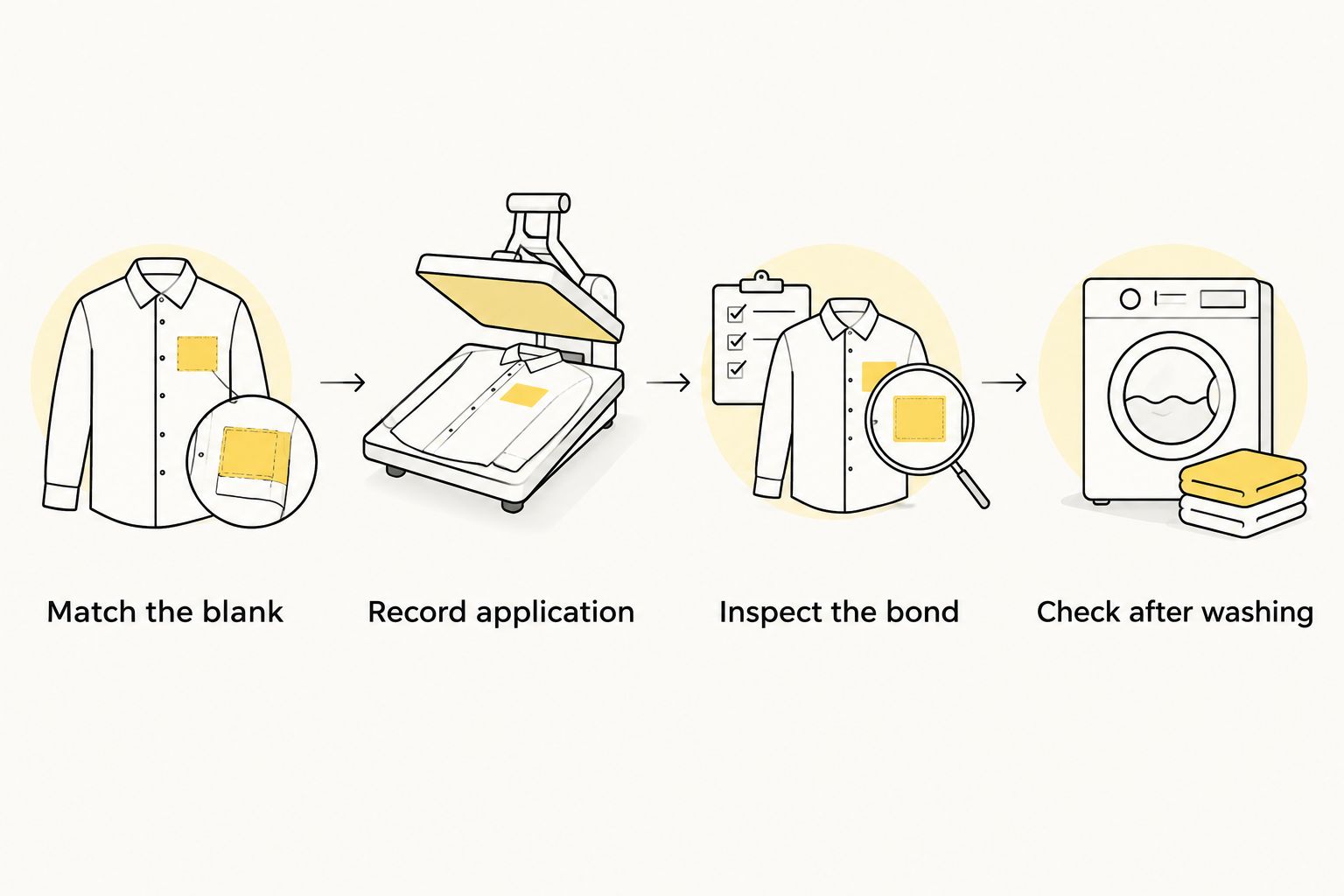
Use a written procedure so that a product comparison does not become a comparison of different fabrics or press settings. The following is a practical screening workflow, not a laboratory bond-strength standard.
Match the blank
Use the same garment style, color, and fabric construction for a direct comparison. Include the actual print location because seams, pockets, and uneven thickness affect how the press contacts the garment.
Start with 3 test garments per candidate as an internal screening plan, not as a statistical certification. Keep one unwashed reference, use another for laundering checks, and reserve the third for a repeat application check.
Record application
Follow each supplier’s prescribed application procedure. Record temperature, dwell time, pressure guidance, peel method, and any required finishing press; do not impose a shared setting that contradicts a supplier’s instructions.
Distinguish between the press display and a verified temperature check. If results vary by platen location, investigate the equipment before assigning the difference to the transfer.
Inspect the bond
After the prescribed application and cooling sequence, inspect edges, corners, narrow strokes, and larger filled areas. Record where separation occurs rather than describing every defect as poor adhesion.
A printed layer cracking while remaining attached is different from the transfer lifting away from the fabric. Photograph both, but classify them separately.
Check after washing
Follow the applicable garment and transfer care instructions, then use the same laundering procedure throughout the comparison. Record completed wash cycles and the condition after each inspection instead of assigning an unsupported durability rating.
Keep the unwashed reference available. It helps distinguish changes caused by laundering from defects already present immediately after application.
Repeat before release
Repeat the successful application with the production artwork. Check fine text, isolated details, and the largest filled areas because a sample graphic does not represent every design.
Save the approved garment, job settings, photographs, and inspection notes together. That record gives your 2026 production team a specific reference when reordering or investigating a failure.
How these recommendations are ranked
The order prioritizes production fit and evaluation usefulness: individual transfers for straightforward staging, samples for qualification, an uploader for prepared layouts, and a builder for a different layout route.
This is not a measured adhesive-strength leaderboard. A defensible strength ranking needs a stated test method, substrate, application conditions, conditioning procedure, and comparable results. Product dimensions and ordering formats cannot supply those results.
For instrumented testing, report force with its units and the specimen dimensions. Keep that evidence separate from visual wash observations; they answer related but different questions.
Which DTF transfer option should you choose?
Choose PRINT & CUT DTF Transfers as the default for individual ready-to-press production, then qualify the result on your actual blank. Choose DTF Transfers Samples when you are still evaluating application behavior.
Use 31" DTF Gang Sheet UPLOADER when your shop already prepares sheet layouts. Choose 32" DTF Gang Sheet BUILDER when the builder route better matches your artwork process.
For DTF2GO orders in 2026, approve the transfer-and-garment combination first and the ordering format second. Neither a gang sheet nor a cut-to-size format deserves a stronger-bond label without comparable evidence.
FAQ
What are the best DTF transfers ranked by adhesive bond strength?
A defensible adhesive-strength ranking requires comparable test results on defined fabrics under documented application conditions. Choose a production format separately, then evaluate its applied performance on your actual garment.
Are cut-to-size DTF transfers stronger than gang sheet transfers?
Cut-to-size format does not establish a stronger adhesive bond than gang sheet format. Cutting changes handling and preparation, not proof of adhesive performance.
What is the best DTF2GO option for individual ready-to-press graphics?
PRINT & CUT DTF Transfers are the cut-to-size option for individual ready-to-press graphics. Qualify the transfer on the intended garment before approving the production job.
Can I judge DTF adhesion immediately after peeling?
An immediate inspection identifies application defects but does not establish wash durability. Complete the prescribed application sequence and follow a consistent laundering evaluation.
Should every DTF transfer use the same heat press settings?
No—follow the application instructions for the specific transfer. Using a shared setting that contradicts those instructions makes the comparison unreliable.
Does a wider gang sheet mean stronger adhesion?
No—gang sheet width does not establish adhesive strength. Select width and layout workflow for production needs, then evaluate bonding on the garment.
What should I record when a DTF transfer lifts?
Record the garment, artwork, application settings, peel procedure, and exact location of the lifting. Photograph the defect and note whether it appeared after application, wear, or laundering.
One last thing
Inspect the garment, not just the graphic. A transfer placed across a seam or an uneven area creates a different pressing situation from the same transfer on a flat panel.
Before rejecting an adhesive, repeat the application on a flat area of the same blank using the prescribed procedure. That check separates a placement problem from a broader transfer-and-fabric problem without pretending either result is a universal strength rating.


