


Pressing every DTF job at 320°F wrecks spandex, nylon, and foam-backed puff designs before the ink ever gets a chance to bond right. The fix isn't a hotter press or a longer dwell — it's picking the transfer built for the temperature your fabric can actually take, and that's exactly what this 2026 ranking of low temperature dtf transfers sorts out.
- Cut-to-size DTF transfers from DTF2GO press flexibly from roughly 270°F to 325°F, the safest default for low temperature dtf transfers work.
- UV-DTF transfers need zero heat-press curing at all, the only true no-heat option for hard or heat-sensitive surfaces.
- Puff DTF needs a controlled lower temperature and longer dwell time or the foam layer scorches.
- DTF gang sheets batch mixed designs efficiently, but the whole sheet still presses at the coolest fabric's setting.
- A sample pack is the cheapest way to confirm press settings before a bulk 2026 order goes wrong.
Why this matters
Heat-sensitive fabric doesn't forgive a guess. Spandex, nylon, foam trucker hats, and some leather patches scorch, shrink, or delaminate above roughly 290°F, and low temperature DTF transfers exist specifically to bond ink to those materials without hitting that ceiling.
Most standard DTF film runs 300-325°F for a 10-15 second dwell, which is fine for cotton and heavier poly-blends. Drop below that range without the right formulation and the powder adhesive doesn't fully melt, so the design cracks or lifts on the first wash in 2026 — long before it should.
What makes the best low temperature DTF transfers
- Press temperature range — how low the film bonds without losing adhesion
- Dwell time flexibility — whether a longer press cycle can substitute for lower heat
- Powder formulation — engineered specifically for lower-temp bonding, not just standard film run hotter than it should
- Peel type — cold peel exposes fabric to heat longer than hot peel, which matters on delicate materials
- Color and edge retention — sharp edges and full color at reduced heat, not washed-out results
- Fabric compatibility — proven performance on spandex, nylon, foam, and leather, not just cotton
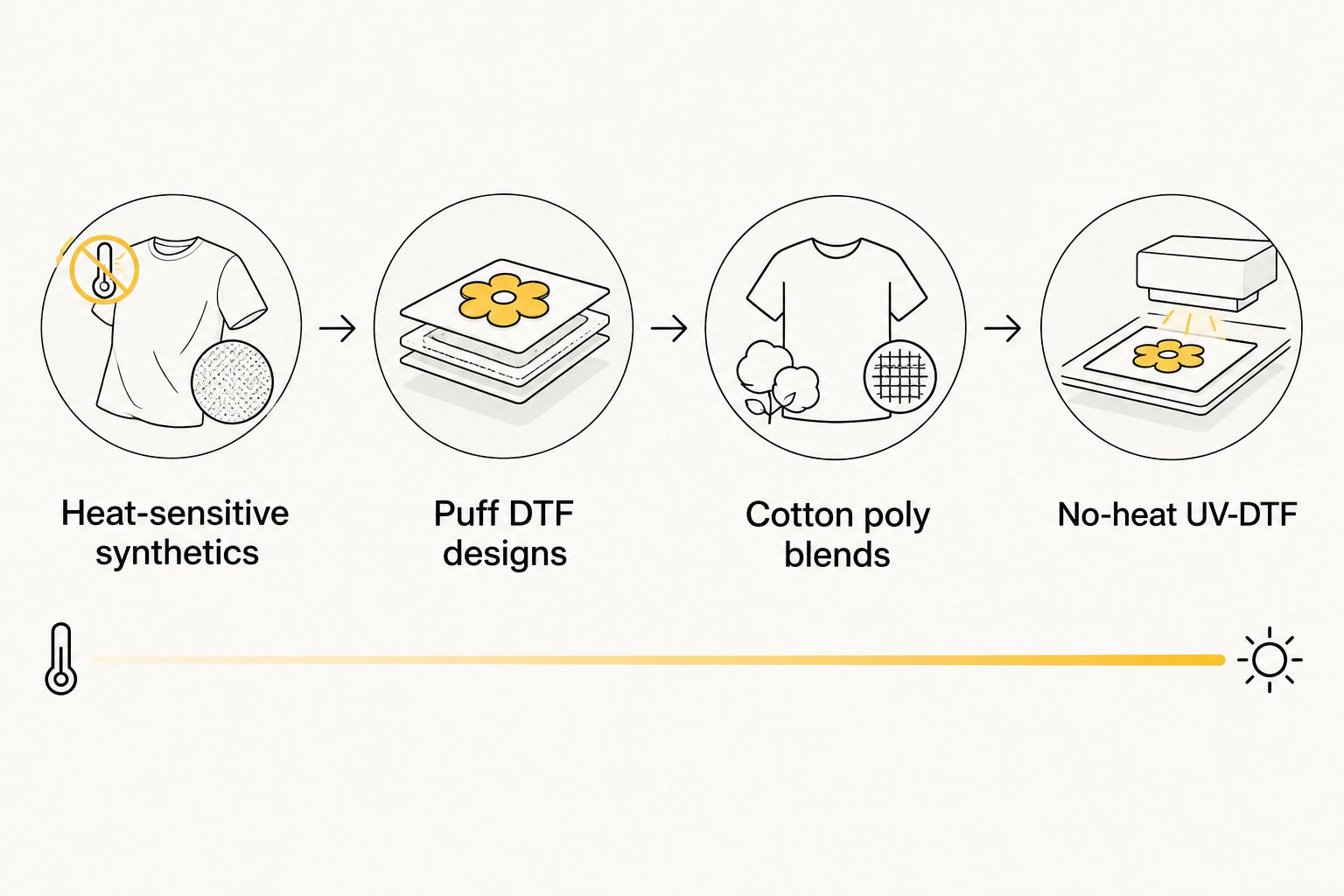
Low temperature DTF transfers at a glance
| Option | Best for | Standout feature | Key limitation |
|---|---|---|---|
| Standard Cut-to-Size DTF Transfers | Everyday low-temp flexibility | One film spans roughly 270-325°F | Needs a calibrated press to hit the low end |
| DTF Gang Sheets | Batching mixed fabric orders | Multiple designs cut to size after one press setup | Doesn't remove the need to match temp per fabric |
| UV-DTF Transfers | Zero heat-press curing | Cures by UV light, no heat press cycle | Not built for soft garment fabric |
| Puff DTF Transfers | Dimensional streetwear prints | Foam layer rises evenly at controlled low heat | Narrow temperature window, longer dwell |
| DTF Sample Pack | Testing settings before a bulk run | Confirms temp and dwell on real film first | Not a production-volume option |
1. Standard Cut-to-Size DTF Transfers: best low temperature DTF transfers for everyday fabric flexibility
Cut-to-size DTF transfers print full color on film trimmed to the design, ready to press straight onto the garment. The powder adhesive bonds across a wide window — roughly 270°F on the low end for spandex and nylon, up to 325°F for cotton and poly-blends — so one film covers most of a shop's mixed order queue in 2026 without switching suppliers mid-shift.
Cut-to-size DTF pros:
- One film works across cotton, poly, and blended fabric without reordering
- Presses down to roughly 270°F for heat-sensitive synthetics
- Ready-to-press format skips an extra powder and cure step
Cut-to-size DTF cons:
- Small orders below gang-sheet quantities cost more per square inch
- The low end of the range still needs a calibrated press, not a dial guess
Verdict: Buy — the default pick when a shop runs hot and cold jobs in the same shift.
2. DTF Gang Sheets: best low temperature DTF transfers for batching mixed fabric orders
A DTF gang sheet packs multiple designs onto one print-ready sheet, then each gets cut and pressed on its own. A spandex legging design sitting next to a cotton tee design on the same sheet doesn't change the physics — the whole sheet still needs pressing at whatever setting fits the coolest fabric going through that day.
Gang sheet pros:
- Cuts per-unit cost on multi-design production runs
- Performs the same at low-temp settings as individual cut-to-size transfers
- Simplifies inventory to one sheet instead of a stack of separate transfers
Gang sheet cons:
- Doesn't solve temperature matching on its own — you still plan per fabric
- A layout error wastes the entire sheet, not one design
Verdict: Buy for batch orders; Hold if you're only pressing one-off jobs.
3. UV-DTF Transfers: best low temperature DTF transfers for zero heat-press curing
UV-DTF transfers skip a heat press entirely — they cure under UV light during production and go on with firm hand or roller pressure, not a press cycle. That makes UV-DTF the only true no-heat option on this list, built for tumblers, signage, phone cases, and anything that can't touch a heat platen at all.
UV-DTF pros:
- No heat press curing step, so heat-sensitive materials never see a platen
- Bonds to hard surfaces standard DTF film can't reach
- Removes press-temperature guesswork completely for those applications
UV-DTF cons:
- Not built for soft garment fabric the way cut-to-size DTF is
- Application still needs firm, even pressure to avoid trapped air
Verdict: Buy for hard-surface and heat-avoidance jobs; Skip for standard apparel runs.
4. Puff DTF Transfers: best low temperature DTF transfers for dimensional streetwear prints
Puff DTF adds a foam layer under the ink that rises when heat hits it, producing the raised, dimensional look streetwear brands ask for. That foam layer is exactly why puff needs a controlled lower temperature with a longer dwell — push the heat too high and the foam scorches or collapses before it fully rises.
Puff DTF pros:
- Delivers raised texture flat DTF film can't produce
- Controlled low-temp pressing keeps the foam layer intact
- Holds up well on hoodies and heavier streetwear fabric
Puff DTF cons:
- Narrower temperature window than standard cut-to-size transfers
- Longer dwell time slows high-volume production
Verdict: Hold — strong for design-driven drops, not for shops pressing hundreds of units an hour.
“If a film needs more than 325°F to bond, it's not built for heat-sensitive fabric.”
5. DTF Sample Pack: best low temperature DTF transfers for testing press settings before a bulk order
A sample pack puts several transfer types on the same fabric a shop plans to run, confirming where the low end of the press range actually holds before a full gang sheet order ships. Skipping this step is how a shop ends up with a scorched batch of spandex or a peeled cotton run in 2026.
Sample pack pros:
- Confirms real press temperature and dwell before a bulk order
- Lets you compare cut-to-size, gang sheet, and puff film side by side
- Cuts the risk of wasting a production run on unfamiliar fabric
Sample pack cons:
- Small quantity, so it won't reveal everything about a full sheet's consistency
- Adds a step when settings are already dialed in
Verdict: Buy for anyone testing a new fabric type; Skip if settings are already confirmed.


How we ranked
Each option got weighed against the six criteria above: press range, dwell flexibility, powder formulation, peel type, color retention, and fabric compatibility. Standard cut-to-size DTF ranks highest because it clears the widest range of that list without a format change; UV-DTF and puff DTF each own a narrower, specific job.
Which low temperature DTF transfer should you choose?
For a shop pressing cotton and heat-sensitive synthetics in the same shift, standard cut-to-size DTF transfers cover the widest range without switching products. For anything that can't touch a heat press — signage, tumblers, hard surfaces — only UV-DTF works. Planning a dimensional streetwear drop means budgeting for puff DTF's longer dwell and tighter window.
Start with a sample pack, confirm 270°F holds on the actual fabric, then order cut-to-size or a gang sheet based on volume. That order avoids the scorched-batch mistake shops still make heading into 2026 production runs.
FAQ
What is the lowest temperature DTF transfers can press at?
Most low temperature DTF transfers bond in the 270-290°F range on heat-sensitive synthetics like spandex and nylon. Standard cotton and poly-blend jobs still run 300-325°F.
Do UV-DTF transfers need a heat press at all?
No, UV-DTF transfers cure by UV light during production and apply with firm hand or roller pressure. There's no heat press cycle involved at any point.
Why does puff DTF need a lower temperature than standard DTF?
Puff DTF has a foam layer that rises when heated, and pushing the temperature too high scorches or collapses that layer before it fully expands. A lower, controlled temperature with a longer dwell keeps the texture intact.
Can low temperature DTF transfers work on cotton too?
Yes, standard cut-to-size DTF film that presses low for synthetics also bonds fine on cotton at the higher end of its range, around 300-325°F. That's what makes one film cover mixed orders.
How long should dwell time be for low-temp DTF pressing?
Typical DTF dwell time runs 10-15 seconds regardless of temperature, though lower-temp jobs sometimes need a few extra seconds to fully bond. Test on a sample piece before committing to a full run.
Is cold peel or hot peel better for heat-sensitive fabric?
Cold peel exposes the fabric to press heat for a shorter total cycle in most workflows, which helps on delicate materials. Check the specific film's peel instructions since this varies by product.
What fabrics need low temperature DTF transfers?
Spandex, nylon, foam-backed hats, and some leather patches all need reduced press temperature to avoid scorching or shrinking. Cotton and heavier poly-blends tolerate standard 300-325°F settings.
Should I test press settings before a bulk DTF order?
Yes, testing on a sample piece confirms the actual press temperature and dwell that fabric needs before a full gang sheet or bulk order ships. Skipping this step is the most common cause of scorched or peeling batches.
One last thing
Most low-temp press failures aren't the film's fault — they're a heat press platen running hotter or cooler than its display claims. Check the platen with an infrared thermometer before blaming the transfer; a miscalibrated press will scorch heat-sensitive fabric even when the dial reads exactly where it should.


