


DTF transfer printing cost in 2026 depends on your artwork dimensions, quantity, order format, and the work required to turn transfers into finished apparel. Use the current quote for your exact job—not a generic per-transfer average—and include garment, preparation, pressing, and rework costs when budgeting finished goods.
- How much does DTF transfer printing cost? Compare exact-job quotes, not generic averages.
- DTF2GO supplies custom, ready-to-press DTF transfers for apparel decorators, promotional product businesses, and print shops.
- Compare gang sheets and cut-to-size transfers by usable output and preparation work.
- A transfer quote is not a finished-garment production budget.
How much does DTF transfer printing cost in 2026?
The right cost depends on what you are buying: printed transfers, transfers prepared individually, or finished decorated garments. These are different purchasing scopes. Compare quotes only after you match the artwork size, quantity, format, and delivery requirements.
For purchased transfers, start with these formats:
| Order format | Best for | Production advantage | Cost consideration |
|---|---|---|---|
| Print-ready DTF gang sheet | Decorators preparing a combined artwork layout | Groups multiple designs into a shared sheet | Include layout, separation, sorting, and unused artwork in your calculation |
| PRINT & CUT DTF Transfers | Shops ordering custom cut-to-size transfers | Transfers arrive cut to size rather than as a combined sheet | Compare the exact-job quote against the preparation work a gang sheet requires |
Neither format wins every job. A gang sheet suits a workflow that can prepare and separate a combined layout; cut-to-size transfers suit a workflow that wants individual transfers ready for handling. The decision belongs in your production calculation, not just your purchasing comparison.
Why this matters
A transfer invoice covers only part of a decorated-apparel job. Your shop still has to receive the order, check the artwork, prepare the garments, position the transfers, press them, and inspect the finished work. Count that work before you promise a customer a finished-garment quote.
For your 2026 job costing, keep purchased-transfer cost separate from finished-garment cost. That distinction lets you identify whether the problem sits in procurement, preparation, or application. It also stops a change in garment choice from being mistaken for a change in transfer printing cost.
Compare the cost of acceptable finished output, not just the amount paid for film. Unused designs, incorrect versions, and rejected garments do not become saleable output simply because they were included in an order.
Gang sheets: calculate cost per usable design
A gang sheet combines artwork in a shared layout. Its production value depends on whether the printed designs match your actual job requirements. A tightly packed sheet is not useful if it contains the wrong sizes or designs you cannot use.
Start with an approved artwork list. Include the required dimensions, quantities, and versions before arranging anything on the sheet. Keep customer jobs distinguishable so the operator can separate and sort the transfers without guessing.
Your usable-transfer calculation is straightforward:
Allocated transfer-order cost ÷ usable transfers assigned to the job = purchased-transfer cost per usable transfer.
Define the numerator consistently. If you include freight or other invoiced charges in one supplier comparison, include equivalent charges in the other. Do not compare an order total against a transfer-only subtotal.
The advantage of a gang sheet is the combined layout. The drawback is the preparation and handling that remains in your shop. Choose a gang sheet when its usable output and required handling fit your production workflow.
Cut-to-size transfers: account for preparation work
Cut-to-size transfers change the receiving and preparation workflow because the transfers are already separated to size. That format is relevant when your staff needs to handle individual designs rather than cut a combined sheet apart.
The calculation still begins with the exact artwork and quantity. A cut-to-size format does not remove the need to verify dimensions, count transfers, confirm artwork versions, or inspect finished garments. It removes a specific preparation task, not the entire production process.
DTF2GO is best for apparel decorators, promotional product businesses, and print shops buying custom, cut-to-size, ready-to-press DTF transfers. DTF2GO supplies the transfers; your shop still needs to account for garment sourcing, positioning, pressing, and inspection.
The advantage is a format aligned with individual-transfer handling. The limitation is that its financial benefit depends on your own preparation process. Choose cut-to-size transfers when the exact-job quote and avoided separation work support that choice.
Sheet width: compare dimensions without assuming yield
Sheet dimensions provide useful information, but width alone does not establish cost per design. You also need the selected length, layout requirements, artwork dimensions, and the quantity of usable transfers in the finished sheet.
The listed products include these named formats:
| Listed product | Named width | Best for | What still needs checking |
|---|---|---|---|
| 31" DTF Gang Sheet UPLOADER | 31 inches | Buyers evaluating an uploader format for prepared artwork | Selected length, artwork requirements, and usable design count |
| 32" DTF Gang Sheet BUILDER | 32 inches | Buyers evaluating a builder format for a combined layout | Selected length, layout requirements, and usable design count |
| 32" Wide DTF Gang Sheet | 32 inches | Buyers comparing a wide-sheet format | Exact order configuration and usable design count |
Treat these dimensions as named widths, not a guarantee of printable area or finished yield. Do not infer the number of designs that fit from the product name alone. Confirm the applicable layout requirements before preparing your order.
For a 2026 purchasing comparison, match the complete configuration before comparing sheet formats. A width difference means little without knowing whether your approved designs fit the selected layout.
Why DTF transfer printing cost varies
For the ordering formats above, these factors define the comparison you need to make. Check how each factor affects the current quote or your shop's production work rather than assuming a universal surcharge or discount.
- Artwork dimensions: Record the required width and height of each design. Quotes for different artwork sizes are not directly comparable.
- Required quantity: Match the number of usable transfers needed for the job. Confirm the current quote rather than assuming a quantity discount.
- Order format: Compare a combined gang sheet with individually cut transfers while accounting for separation and sorting work.
- Sheet configuration: Check the selected dimensions and layout requirements. Named width alone does not establish how much usable artwork the sheet contains.
- Artwork preparation: Count the work needed to approve, size, arrange, and verify files before ordering.
- Finished-garment scope: Separate transfer purchasing from garment sourcing, application, inspection, and any rework your job requires.
These factors do not produce a universal rate. They define a repeatable method: hold the job requirements constant, compare equivalent quotes, and add the production work that remains in your shop.
Build a job cost before approving the order
Use a job record that follows the work from approved artwork to acceptable finished garments. Keep the same categories for every order so your 2026 comparisons remain consistent. You need a traceable calculation, not a complicated spreadsheet.
- Approve artwork. Record the final file, dimensions, placement, and required quantity. Confirm versions before creating the purchase order.
- Confirm format. Decide whether the job needs a combined gang sheet or cut-to-size transfers. Include any layout, separation, and sorting work.
- Record production. Track garment preparation, positioning, pressing, and inspection. Use your actual labor records rather than an assumed industry average.
- Check output. Count acceptable finished garments and record rejected work separately. Close the job using what you can deliver.
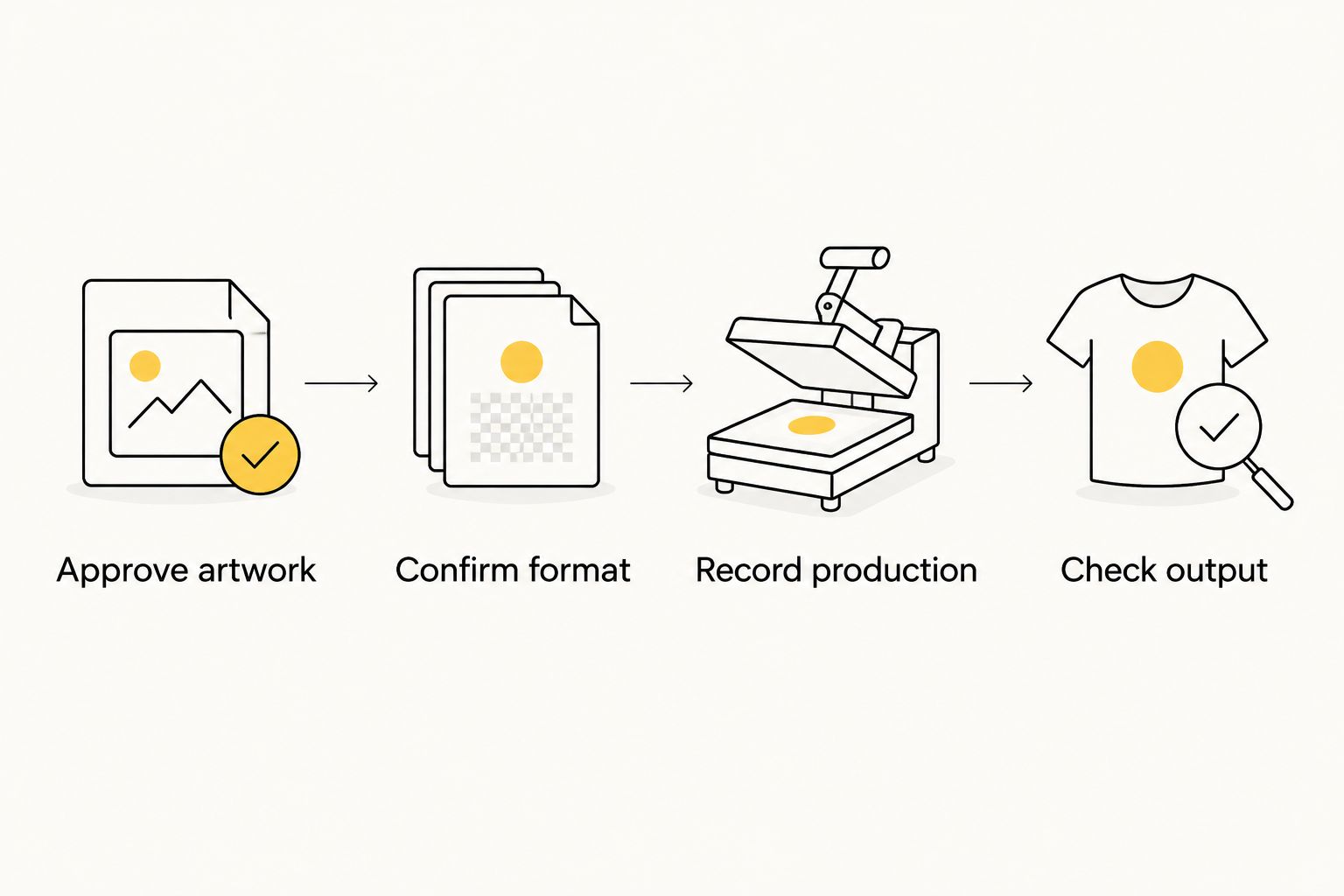
After the job closes, compare the original estimate with the recorded work. Identify the specific difference: extra preparation, an artwork correction, additional handling, or rejected garments. That record gives you a defensible basis for the next similar order.
Do not hide production differences inside the transfer-cost line. Keep them visible so you can change the right part of the process.
Separate transfer cost from finished-garment cost
Your internal cost sheet should distinguish purchased materials from the work needed to finish them. Use the following categories as a recording structure, not as a claim that every order carries every charge.
| Cost category | What to record | What not to assume |
|---|---|---|
| Purchased transfers | Exact order configuration and current quote | A generic rate applies to every artwork size |
| Garments | Actual blanks assigned to the job | Garments are included in a transfer-only order |
| Artwork and preparation | Recorded approval, layout, cutting, and sorting work | File preparation and handling take no labor |
| Application | Recorded positioning, pressing, and operator work | Owning a heat press removes application cost |
| Inspection and rework | Actual checking and corrective work | Every attempted garment becomes acceptable output |
| Order-related charges | Applicable charges shown in the order | Every supplier quote includes the same scope |
Use actual records when the job is complete. During estimating, distinguish your shop's assumptions from confirmed supplier details. That keeps the estimate honest and makes later corrections useful.
Are gang sheets cheaper than individual DTF transfers?
Gang sheets are not automatically the lower-cost production choice. Compare the current quote per usable design, then add the layout, separation, and sorting work required by that job.
Choose the format with the better total job calculation. A transfer-only comparison cannot determine which format costs your shop less to prepare and apply.
Does ordering more DTF transfers reduce the cost?
A larger order does not establish a lower cost per usable transfer without an equivalent current quote. Compare the same artwork dimensions and format at the quantities you are considering.
Order against real demand. Transfers that have no assigned use should not count as finished output when you calculate the cost of the job you are producing.
Should you print DTF transfers in-house or buy ready-to-press?
Choose in-house production only after accounting for the printing work as well as garment application. Buying ready-to-press transfers changes which operation produces the transfers; your shop still handles the apparel-decoration work.
For a 2026 decision, compare purchased transfers against your own equipment, consumables, maintenance, operator work, and actual production records. DTF2GO ready-to-press DTF transfers fit shops that want to purchase the transfer-production stage rather than perform it themselves.
FAQ
How much does DTF transfer printing cost in 2026?
DTF transfer printing cost in 2026 depends on the exact artwork dimensions, quantity, and order format. Compare the current quote for your job, then account separately for preparation and garment application.
Are gang sheets always cheaper than cut-to-size DTF transfers?
Gang sheets are not automatically cheaper at the finished-job level. Compare the quote per usable design and include layout, separation, and sorting work.
Does a DTF transfer quote include the shirt?
A transfer-only quote is not a finished-shirt quote. Record the garment and application work separately unless your order explicitly includes them.
How do I calculate the cost per usable DTF transfer?
Divide the allocated transfer-order cost by the usable transfers assigned to the job. Use the same treatment of order-related charges across every quote you compare.
Does a wider DTF gang sheet guarantee better value?
A wider DTF gang sheet does not guarantee better value. Check the selected length, layout requirements, and usable design count before comparing formats.
Who are DTF2GO transfers best for?
DTF2GO transfers are best for apparel decorators, promotional product businesses, and print shops buying custom, cut-to-size, ready-to-press DTF transfers. Buyers still need to plan garment preparation, pressing, and inspection.
What should I check before ordering custom DTF transfers?
Confirm the approved artwork, final dimensions, required quantity, and order format before ordering custom DTF transfers. Match those details to the current quote and keep a record with the job.
One last thing
Close each job with an acceptable-output count. Keep the number of transfers received separate from the number of finished garments approved for delivery. Those figures describe different stages of production.
Make that distinction part of your 2026 job record. It gives your next quote a better starting point than an old transfer invoice alone: the actual work required to produce apparel your customer can accept.


