


DTF transfers are not automatically suitable for industrial or commercial laundering; approve them only after the decorated garment passes the laundry process it will actually face. A successful home-wash test does not establish resistance to a commercial wash formula, industrial drying, or finishing equipment.
- DTF transfers commercial laundering durability requires testing the finished garment under its actual wash and drying conditions.
- DTF2GO supplies ready-to-press DTF transfers for decorators; commercial laundry suitability requires separate qualification.
- ISO 15797 addresses industrial washing and finishing tests for workwear; domestic wash results answer a different question.
- Approve the garment, transfer, pressing process, and laundry formula together—not the transfer alone.
Can DTF transfers survive industrial or commercial laundering?
Treat commercial laundry durability as a qualification requirement, not an assumed feature of DTF printing. The relevant evidence is a documented result for the transfer applied to the intended garment and exposed to the intended laundering process.
Start with the actual care requirements. A laundry operator's process specification is more useful than a general statement that a print is washable. For everyday garment-care practices, see how to wash apparel with DTF transfers, but keep routine care advice separate from industrial qualification.
For a 2026 uniform program, distinguish these evidence types before accepting a durability claim:
| Evidence type | Best for | What it establishes | Limitation |
|---|---|---|---|
| Domestic washing test | Apparel intended for household care | Performance under the specified domestic procedure | Does not establish industrial laundering suitability |
| Industrial workwear test | Workwear with a defined industrial care requirement | Performance under the selected industrial test procedure | Must still match the relevant garment and acceptance criteria |
| Actual laundry trial | A named commercial laundry program | Performance in the operator's documented process | Results apply to the tested configuration and conditions |
These routes answer different questions. A commercial laundry's business address does not define its wash chemistry, drying conditions, or finishing method.
Why this matters
A decorated uniform is a system: fabric, surface finish, adhesive, printed layer, and application process. Evaluating only the transfer leaves the garment and laundry conditions outside the decision.
The practical consequence is straightforward. If a customer requires a particular laundry process, a care instruction that excludes that process does not solve the production requirement.
Before accepting the order, establish who controls laundering. If employees wash garments at home, household care instructions matter; if a rental operator controls washing and finishing, the operator's process becomes the qualification target.
Domestic washability is not industrial laundry qualification
ISO 6330 specifies domestic washing and drying procedures for textile testing. ISO 15797 specifies industrial washing and finishing procedures for testing workwear. These standards describe test procedures; naming either standard does not, by itself, establish that a decorated garment passes a customer's requirements.
For a 2026 specification, request the actual test report rather than a standard number printed beside a durability claim. Check the specimen description, selected procedure, drying or finishing method, inspection results, and acceptance criteria.
A wash-test result is only as useful as its match to the intended use. A report for a different fabric or a different transfer application cannot establish performance for your exact uniform configuration.
Neither standard is a blanket approval for every laundry process. When the customer names a standard, ask which procedure and performance criteria the contract requires before arranging testing.
Why DTF transfers commercial laundering durability varies
Evaluate these factors together. They describe the exposure and the decorated assembly, rather than providing a universal wash-life prediction.
- Garment construction and finish. Identify the fabric composition, surface treatments, and decoration location. Do not assume that approval on one blank transfers to another.
- Transfer construction. Confirm which transfer system was tested. A report for a different adhesive or printed construction is not evidence for the supplied transfer.
- Heat-press application. Record temperature, dwell time, pressure, peel procedure, and any required finishing press. Follow the transfer supplier's instructions rather than substituting generic settings.
- Wash formula. Document temperature, exposure time, detergent, alkalinity, bleach or disinfectant use, and mechanical action. The entire formula matters, not temperature alone.
- Drying and finishing. Include tumble drying and any subsequent pressing or finishing operation in the evaluation. Washing is not the end of the laundry route.
- Repeated exposure and inspection. Agree on the required repetitions and acceptable changes before testing. Appearance, adhesion, and garment condition need separate inspection criteria.
How do you qualify a DTF-decorated garment for commercial laundry?
Use a written sequence that connects the customer's requirement to a release decision. For 2026 production records, keep the approved configuration with the job specification so repeat orders have an identifiable reference.
1. Define requirements
Ask the customer and laundry operator for the required care process, service expectations, and acceptance criteria. Establish whether the garment enters a household-care program, a commercial laundry, or an industrial workwear system.
Write down what failure means. Edge lifting, visible cracking, unacceptable color change, loss of legibility, and garment damage are different outcomes; a single description such as good condition is too vague for approval.
2. Record application
Use the actual blank, artwork, decoration size, placement, and transfer intended for production. Apply the transfer according to the supplier's instructions, including the specified peel and any finishing step.
Record the settings and equipment used. Keep an unwashed decorated reference and identify each test garment so the results remain traceable to its application record.
3. Run laundering
Have the intended laundry operator process the specimens using the agreed route, or commission an appropriate laboratory procedure. Include drying and finishing rather than stopping the test when washing ends.
Follow the supplier's instructions about the interval between application and laundering. Do not invent a universal waiting period or replace the required laundry formula with a gentler cycle to obtain a passing result.
4. Inspect results
Compare the washed garments with the retained reference under consistent viewing conditions. Examine the transfer edges, solid printed areas, fine details, and the underlying garment.
Record observations against the criteria agreed before testing. Photograph the same locations consistently; photographs supplement inspection but do not replace an agreed assessment method.
5. Approve scope
Release only the configuration that meets the agreed requirements. Identify the garment, transfer, application instructions, laundry process, and acceptance record in the approval.
If a material, blank, application procedure, or laundry route changes, review whether the existing evidence still applies. Do not silently extend a narrow approval to an entire product category.
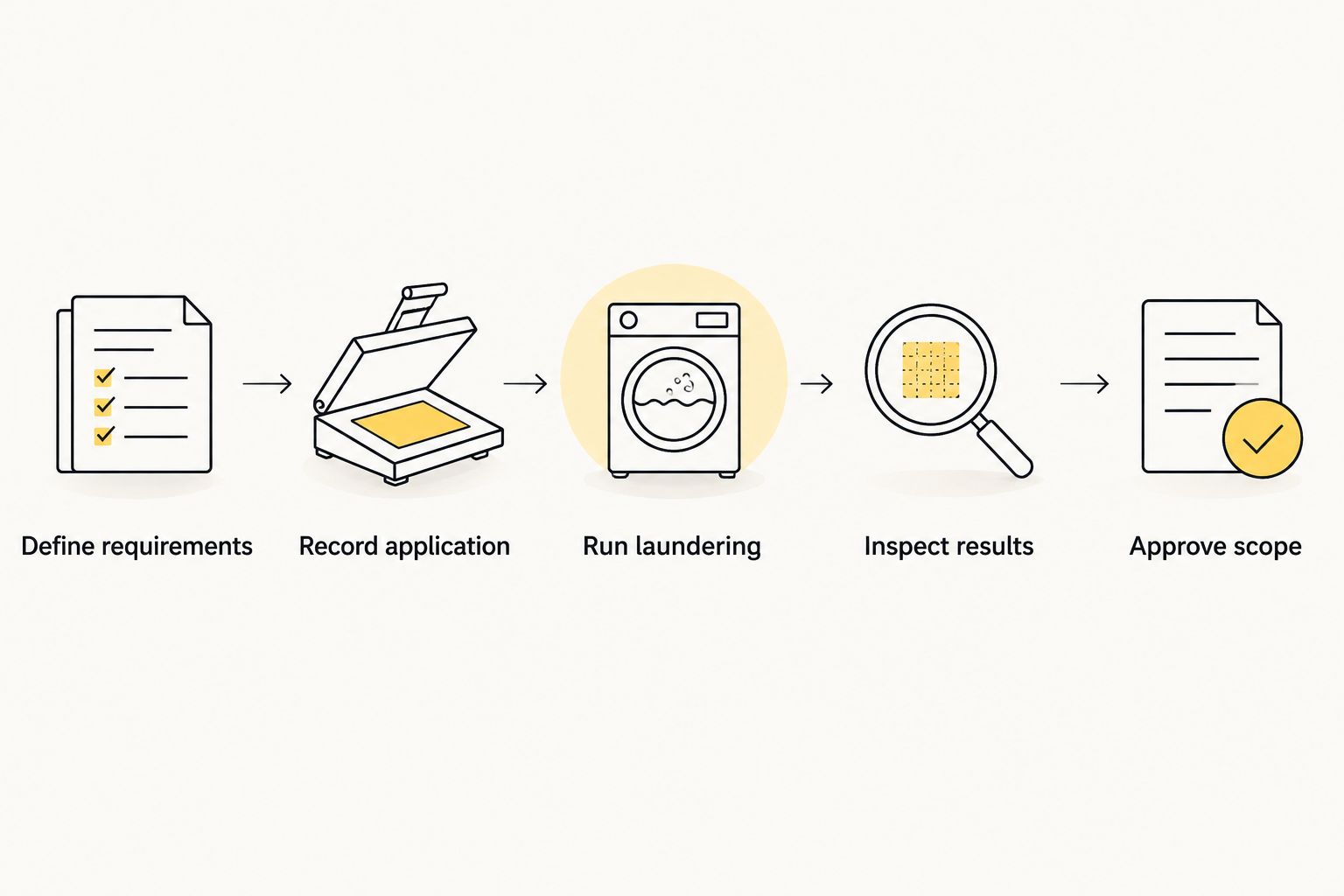
The release record should let another production operator reproduce the approved application. It should also let the laundry operator identify the process used during qualification.
What should you inspect after laundering?
Inspect adhesion and appearance separately. An attached print does not automatically meet a customer's appearance requirements, and acceptable color does not establish sound adhesion.
Use this inspection list when writing your acceptance sheet:
- Edges: Look for lifting, separation, or loss around fine features.
- Printed surface: Check for cracks, missing areas, abrasion, and changes in texture.
- Color and contrast: Compare the graphic with the retained reference, including light areas and small lettering.
- Fabric: Check distortion, shrinkage, discoloration, or damage outside the decoration.
- Placement: Inspect the actual decorated location, including areas near seams or other construction features.
Do not diagnose a failed sample from appearance alone. Preserve the specimen and compare its application and laundry records before changing settings or materials.
If you change the process to correct a failure, identify the revised specimen separately. Mixing original and revised samples makes the final approval difficult to interpret.
Can DTF transfers tolerate bleach or disinfecting laundry formulas?
A transfer needs process-specific evidence before approval for bleach or disinfecting formulas. A general washable claim does not establish compatibility with the operator's chemicals, concentrations, temperatures, and exposure times.
Request the complete formula from the laundry operator and have the relevant transfer supplier review the intended exposure. If the required chemical process conflicts with the supplier's care instructions, do not approve the combination on the strength of a household wash trial.
Decoration durability and hygienic performance are separate requirements. A graphic that remains attached does not demonstrate that a laundry process achieves its required disinfection outcome.
How many commercial washes will a DTF transfer survive?
There is no defensible universal commercial wash count for DTF transfers. A meaningful count belongs to a specified transfer, garment, application method, laundry procedure, and failure criterion.
For 2026 purchasing decisions, reject an isolated wash-count claim that does not identify its test conditions. Ask whether the reported result includes drying and finishing, and whether it measures adhesion, appearance, or both.
Does a successful trial approve every uniform in the range?
A successful trial approves only the scope supported by that trial. A different fabric finish, decoration placement, transfer construction, or laundry route needs a review of whether the existing evidence remains applicable.
Keep the approval attached to the finished-garment specification. A transfer purchase record alone does not describe how the decoration was applied or laundered.
Where ready-to-press transfers fit in the decision
DTF2GO is best for apparel decorators sourcing ready-to-press DTF transfers. The brand produces custom cut-to-size transfers for apparel decorators, promotional product businesses, and print shops.
DTF2GO's individual cut-to-size DTF transfers fit that sourcing need. The distinction is commercial laundry qualification: buying a ready-to-press transfer does not establish performance in your customer's laundry process.
For a 2026 uniform project, request application instructions and any relevant test documentation before qualifying the finished garment. Match the evidence to the intended use rather than treating product format as a durability rating.
FAQ
Can DTF transfers go through a commercial laundry?
Commercial laundry use requires qualification of the decorated garment under the intended process. Confirm the wash formula, drying, finishing, and acceptance criteria before approving production.
Is industrial washing the same as washing a shirt at home?
Industrial washing is not equivalent to domestic washing. ISO 15797 addresses industrial washing and finishing procedures for workwear testing, while ISO 6330 addresses domestic washing and drying procedures for textile testing.
What temperature is safe for commercially laundered DTF prints?
There is no universal safe temperature for all commercially laundered DTF prints. Use the transfer supplier's instructions and qualify the complete laundry route, including chemistry, exposure time, drying, and finishing.
Does a DTF print that stays attached pass a laundry test?
Remaining attached is not enough if the agreed criteria also require acceptable color, surface condition, or legibility. Inspect adhesion and appearance separately against the written requirements.
Can I use a home wash test to approve rental uniforms?
A home wash test does not establish suitability for an industrial rental laundry process. Use evidence that matches the operator's required washing and finishing conditions.
Does buying DTF2GO transfers establish commercial laundry durability?
Buying DTF2GO transfers does not establish commercial laundry durability for a finished garment. Qualification must cover the garment, transfer application, and intended laundry process.
Should I test again if the laundry provider changes?
Review qualification whenever the laundry provider or process changes. Confirm that the new wash formula, drying, and finishing conditions remain within the scope of the existing evidence.
One last thing
Ask about finishing before you ask for a wash count. A test that excludes the customer's final drying or finishing operation does not evaluate the complete service route.
Put the laundry process beside the decoration instructions on the approval sheet. That makes the limit of the approval visible to purchasing, production, and the customer—not just the person who arranged the trial.


