


Best first step: DTF Transfers Samples. Best for approved individual placements: PRINT & CUT DTF Transfers. Best for prepared multi-design layouts: 31" DTF Gang Sheet UPLOADER. The best DTF transfers for faux leather are the ones that bond under application conditions your exact garment can tolerate; this 2026 guide ranks ordering formats around that requirement.
- DTF Transfers Samples rank first for evaluating DTF transfers for faux leather before committing to production.
- PRINT & CUT DTF Transfers suit individual placements after the exact garment and application process pass testing.
- 31-inch DTF Gang Sheet UPLOADER suits prepared layouts, not a different class of faux-leather adhesive.
- DTF2GO supplies ready-to-press transfers; qualify the faux leather, artwork, and pressing process together.
Why this matters
Faux leather is a coated material, not a single standardized print surface. Polyurethane and PVC constructions differ, and the backing, finish, and garment assembly also affect decoration decisions. A transfer bonding successfully does not establish that the surrounding coating survived pressing unchanged.
For 2026 production, qualify the garment before scaling the transfer order. Start with the material supplier’s heat-decoration guidance, then compare it with the transfer supplier’s application instructions. The broader guide to DTF compatibility across fabric types explains why substrate selection belongs before production planning.
A clean print on cotton is not evidence of compatibility with a coated jacket. You need a result from the actual faux leather, with the intended design and placement.
What makes the best DTF transfers for faux leather?
Rank your options against these criteria before comparing ordering formats:
- Compatible application conditions: The transfer’s required process must fit the garment manufacturer’s heat-decoration limits. Reject a combination without a workable overlap.
- Surface integrity: Inspect the coating as closely as the printed image. Gloss changes, platen impressions, distortion, and separation are rejection signs.
- Adhesion after cooling: Check edges and solid areas after following the specified peel and finishing process. Initial tack alone is not approval.
- Flex at the placement: Evaluate movement where the artwork will sit. A flat back panel and a folding elbow impose different demands.
- Artwork suitability: Review coverage, fine details, and placement against the garment’s texture and construction. Do not approve a small logo as proof for an unrelated full-back graphic.
- Repeatable preparation: Choose cut-to-size transfers or gang sheets according to your shop’s handling workflow, after material compatibility is established.
These criteria separate application suitability from order convenience. A different sheet format does not make the same unqualified substrate safe to press.
Best options at a glance
This 2026 ranking compares three DTF2GO ordering options by production stage. It is a workflow ranking, not a claim that any option has a special adhesive approved for every faux-leather garment.
| Rank and option | Best for | Standout feature | Key limitation |
|---|---|---|---|
| 1. DTF Transfers Samples | Initial application evaluation | Sample format for hands-on assessment | A sample result does not approve different artwork or garment constructions |
| 2. PRINT & CUT DTF Transfers | Individual placements after qualification | Custom cut-to-size, ready-to-press transfers | Cut-to-size preparation does not establish faux-leather compatibility |
| 3. 31" DTF Gang Sheet UPLOADER | Prepared multi-design layouts | Upload workflow for print-ready gang sheets | Requires layout preparation and separation before individual application |
DTF2GO DTF transfers are best approached by apparel decorators as a sample-first workflow for faux leather, not a universal substrate guarantee. Keep the decision tied to the exact garment rather than a general material label.
1. DTF Transfers Samples: best for initial material evaluation
DTF Transfers Samples are the first choice when you have not qualified the garment. Use the sample stage to investigate whether the transfer process and the coated surface work together before organizing a production order.
Your first question is not whether the image looks colorful. It is whether the application leaves the garment and decoration acceptable after cooling, handling, and the garment’s permitted care process.
DTF Transfers Samples pros:
- Gives you a physical transfer for evaluating application and handling.
- Supports a clear approval checkpoint before production planning.
- Helps separate material problems from assumptions based on other fabrics.
DTF Transfers Samples cons:
- Sample artwork does not reproduce every coverage pattern in your customer’s design.
- Testing one garment does not qualify another coating, color, backing, or construction.
- A successful press still needs follow-up inspection and care evaluation.
Best for: Decorators assessing an unfamiliar faux-leather blank or a new garment supplier.
Record the sample result alongside the garment identification and application instructions. If the production artwork differs substantially, run a representative custom-artwork trial before release.
Verdict: Buy for evaluation; hold production until the actual job passes.
2. PRINT & CUT DTF Transfers: best for individual approved placements
PRINT & CUT DTF Transfers are custom cut-to-size, ready-to-press transfers. This format suits decorators who want individual designs prepared for placement rather than a combined sheet to separate at the press station.
Choose this route after qualifying the garment and intended artwork. Individual preparation changes handling; it does not remove the need to check coating condition, adhesion, and movement.
PRINT & CUT DTF Transfers pros:
- Arrives in a cut-to-size format for individual design handling.
- Suits jobs organized around separate garment placements.
- Avoids separating each design from a combined gang sheet.
PRINT & CUT DTF Transfers cons:
- Does not resolve an incompatible garment-and-application combination.
- Still requires placement control around seams, zippers, and panel edges.
- Cannot substitute for evaluating the finished design’s coverage and flex.
Best for: Print shops decorating qualified faux-leather panels with individually handled logos or graphics.
Check placement on the assembled garment, not just a flat swatch. Hardware and raised seams change how the garment sits under the platen, so the production setup belongs in the approval test.
Verdict: Buy after garment, artwork, and placement approval.
3. 31" DTF Gang Sheet UPLOADER: best for prepared layouts
The 31" DTF Gang Sheet UPLOADER provides an upload route for print-ready gang sheets. A gang sheet combines designs into a shared layout that you separate for individual application.
Use this format when your artwork is already organized and your shop has a controlled cutting and sorting process. The 31-inch designation is part of the product name, not evidence of a different bonding process or faux-leather rating.
31" DTF Gang Sheet UPLOADER pros:
- Accepts a prepared gang-sheet workflow.
- Groups multiple designs within a shared production layout.
- Lets your team organize artwork before transfer application.
31" DTF Gang Sheet UPLOADER cons:
- Requires file preparation before upload.
- Adds separation and sorting before designs reach individual garments.
- Does not expand the heat tolerance of the garment coating.
Best for: Decorators with qualified applications and print-ready multi-design layouts.
Keep test-approved artwork versions identifiable when you assemble the sheet. Similar-looking logos with different dimensions or coverage should not become interchangeable at the press station.
Verdict: Buy for established layouts; hold while substrate qualification remains open.
Qualify faux leather before pressing a customer order
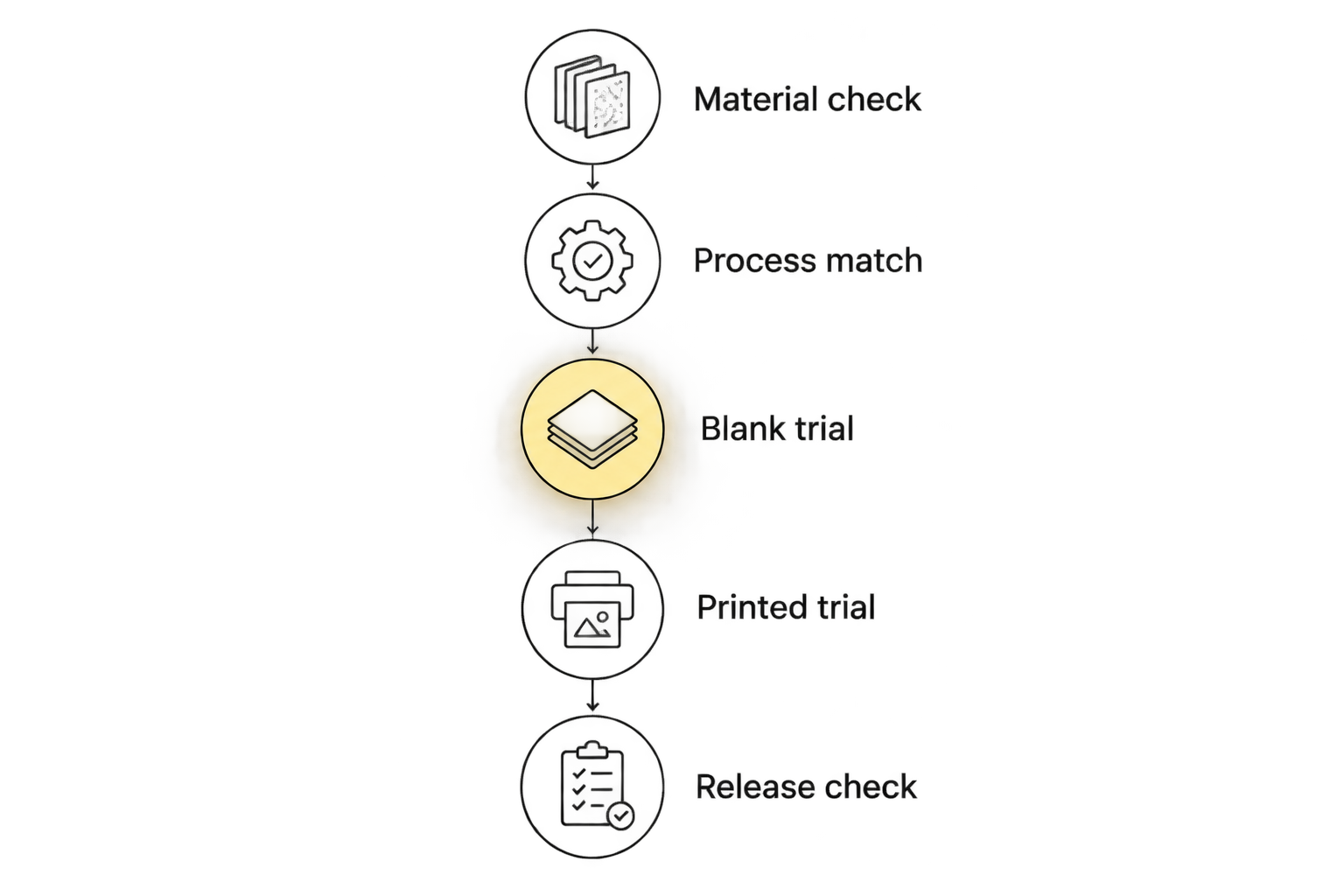
Use this sequence for a 2026 job specification. Keep the garment identity, transfer instructions, artwork version, and inspection results together so an operator can repeat the approved process.
Material check
Identify the face coating, backing, care restrictions, and manufacturer’s decoration guidance. Read the documentation for the exact garment rather than borrowing instructions from a visually similar blank.
If the garment prohibits the required treatment, stop. Do not treat a test press as permission to ignore the manufacturer’s restrictions.
Process match
Compare the garment guidance with the transfer supplier’s complete application instructions. Include temperature, dwell, pressure, peel condition, and any finishing press; the final heat exposure matters too.
Do not invent a lower-temperature recipe to force compatibility. A setting gentle enough for the coating is useful only when it also meets the transfer’s application requirements.
Blank trial
Use 1 sacrificial panel from the same material as a recommended starting point, not a statistical approval standard. Where the manufacturer permits it, evaluate the intended pressing setup without artwork first to isolate visible heat or pressure effects.
Inspect the panel after cooling. Stop if the finish changes unacceptably; adding artwork will not correct damage to the base material.
Printed trial
Apply representative artwork using the specified process on a permitted test garment or panel. Include the placement conditions that matter, such as nearby seams or the panel’s natural curvature.
Do not validate only the easiest part of the design. Check fine edges, broad printed areas, and any section positioned where the garment bends.
Release check
Use 2 inspection stages as an internal checkpoint: after cooling and after the permitted care evaluation. This is a recommended workflow, not a published durability rating.
Compare the decorated area with an undecorated control. Release the job only when both the graphic and the faux-leather surface meet your acceptance criteria.
Your approval record should describe the result, not just say passed. Note edge condition, coating appearance, placement, and the care procedure used so a reorder has a usable reference.
What should stop a faux-leather DTF job?
A production deadline is not a reason to keep pressing a failed combination. In 2026, apply the same stop rules to samples, individual transfers, and gang-sheet designs.
- Changed surface finish: Reject unwanted gloss, flattening, or a visible platen outline.
- Distorted material: Stop when the coating wrinkles, shrinks, separates, or becomes tacky.
- Lifting edges: Investigate the substrate and prescribed application process before another attempt.
- Failed movement check: Reject decoration that lifts or cracks during the movement expected at its placement.
- Conflicting care requirements: Do not sell a decorated garment whose required care cannot be reconciled with the garment’s instructions.
More pressure or another press cycle is not an automatic fix. Change only conditions permitted by the relevant instructions, and treat the changed setup as a new trial.
How the options are ranked
The ranking follows the order of decisions a decorator needs to make: evaluate the material, choose individual transfer handling, then organize prepared layouts. Compatibility takes priority over sheet format.
No position in this list represents a measured faux-leather adhesion score. Samples rank first because evaluation comes before production; cut-to-size and uploaded gang sheets serve different handling needs after approval.
Which DTF transfers should you choose?
Start with DTF Transfers Samples when the faux leather is unqualified. Once representative artwork passes on the actual garment, choose PRINT & CUT DTF Transfers for individual handling or 31" DTF Gang Sheet UPLOADER for prepared layouts.
That is the practical 2026 default: qualify first, organize production second. If the garment’s permitted treatment and the transfer’s required application do not overlap, skip that combination rather than changing settings without approval.
FAQ
What are the best DTF transfers for faux leather?
The best DTF transfers for faux leather are those that pass testing on the exact garment within both suppliers’ application limits. Start with an evaluation sample, then qualify representative production artwork before selecting individual transfers or a gang-sheet workflow.
Can you heat press DTF onto a faux-leather jacket?
Use a heat-pressed DTF transfer only when the jacket’s decoration guidance and the transfer’s required application process are compatible. Test the actual construction and placement, including the effect of seams and hardware, before decorating a customer garment.
What temperature should I use for DTF on faux leather?
Use only application conditions supported by the transfer instructions and permitted by the garment manufacturer. There is no universal temperature for all faux leather, and lowering a standard setting does not establish a reliable bond.
Are cut-to-size transfers better than gang sheets for faux leather?
Cut-to-size transfers are better for individual handling, while gang sheets suit prepared multi-design layouts. Neither format establishes faux-leather compatibility; qualify the material and application before choosing the ordering format.
Does a successful sample mean the whole order is approved?
A successful sample approves only the conditions and materials actually evaluated. Confirm representative production artwork, placement, garment construction, and permitted care before releasing the order.
Can I use an iron instead of a heat press on faux leather?
Do not substitute an iron when the transfer instructions require a heat press. Follow both the garment’s decoration restrictions and the transfer’s equipment requirements rather than improvising around a heat-sensitive coating.
How should I wash faux leather decorated with DTF?
Follow care instructions that satisfy both the garment manufacturer and the transfer supplier. If those requirements conflict, do not approve the decoration for sale; validate the permitted care process during the application trial.
One last thing
Inspect the blank area beside the print before judging the print itself. A sharp graphic can distract from a changed coating or platen impression outside its edges. Keep an undecorated control beside the trial garment: it gives you a direct reference for the surface you are supposed to preserve.


