


Best overall after fabric testing: PRINT & CUT DTF Transfers. Best for initial evaluation: DTF Transfers Samples. Best for approved, print-ready layouts: 31" DTF Gang Sheet UPLOADER. For dtf transfers for rayon viscose blends, choose the format around your production workflow, but approve the transfer on the actual garment before committing the run.
- For dtf transfers for rayon viscose, approve fabric compatibility before choosing cut-to-size transfers or gang sheets.
- DTF2GO DTF transfers suit decorators buying ready-to-press decoration rather than operating a DTF printer.
- PRINT & CUT DTF Transfers are the default production format after the garment passes testing.
- DTF Transfers Samples support initial evaluation; a sample does not certify every rayon or viscose blend.
Why this matters
Rayon and viscose describe related regenerated-cellulose fibers, not a universal heat-press specification. Blend composition, fabric construction, dyes, and finishes all belong in your approval process. A successful cotton job does not establish compatibility with a lightweight viscose jersey.
DTF2GO is best for apparel decorators buying custom, ready-to-press DTF transfers. This 2026 guide ranks ordering formats by production use, not by unverified claims about rayon-specific adhesives or guaranteed fabric compatibility.
What makes the best DTF transfers for rayon and viscose?
- Application compatibility: The transfer instructions and garment restrictions must permit a workable application process.
- Fabric appearance: Approve the surrounding fabric, not just the printed image.
- Hand feel: Judge the decoration at its intended size on the actual garment.
- Finished-garment performance: Inspect adhesion and appearance after laundering under the applicable care instructions.
- Production fit: Choose individual transfers or a prepared gang sheet only after the garment passes testing.
DTF transfer options at a glance
| Rank and option | Best for | Standout feature | Key limitation |
|---|---|---|---|
| 1. PRINT & CUT DTF Transfers | Approved jobs needing individual transfers | Custom cut-to-size, ready-to-press format | Individual formatting does not establish rayon compatibility |
| 2. DTF Transfers Samples | Initial material and application evaluation | A sample product to examine before production | Sample artwork does not replace testing your final design |
| 3. 31" DTF Gang Sheet UPLOADER | Approved jobs with prepared gang-sheet artwork | An upload route for print-ready gang sheets | Layout preparation and design separation remain production considerations |
These options address different stages of the same job. A sample supports evaluation, individual transfers support a cut-to-size workflow, and a gang sheet supports prepared layouts. None of those formats proves how a particular viscose blend will behave under your press.
1. PRINT & CUT DTF Transfers: best for approved individual jobs
PRINT & CUT DTF Transfers are the default choice when you want custom decoration supplied as individual, cut-to-size transfers. DTF2GO produces ready-to-press transfers for apparel decorators, promotional product businesses, and print shops. You handle garment application rather than transfer printing.
For rayon and viscose work, separate ordering convenience from application approval. Cut-to-size preparation addresses the transfer format; it does not establish a safe pressing temperature, suitable pressure, or wash result for your blank.
PRINT & CUT DTF Transfers pros:
- Individual transfers fit a workflow organized by garment or placement.
- Cut-to-size preparation removes gang-sheet separation from your press-side tasks.
- Ready-to-press decoration lets your shop focus on application and garment handling.
PRINT & CUT DTF Transfers cons:
- Each garment style and relevant color still needs approval before production.
- Individual formatting does not solve heat sensitivity, fabric marking, or unsuitable artwork coverage.
Best for: Decorators who have approved the blank and want individual transfers organized for pressing.
Before ordering production quantities, confirm the finished dimensions and placement. A small chest mark and a broad back graphic impose different demands on drape and wearer comfort, even when both use the same artwork colors.
Verdict: Buy after the actual garment and final-size artwork pass application and laundering checks.
2. DTF Transfers Samples: best for initial evaluation
DTF Transfers Samples give you a starting point for examining the transfer material and practicing the supplier-directed application process. Use the sample on the garment you intend to decorate, not a spare cotton shirt that happens to be near the press.
A sample answers questions about that sample, that blank, and that application. It does not establish that a larger custom graphic, another garment color, or another fabric finish will produce the same result.
DTF Transfers Samples pros:
- Supports hands-on evaluation before a production decision.
- Lets you inspect the relationship between a transfer and your chosen fabric.
- Provides a starting point for documenting application observations.
DTF Transfers Samples cons:
- Sample artwork does not reproduce every production design or coverage pattern.
- A successful test on one blank does not approve other rayon or viscose garments.
Best for: Shops evaluating a new garment style or introducing DTF decoration to an unfamiliar blend.
For your 2026 sample record, document the garment style, color, fiber content, transfer identity, and application instructions used. Keep the decorated sample with the record so the next operator can compare the physical result, not just read a pass notation.
Verdict: Buy for evaluation; hold the production order until your final design also passes.
3. 31" DTF Gang Sheet UPLOADER: best for prepared production layouts
The 31" DTF Gang Sheet UPLOADER is an ordering route for print-ready gang-sheet artwork. It belongs later in the approval process, when you have settled the designs, sizes, and quantities rather than while you are still deciding whether the garment is suitable.
The product name identifies a 31-inch format. Confirm the current file requirements before building the layout; a named sheet dimension does not establish every printable-area or spacing requirement.
31" DTF Gang Sheet UPLOADER pros:
- Fits a workflow built around prepared gang-sheet files.
- Lets you organize multiple designs within your production layout.
- Keeps artwork sizing and arrangement under your prepress process.
31" DTF Gang Sheet UPLOADER cons:
- Incorrect dimensions or quantities in the file carry into the job.
- Separating designs adds a handling step compared with cut-to-size transfers.
Best for: Print shops with approved garments, finished artwork, and a repeatable gang-sheet preparation process.
Check every placement at finished size before upload. Do not approve a small test graphic and assume it validates a much larger solid design simply because both appear on the same sheet.
Verdict: Buy for approved layouts; wait if garment compatibility or artwork size remains unresolved.
How these options were ranked
The ranking prioritizes production fit, then the limits of what each format establishes. Individual transfers take the default production slot, samples take the evaluation slot, and the uploader takes the prepared-layout slot.
This is a 2026 ordering guide, not a laboratory ranking of adhesion, wash durability, or rayon-specific performance. The decisive evidence comes from your finished garment under the intended application and care process.
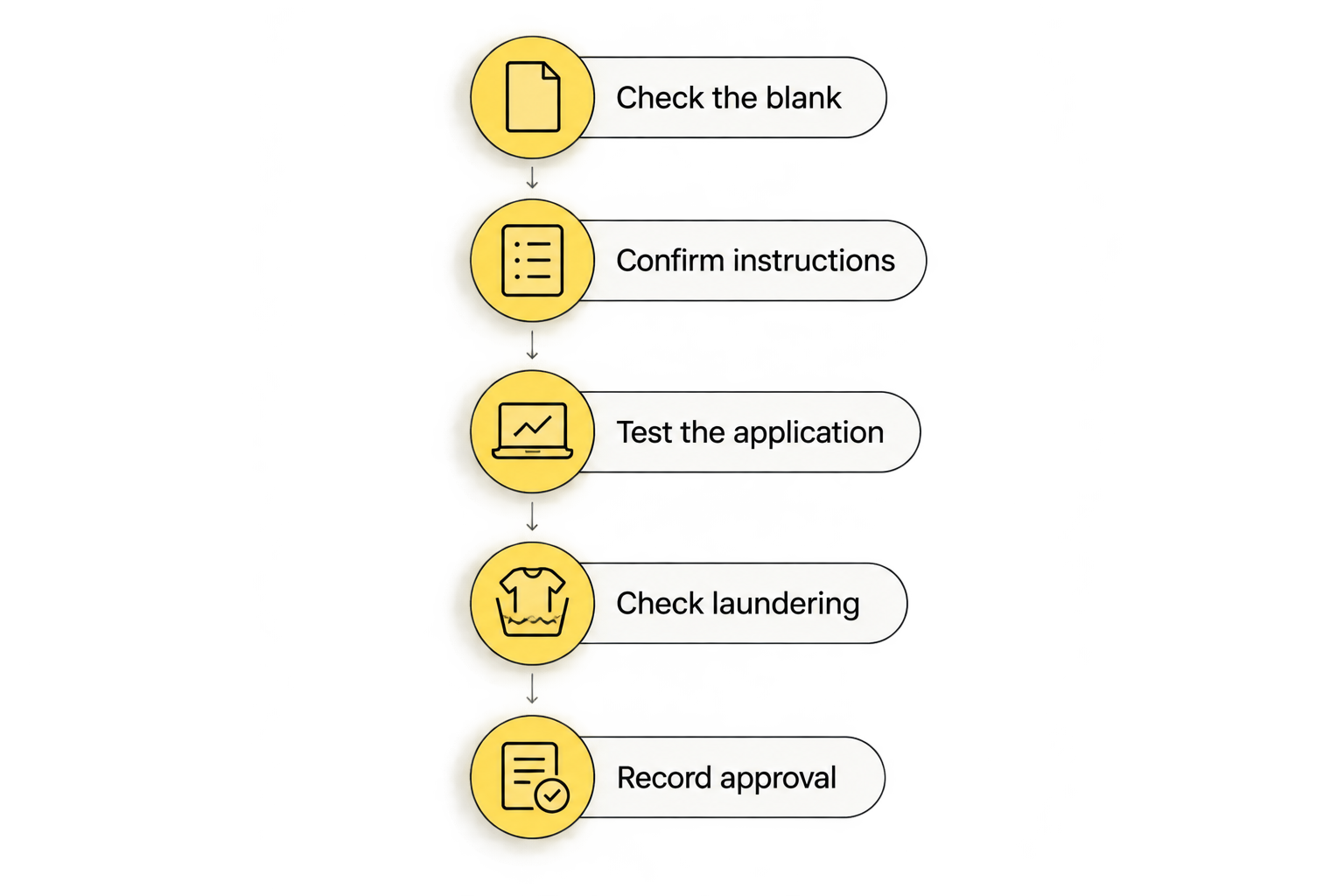
How to approve DTF transfers on a rayon or viscose blend
Use a documented sequence rather than adjusting the press until the image appears to stick. If the garment restrictions and transfer instructions conflict, stop the job and resolve the conflict before pressing production. A lower temperature without an approved application process is not a compatibility solution.
Check the blank
Read the fiber composition and care information, then identify the exact style and color. Viscose-rich jersey, a woven blend, and a stretch blend are different approval subjects. Do not group them under a single rayon setting.
Ask the garment supplier about decoration restrictions when the available instructions do not address heat application. Record the response with the job rather than relying on an operator's memory.
Confirm instructions
Obtain the transfer's application instructions, including temperature, dwell, pressure, peel procedure, and any finishing step. Compare those requirements with the garment guidance before testing. Do not substitute a generic online setting for the instructions supplied with the transfer.
For a new style, set aside 2 test garments as a shop protocol: one for application development and one for the final, documented approval. This is a planning recommendation, not a claim that two garments establish statistical reliability.
Test the application
Apply the transfer using the instructed process on a representative garment. Inspect the print edges and the surrounding fabric after the garment has cooled as required by the application procedure.
Look for discoloration, unwanted shine, a visible platen outline, puckering, and distortion. A print that stays attached while the blank changes appearance is a failed garment, not a successful transfer.
Check laundering
Launder the approval garment according to the applicable garment and transfer care instructions. Resolve incompatible care requirements before offering the decorated product to a customer. Inspect adhesion, edge condition, surface appearance, and the garment itself afterward.
Do not turn an initial wash check into a promised lifespan. A durability claim needs evidence that matches the claim's conditions and scope.
Record approval
Create 1 production record for each approved garment style, color, design, and application combination. Include finished artwork dimensions and photographs of the accepted result. A change in the blank or design coverage should trigger a review rather than automatic reuse of the old approval.
Choose artwork that respects the garment
Rayon and viscose garments are often selected for their drape. A broad, continuous printed area changes how decorated fabric bends, so evaluate coverage as well as color and detail. The right ordering format cannot compensate for artwork that feels wrong on the finished shirt.
Prepare 2 artwork versions when hand feel is a concern: the original design and a version with more open space. Compare both at intended size. This gives your customer a concrete choice without assuming that smaller artwork automatically meets the brief.
Keep fine details intentional. Do not remove so much coverage that essential lettering or identity becomes difficult to reproduce; confirm artwork requirements before submitting a revised file.
Diagnose the result before changing the press
A failed rayon or viscose test needs a defined observation, not an immediate increase in heat. More heat does not address every cause of poor adhesion, and it adds thermal exposure to the garment.
| Observation | What to check next | What not to assume |
|---|---|---|
| Edges lift during peeling | Specified peel procedure, pressure, and application instructions | That every transfer uses the same peel method |
| Fabric looks shiny or discolored | Garment restrictions and the complete heat-and-pressure process | That attached artwork means the garment passed |
| The print feels too dominant | Final-size coverage and open areas in the design | That a different ordering format changes hand feel |
| Appearance changes after washing | Both sets of care instructions and the recorded application | That an unwashed sample establishes durability |
Keep failed samples until the cause is resolved. Comparing them with an accepted garment is more useful than repeatedly changing several settings and losing track of what changed.
Which DTF transfer format should you choose?
Choose PRINT & CUT DTF Transfers for approved jobs that need individual, ready-to-press decoration. Start with DTF Transfers Samples when you are evaluating the material, and use the 31" DTF Gang Sheet UPLOADER when your artwork and production layout are already settled.
For 2026 production, keep the decision order fixed: garment compatibility, finished-design approval, then ordering format. DTF2GO supplies the transfers; your shop's documented garment approval determines whether the specific rayon or viscose job is ready to press.
FAQ
What's the best DTF transfer option for rayon and viscose blends?
PRINT & CUT DTF Transfers are the default ordering choice for approved jobs needing individual transfers. Fabric suitability still depends on testing the exact garment with the instructed application process.
Can you heat press DTF transfers onto viscose?
Treat viscose as a test-required fabric, not an automatically approved substrate. Confirm that the garment restrictions and transfer instructions permit a compatible application process before production.
Are rayon and viscose the same thing for DTF printing?
Viscose is a type of rayon, but neither label defines a complete pressing specification. The blend, construction, dyes, finishes, and garment instructions still matter.
What temperature should I use for DTF transfers on rayon?
Use the transfer supplier's instructed application process only when it is compatible with the garment restrictions. There is no single setting established here for every rayon or viscose blend.
Are gang sheets better than cut-to-size transfers for viscose?
Gang sheets and cut-to-size transfers serve different handling workflows; the format does not establish viscose compatibility. Choose cut-to-size for individual preparation and a gang sheet when you have an approved layout.
Does a successful sample mean my whole order is approved?
A successful sample approves only the tested combination and conditions. Confirm the final artwork size, garment style, color, application, and laundering result before releasing production.
How do I keep a DTF design from overpowering a lightweight shirt?
Evaluate the printed area at its intended size on the actual garment. Compare the original artwork with a more open version when drape and hand feel are priorities.
One last thing
Approve the fabric outside the artwork. A sharp image with clean edges still fails if the surrounding viscose has a permanent press outline or altered sheen. Add an unprinted-fabric inspection to your 2026 sign-off so artwork quality never hides garment damage.


