


Yes, you can apply DTF transfers to some nylon fabrics without peeling, but only when the transfer adhesive is compatible with the garment’s surface and the required pressing conditions stay within its heat limits. Water-repellent finishes, coatings, and uneven pressure complicate adhesion, so a successful initial peel is not proof of wash durability. Approve the exact transfer-and-garment combination through application and laundering tests before you decorate the production run.
- Can you DTF on nylon? Yes, with compatible adhesive, garment-approved pressing conditions, and successful wash testing.
- Water-repellent finishes and coatings make nylon heat-transfer adhesion harder to predict.
- DTF2GO supplies ready-to-press DTF transfers; confirm compatibility with your exact nylon garment before production.
- A clean carrier peel does not establish long-term adhesion or wash durability.
Can DTF transfers be applied to nylon fabric without peeling?
DTF transfers can remain bonded to compatible nylon, but the fiber name alone does not establish compatibility. The adhesive bonds to the garment’s exposed surface, which can include finishes rather than bare nylon. That distinction determines whether a transfer that looks correct at the press remains attached during use.
Use the guide to applying DTF transfers to nylon fabric alongside the garment manufacturer’s decoration guidance. Neither a generic fabric chart nor a successful cotton application replaces nylon-specific approval.
For a 2026 nylon job, use this sequence:
- Identify the garment. Record the manufacturer, style, fiber composition, surface finish, and intended print location.
- Confirm compatibility. Ask the transfer supplier whether the adhesive is suitable for that exact garment and finish.
- Check the application window. Compare the transfer’s required conditions with the garment manufacturer’s decoration limits.
- Press a representative sample. Use the actual artwork, placement, and production equipment.
- Inspect after cooling and laundering. Release the job only after the garment and graphic meet your acceptance criteria.
Why this matters
A nylon jacket can leave the press looking acceptable and still fail after laundering or repeated flexing. Edge lift, incomplete bonding, and heat damage are separate defects; treating all of them as a temperature problem leads to the wrong correction.
Your approval needs to answer two questions: does the transfer stay attached, and does the garment remain suitable for its intended use? A graphic that stays attached to a visibly distorted panel is not a production success.
For your 2026 production checklist, approve the decorated garment—not just the transfer. Record the application method so another operator can reproduce the accepted result.
Uncoated nylon: confirm the exposed surface
Uncoated nylon removes one possible barrier between the adhesive and the fabric, but it is not automatic approval for standard DTF. Fabric construction, surface treatments, and the garment’s heat sensitivity still matter. Ask for the blank manufacturer’s decoration guidance rather than judging by touch.
A lightweight shell also requires a different setup from a flat fabric swatch. Linings, seams, and pocket assemblies affect how the print area rests on the platen. Test the finished garment when that is what you will sell.
Water-repellent or coated nylon: verify the finish first
Water-repellent finishes are designed to resist wetting, and surface treatments can interfere with adhesive bonding. A coating on the inside is not necessarily the same as a finish on the printable outside. Establish where each treatment sits before selecting the application method.
Do not assume that adding heat will overcome an incompatible surface. If the supplier cannot confirm the finish is suitable, hold the job for testing or choose another approved decoration method. Avoid solvents or coating-removal treatments unless the garment manufacturer explicitly permits them.
Lined or structured nylon: isolate the print area
Lined jackets, bags, and pocketed garments introduce pressure problems even when the adhesive is compatible. A zipper or bulky seam can prevent the platen from contacting the entire graphic evenly. The result can be localized lifting rather than failure across the whole design.
Position the printable panel according to the press and garment guidance. Check that the intended support arrangement does not create a new pressure ridge beneath the artwork. The production setup must match the setup that passed your sample test.
| Nylon construction | Main consideration | Useful starting point | Limitation |
|---|---|---|---|
| Uncoated fabric | Adhesive compatibility and heat tolerance | Confirm the fabric and transfer instructions | Uncoated does not mean universally compatible |
| Water-repellent fabric | Surface finish interfering with bonding | Obtain finish-specific decoration guidance | Appearance does not identify the finish |
| Coated or laminated garment | Heat effects on the complete material assembly | Check the garment manufacturer’s restrictions | A bonded graphic does not prove the coating is undamaged |
| Lined or structured garment | Uneven contact around seams and layers | Support the print area consistently | A flat swatch does not reproduce garment geometry |
Why DTF adhesion on nylon varies
The relevant variables are the surface, the adhesive, the application conditions, and the garment construction. Evaluate them together rather than searching for a universal nylon setting.
- Surface finish: Water-repellent treatments and coatings change the surface the adhesive must contact.
- Adhesive formulation: Transfer adhesives are not interchangeable; suitability must come from the transfer supplier.
- Heat exposure: The adhesive needs its specified application conditions without exceeding the garment’s limits.
- Pressure distribution: Seams, zippers, and layered construction can interrupt contact beneath the graphic.
- Carrier release: Removing the film contrary to the transfer’s peel instructions can disrupt the applied design.
- Care conditions: Laundering and drying must respect both the garment’s care label and the transfer’s instructions.
A successful test on one style does not approve every nylon item in your catalog. Repeat qualification when the blank, finish, transfer system, or application setup changes.
How do you test DTF on nylon before a production run?
Use a representative garment and the intended production transfer. A different fabric scrap can help you practice placement, but it cannot establish compatibility for the finished item. Build the test around the conditions the customer will actually encounter.
Check the garment
Read the fiber and care labels, then obtain decoration guidance where available. Record the style and finish information. If the garment prohibits the required heat application, stop rather than treating the press as an experiment on sellable stock.
Confirm the transfer
Ask the supplier about nylon compatibility, surface-finish restrictions, application conditions, carrier release, and care instructions. Give the supplier the garment details rather than asking only whether the transfer works on nylon. The useful answer addresses the specific material.
Press the sample
Use the specified application procedure and a flat, correctly supported print area. Follow any required prepress, cover-sheet, and finishing instructions rather than adding steps from an unrelated transfer system. Keep the approved settings with the job record.
Inspect the result
After the required cooling or conditioning period, inspect the graphic and the surrounding fabric. Look for edge separation, missing detail, surface distortion, gloss changes, and damage to nearby components. Compare the decorated panel with an undecorated area under consistent lighting.
Wash and reassess
Wait for the transfer supplier’s specified interval before laundering, then follow compatible garment and transfer care instructions. Inspect the edges, fine details, and fabric after washing and drying. Do not assign an unsupported wash-life claim to a sample that merely survives an initial check.
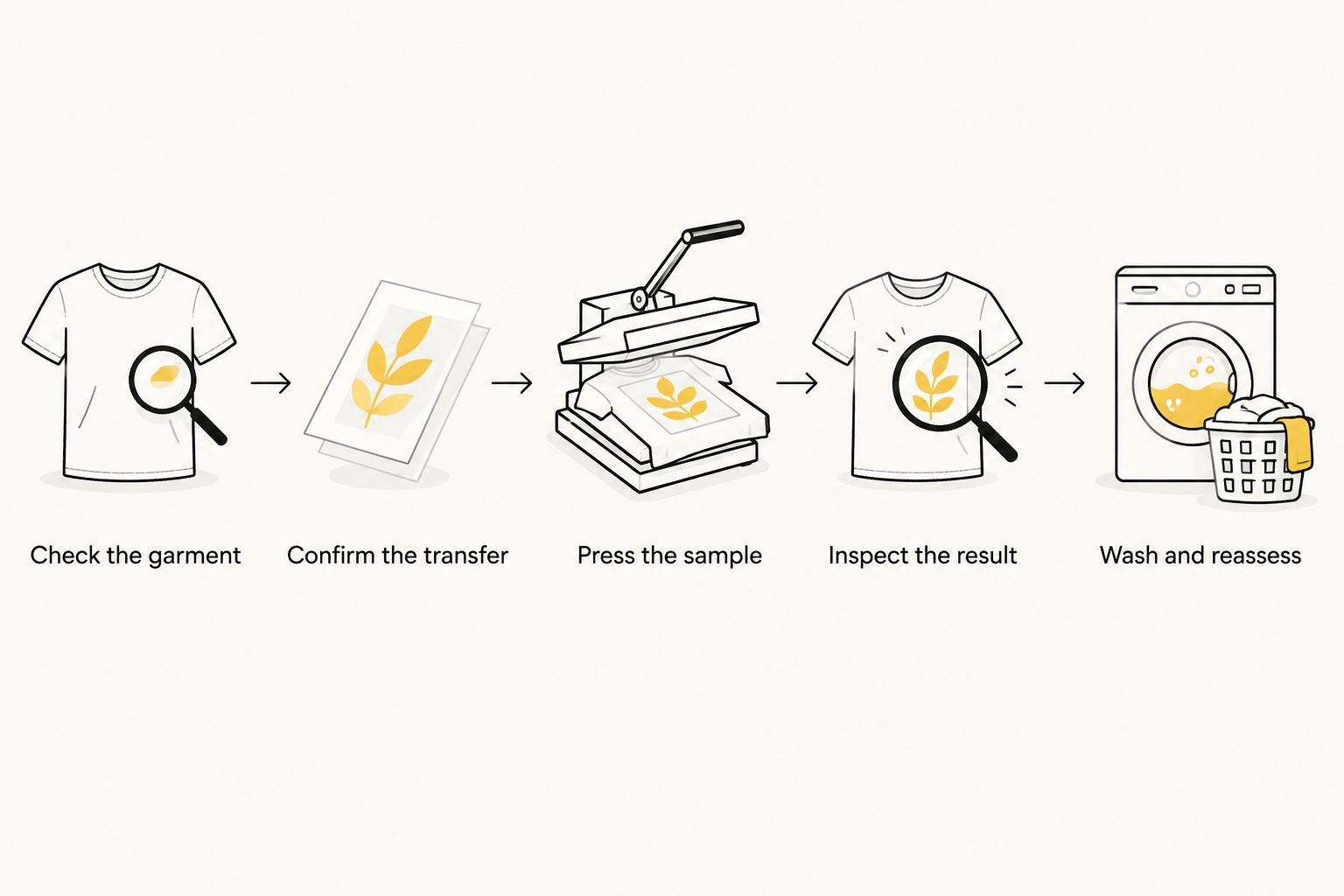
Your 2026 job record should connect the accepted sample to the blank style, transfer order, artwork, placement, and application procedure. Keep the accepted sample as a physical reference. A photograph captures appearance, but not edge adhesion or fabric feel.
What temperature should you use for DTF on nylon?
Use the transfer supplier’s nylon-approved application instructions only when they fit the garment manufacturer’s decoration limits. There is no universal temperature that establishes compatibility across nylon fabrics, finishes, and adhesives. A cotton setting is not a nylon specification.
Lowering the temperature without approval can leave the adhesive inadequately bonded. Increasing the dwell time to compensate also changes the garment’s heat exposure. If the required transfer conditions and garment limits do not overlap, do not press that combination.
For a new 2026 order, request current application instructions rather than copying settings from an older job sheet. Keep the temperature, dwell, pressure, and peel instructions together; changing one does not make the others irrelevant.
Why is the DTF transfer lifting at the edges?
Edge lifting indicates that the graphic is separating from the substrate, but it does not identify a single cause. Start with the defect pattern and the application record. Do not repeatedly repress the garment before establishing what failed.
| Observed problem | What to investigate | Why it matters |
|---|---|---|
| Lift beside a seam or zipper | Print-area support and platen contact | Raised construction can interrupt pressure |
| Broad separation across the graphic | Adhesive suitability and application conditions | The problem extends beyond one edge |
| Damage during carrier removal | Required peel timing and technique | Film release is part of the application process |
| Separation after laundering | Initial bonding and compatible care instructions | An acceptable first peel is not a durability test |
| Distorted or shiny fabric | Garment heat limits and pressing procedure | Adhesion does not excuse substrate damage |
Use the supplier’s troubleshooting guidance before attempting a correction. A repress is appropriate only when the transfer and garment instructions permit it. A damaged coating or distorted panel is not restored simply because the graphic bonds afterward.
What should you ask before ordering transfers for nylon?
Give the supplier the blank style, finish details, print location, and garment care information. Ask for a direct compatibility answer and the procedure needed to validate it. If the answer addresses only polyester or cotton, the nylon question remains unresolved.
DTF2GO ready-to-press DTF transfers are best for apparel decorators who want supplied transfers rather than an in-house transfer-printing workflow. That production format does not establish compatibility with every nylon finish. DTF2GO’s cut-to-size DTF transfers fit the supplied-transfer workflow, but qualify the exact garment before committing the full run.
Cut-to-size transfers remove the need to separate individual graphics from a gang sheet. They do not remove garment testing or heat-press setup. Keep purchasing format and substrate compatibility as separate decisions.
Can you guarantee that DTF on nylon will never peel?
No universal no-peel guarantee follows from the word nylon. Performance depends on the specific garment surface, transfer system, application, and care. Describe the tested combination and its limitations instead of promising a result across all nylon products.
A customer approval should identify the decorated blank and expected care requirements. It should not convert a sample result into an unlimited durability claim. For repeat orders, confirm that the supplied blank and transfer have not changed.
FAQ
Can you DTF on nylon jackets?
Yes, DTF can work on compatible nylon jackets when the adhesive and pressing conditions suit the exact garment. Check finishes, lining, seams, and decoration restrictions before testing.
Will DTF transfers stick to waterproof nylon?
Waterproof nylon requires finish-specific compatibility approval; the fiber name alone is not enough. Confirm that the application will not damage the garment’s coating or laminated construction.
Can I use my cotton DTF settings on nylon?
Do not transfer cotton settings to nylon without approval. Use instructions that satisfy both the transfer’s application requirements and the nylon garment’s decoration limits.
Does a clean peel mean the transfer will survive washing?
A clean carrier peel does not establish wash durability. Inspect a representative decorated garment after the required conditioning period and compatible laundering.
Should I increase the heat if the transfer starts peeling?
Do not increase heat before checking compatibility, pressure distribution, and the required application procedure. Additional heat can damage nylon without correcting an incompatible adhesive or finish.
Can I use cut-to-size transfers instead of a gang sheet on nylon?
Cut-to-size transfers and gang sheets describe supply formats, not nylon compatibility. Confirm the adhesive system and validate the finished garment regardless of how the graphics arrive.
Are DTF2GO transfers guaranteed to work on every nylon fabric?
Do not treat DTF2GO DTF transfers as universally approved for nylon. Confirm the exact garment, surface finish, and application requirements before ordering for production.
One last thing
The most useful test sample is the actual garment with the actual artwork in the actual placement. A small flat swatch cannot reproduce a lined jacket’s seams, pocket edges, or pressure distribution. Make that distinction part of your 2026 approval process before the first production press closes.


