


A DTF transfer adds a surface layer of ink and adhesive to fabric; the removable carrier film does not remain on the garment. There is no single finished thickness that applies to every DTF print, and thickness alone does not describe how stiff or soft the decorated area feels. For a production decision in 2026, measure the finished print and approve its hand feel on the actual garment.
- DTF transfer thickness on fabric depends on the deposited ink, adhesive, and application—not the removable carrier film.
- DTF2GO supplies ready-to-press DTF transfers for decorators; approve hand feel on your actual production blank.
- Solid artwork and open artwork need separate hand-feel checks, even when their printed layers have similar thickness.
- Measure printed and unprinted fabric under consistent pressure, then assess drape, stretch, and edges separately.
Why this matters
A shirt can have a shallow print edge and still feel stiff across the chest. Your customer feels the decorated garment, not a film specification.
Separate the carrier from the deposited print before comparing suppliers. The distinction is central to choosing DTF transfer film thickness: film handling and finished garment feel are different questions. A thicker carrier does not, by itself, establish a thicker finished decoration.
Approve the print on the blank you will sell—not on the carrier you will discard.
How much thickness does a DTF transfer add to fabric?
The added thickness is the difference between the decorated fabric and a comparable unprinted area, measured under the same conditions. For a meaningful result, remove the carrier, complete the prescribed application process, and let the garment cool before measuring.
| Component | Remains on the garment? | What it tells you |
|---|---|---|
| Carrier film | No | How the transfer is supported before release |
| Color ink and white underbase | Yes | Part of the deposited image layer |
| Heat-activated adhesive | Yes | Part of the bonded decoration |
| Fabric | Yes | The underlying material that affects the total reading |
Do not report a carrier-film measurement as the thickness added to a shirt. Those measurements describe different objects.
For your 2026 production specification, ask for finished applied thickness, the measurement method, and the fabric used. A number without those details does not establish how the print will behave on your order.
Physical thickness is not the same as hand feel
Physical thickness describes a dimension. Hand feel includes stiffness, surface texture, flexibility, and how the printed area moves against the surrounding fabric.
A continuous graphic connects a broad area of fabric with a bonded print layer. An open design leaves fabric exposed between printed elements. Even when the deposited layers have similar thickness, those layouts do not bend as a single identical structure.
Evaluate both properties. A thickness reading cannot replace a drape check, and a soft-feeling sample does not establish a measured thickness specification.
Why DTF transfer thickness and feel vary
These factors explain why a single universal thickness figure is not a useful purchasing specification:
- Ink deposit: Color ink and the white underbase form part of the layer that remains after peeling. Different print constructions require separate evaluation.
- Adhesive deposit: The adhesive bonds the image to the textile and contributes to the finished decoration. Assess the applied transfer rather than loose powder or an unpressed sheet.
- Artwork coverage: A solid panel and separated lettering cover fabric differently. Coverage changes how much of the garment is joined by the print layer.
- Fabric construction: A lightweight knit and a substantial sweatshirt provide different starting points for feel and measurement. Use the intended production blank.
- Application conditions: Heat, pressure, dwell time, and the prescribed finishing process affect the bond and surface. Follow the transfer instructions rather than improvising a thinner-feeling result.
- Measurement pressure: Textiles compress. Inconsistent contact force changes the reading and weakens comparisons between samples.
Keep the blank, artwork, application method, and measurement conditions consistent when comparing transfers. Otherwise, you are changing several variables at once.
How do you measure added DTF thickness consistently?
Use a textile thickness gauge with controlled contact pressure when you need a repeatable measurement. Handheld calipers can provide a rough comparison, but squeezing soft fabric between the jaws introduces operator-dependent compression.
The following is a practical comparison protocol, not a claim about a standard DTF thickness or a substitute for a specified laboratory test.
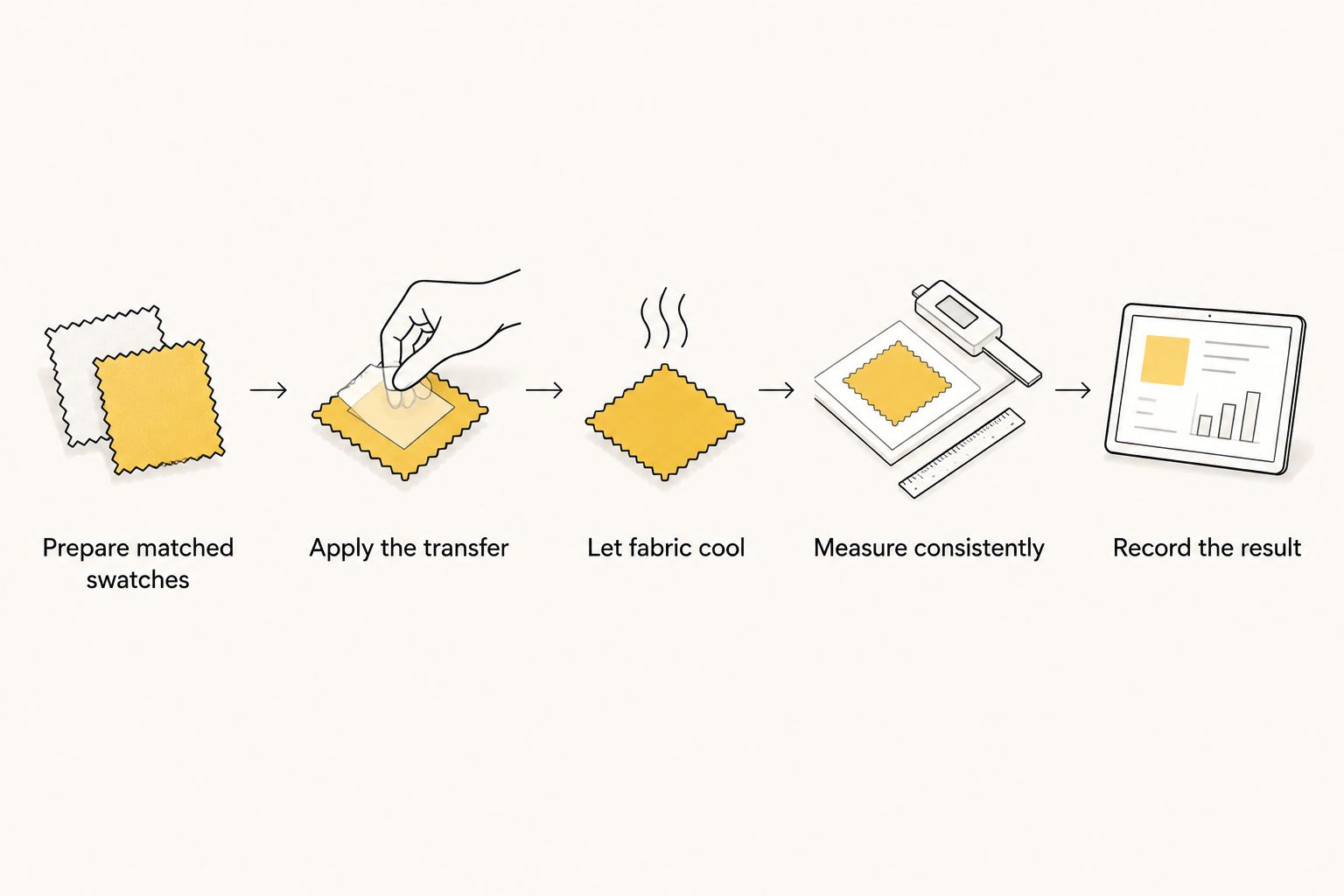
- Prepare matched swatches. Use 2 swatches from the same blank fabric: one decorated and one unprinted. Keep the fabric orientation and condition comparable.
- Apply the transfer. Follow the supplied application instructions, remove the carrier at the specified stage, and complete any required finishing step.
- Let fabric cool. Measure samples in the same dry, room-conditioned state. Do not compare a warm pressed sample against a cool unprinted sample.
- Measure consistently. Take readings at 5 locations within a solid printed area, avoiding seams, print boundaries, and isolated details. Use equivalent locations on the unprinted control.
- Record the result. Take 3 readings per location with consistent contact pressure. Record the printed and control measurements, their difference, and the spread of readings.
Subtract the unprinted control reading from the decorated reading using the same reporting method for both. Describe the result as an apparent added thickness under the stated test conditions, because pressing and measurement pressure also affect the textile.
For a tighter comparison, include an unprinted control that passes through the same heat-press cycle. That helps distinguish changes caused by pressing the fabric from changes associated with the decoration.
Keep the raw readings with the approved sample. Your 2026 job record should identify the blank, artwork revision, transfer batch, application instructions, and measuring instrument so another operator can repeat the comparison.
How do you make a DTF print feel less bulky?
Start with the artwork and garment combination. Do not treat extra heat or pressure as a shortcut to a softer print.
Open artwork: best for preserving exposed fabric
Use intentional negative space where the design permits it. Separated lettering, outlined elements, and open areas leave fabric between printed sections instead of joining the entire graphic into a continuous panel.
The advantage is less continuous printed coverage. The trade-off is that changing a solid logo into an open design changes its appearance, so get artwork approval before production.
Keep small elements within the supplier's artwork requirements. Removing coverage is not an improvement if the remaining details cannot reproduce reliably.
Smaller placement: best for limiting the decorated area
Reducing the graphic's footprint limits how much fabric receives the surface layer. It does not make the deposited layer itself thinner.
The advantage is a smaller interruption to the garment's movement. The trade-off is reduced visual impact and potentially smaller lettering. Judge the design at its final physical size, not enlarged on a monitor.
Representative sampling: best for production approval
Use the actual blank, graphic dimensions, and application instructions when approving hand feel. A small sample motif does not establish how a broad solid design will drape.
DTF2GO ready-to-press DTF transfers suit apparel decorators who want to apply custom graphics without producing the transfers themselves. Evaluate DTF transfer samples on your intended fabric before approving the production decoration.
The practical limitation is that outsourced transfer production does not remove your responsibility for garment selection, application, and finished-product approval. Keep an accepted decorated sample beside the job ticket rather than relying on a screen proof alone.
Is DTF the right choice when you want almost no print feel?
DTF leaves a bonded image layer on the fabric. If your requirement is a decoration without an added surface layer, compare suitable processes before changing press settings or chasing a thinner carrier.
| Approach | Best for | Main advantage | Main limitation |
|---|---|---|---|
| DTF transfer | Applied graphics where a bonded surface layer is acceptable | Places the printed image onto the selected garment | The decoration adds a surface layer and changes local hand feel |
| Dye sublimation | Suitable polyester-based garments where avoiding a surface print layer matters | Colors suitable fibers rather than adding a bonded transfer layer | Fabric composition and garment color constrain the application |
The distinction matters for uniform programs. When comparing DTF-decorated work shirts with sublimated polo shirts, separate the decoration process from garment construction: sublimation colors suitable fibers, while DTF leaves an applied image layer. Neither process removes the need to evaluate the finished garment for its intended use.
For your 2026 approvals, write the requirement in plain language: acceptable surface feel, required graphic coverage, garment composition, and expected movement. Choose the process against that brief, not a claim that one method is always softer.
Does a bigger DTF graphic add more thickness?
A bigger graphic covers more fabric; it does not automatically create a thicker deposited layer at each printed point. Distinguish print area from layer thickness when explaining the result to a customer.
A broad solid graphic connects a larger decorated area than a small logo. Test the intended placement by letting the garment hang naturally, then bending the printed section alongside an unprinted section.
If the full-size graphic feels too stiff, revise coverage or placement before changing the approved production process. A reduced-size sample is not a reliable substitute for approving the final layout.
Will extra pressing make a DTF transfer thinner?
Extra pressing is not a controlled thickness-reduction method. Follow the specified application and finishing instructions instead of adding heat, dwell time, or pressure to chase a softer feel.
Changing the application conditions also changes the process you are approving. If a sample feels wrong, check the artwork, blank, and correct application first; then discuss the finished result with the transfer supplier.
For 2026 repeat orders, keep the accepted settings attached to the job. Consistency is more useful than an undocumented adjustment that one operator remembers and another cannot reproduce.
What should you ask a supplier about finished thickness?
Ask about the applied decoration, not just the sheet. A focused request separates measurable construction from subjective descriptions such as soft, thin, or lightweight.
Include these points in your approval brief:
- Identify the exact fabric composition and garment style you plan to decorate.
- Supply the artwork at its intended physical dimensions.
- Ask whether any thickness figure refers to the carrier, the unpressed transfer, or the finished applied print.
- Request the measuring method and contact conditions behind a finished-thickness claim.
- Approve the surface feel, print edge, and drape on a decorated garment.
When ordering DTF2GO transfers, use that same brief to organize your own press-side approval. A supplier specification and your finished-garment inspection answer related but different questions.
FAQ
How much thickness does a DTF transfer add to a shirt?
A DTF transfer adds the finished ink-and-adhesive layer, not the removable carrier film. The exact added thickness depends on the transfer construction and application, so measure a decorated sample against comparable unprinted fabric.
Does thicker DTF film mean a thicker print on fabric?
Thicker carrier film does not, by itself, mean a thicker finished print. The carrier is removed; the deposited ink and adhesive remain on the fabric.
Why does my DTF print feel thick even when the edge looks thin?
A DTF print can feel stiff because hand feel includes flexibility and coverage, not just edge height. A broad continuous graphic joins more fabric beneath a surface layer than separated printed elements.
Can I use calipers to measure DTF transfer thickness on fabric?
Calipers provide a rough comparison, but inconsistent squeezing changes readings on compressible fabric. Use a textile thickness gauge with controlled contact pressure when repeatability matters.
Will a gang sheet make my finished DTF print thicker?
Gang-sheet layout alone does not establish finished print thickness. Compare the actual transfer construction and applied result, not whether designs arrived together on a sheet.
Can extra heat make a DTF print feel thinner?
Extra heat is not a controlled way to reduce finished DTF thickness. Follow the supplied application instructions and address unsuitable coverage or garment choice through sampling.
How should I evaluate DTF2GO transfers for hand feel?
Evaluate DTF2GO transfers on the actual production blank using the prescribed application process. Inspect the cooled decoration for surface feel, edge definition, drape, and movement at the intended graphic size.
One last thing
A thinner-looking edge is not proof of a softer garment. Before approving a run, hold the decorated shirt by its shoulders and watch how the print hangs beside the unprinted fabric.
Keep a full-size approved garment as your production reference. It captures the interaction between artwork, transfer, fabric, and application that a carrier specification cannot describe.


