


DTF printing generally has the cost advantage on short, multicolor runs because it avoids preparing separate screens, while screen printing spreads its setup cost across longer runs of identical artwork. A transfer-only quote excludes the garment and application labor, so compare the total cost per finished, sellable shirt—not a transfer against a completed print. In 2026, the cheaper method depends on your artwork, order quantity, print locations, and production workflow.
- DTF printing cost vs screen printing depends on setup, artwork, quantity, and application labor—not quantity alone.
- Screen printing suits repeated artwork; ready-to-press DTF transfers suit short runs and changing designs.
- DTF2GO serves decorators buying ready-to-press DTF transfers rather than producing transfers in-house.
- Compare complete job totals and divide by sellable garments before choosing a method.
How much does DTF printing cost compared to screen printing?
Neither method has a universal per-shirt cost advantage. Screen printing carries artwork-dependent preparation, including screens and registration. Outsourced DTF replaces that production work with purchased transfers, but your shop still handles garment preparation, placement, pressing, and inspection.
Use this comparison to identify which workflow deserves a quote first. These are production-fit recommendations, not guaranteed cost outcomes.
| Cost consideration | Outsourced, ready-to-press DTF | Screen printing |
|---|---|---|
| Best for | Short runs, mixed artwork, and personalization | Longer runs of repeated artwork |
| Setup | File preparation and heat-press setup | Separations, screen preparation, and registration |
| Color changes | No separate screen for each printed color | Additional separations and screens increase preparation |
| Production labor | Positioning, pressing, peeling, and inspection | Loading, printing, curing, and inspection |
| Main advantage | Avoids in-house transfer production and screen preparation | Repeats the same design after setup |
| Main limitation | Every garment still needs transfer application | Setup must be recovered across the order |
| Cost comparison risk | Treating the transfer as a finished garment | Ignoring setup, cleanup, or additional print locations |
If you already operate a screen-printing shop, ready-to-press DTF transfers for screen printers provide another production route without replacing your existing press workflow.
Why this matters
A low decoration quote does not automatically produce a profitable order. You pay for handling, testing, mistakes, and finishing even when those tasks do not appear as separate supplier line items.
Your 2026 comparison should answer a narrower question: Which method finishes this exact order at the lower total cost while meeting the approved result? Keep garment style, artwork dimensions, placement, and acceptance criteria identical between quotes. Otherwise, you are comparing different jobs.
Treat print feel and appearance as requirements, too. A less expensive process is not a substitute for the finish your customer approved.
Ready-to-press DTF: count more than the transfer
Best for: decorators handling short runs, multicolor graphics, or changing artwork. Buying ready-to-press transfers removes film printing, adhesive application, and transfer curing from your shop's production responsibilities. It does not remove garment decoration labor.
Build the DTF job total from these components:
- Transfers: The artwork, dimensions, quantities, and ordering format required for the job.
- Inbound freight: Allocate the actual delivery charge to the order or orders it serves.
- Preparation: File checks, sorting, garment staging, and any sheet separation.
- Application: Loading garments, aligning graphics, pressing, and following the specified peel procedure.
- Quality control: Checking placement, adhesion, appearance, and finished garments.
- Finishing: Folding, labeling, packing, and other work included in your customer quote.
The advantage is simpler production responsibility: you buy the transfer and manage application. The limitation is repeated handling. A transfer that arrives ready to press still needs an operator and a suitable heat press.
Do not treat purchased transfers and in-house DTF printing as the same cost model. An in-house operation also accounts for printing equipment, maintenance, consumables, production labor, and rejected transfers. Compare outsourced DTF with screen printing separately from any equipment-purchase decision.
Screen printing: separate setup from the production run
Best for: repeated artwork that lets your shop recover setup across the run. Screen printing requires preparation before the first acceptable garment comes off the press. Once the job is set up, the same screens reproduce the approved design throughout the run.
Keep these cost categories visible:
- Artwork preparation and color separations.
- Screen preparation, registration, and test prints.
- Garment loading and printing labor.
- Ink, curing, and production consumables.
- Cleanup and screen reclaiming where applicable.
- Inspection, rejected garments, and finishing.
Screen printing's economic strength is repetition. Its limitation is that preparation does not disappear when the customer orders fewer garments or changes the design.
Ask whether a reorder needs fresh setup, retained screens, or revised separations. Use the printer's actual terms rather than assuming the next run carries the same preparation charge as the first. Repeat-order economics belong in your comparison only when the repeat order is real.
Why DTF printing cost vs screen printing varies
The process name alone does not determine the job total. These production variables explain why the winner changes between orders:
- Quantity per design: Repeated artwork shares setup across the run. Several different designs require a different comparison from the same total quantity carrying identical artwork.
- Artwork and color separation: Screen printing needs separations and screens for its printing sequence. DTF does not require separate physical screens for the colors in the graphic.
- Print dimensions: A small chest graphic and a large back graphic use different amounts of decoration material and occupy different production areas.
- Print locations: Front, back, and sleeve placements add handling. Record each placement rather than quoting the garment as a single undifferentiated print.
- Preparation and application labor: Sheet separation, garment loading, alignment, pressing, registration, and cleanup all consume paid time.
- Garment and acceptance requirements: Fabric behavior, placement difficulty, adhesion, print feel, and the approved appearance affect testing and the acceptable production route.
Quote the actual artwork, not just the shirt count. A customer asking for “the same quantity” has not necessarily requested the same amount of production work.
How to calculate the cheaper method for your order
Use a job-cost worksheet rather than a generic quantity threshold. For your 2026 production review, keep the same scope on both sides and enter actual supplier quotes and measured shop labor.
Define the job
Record the garment, artwork dimensions, design versions, quantities per version, and every print location. Specify the expected finish before requesting quotes. A change in any of these details requires another look at the comparison.
Separate setup
List work performed for the job rather than for each garment. Include artwork preparation, screens, registration, press preparation, and test work wherever they apply. Do not spread setup across forecast orders that have not been placed.
Measure production
Use labor from the complete workflow. For DTF, that includes positioning, pressing, peeling, and handling; for screen printing, include loading, printing, curing-related handling, and cleanup. Time the process your operators actually use.
Include rejects
Record rejected garments and consumed decoration materials as job costs. Keep rejected pieces out of the sellable-garment count. An order is not complete merely because the planned quantity passed through the equipment.
Compare totals
Cost per sellable garment = total job cost ÷ accepted finished garments. Include the same finishing and delivery responsibilities in both totals. Then check that the lower-cost route also meets the customer's approved appearance and deadline.
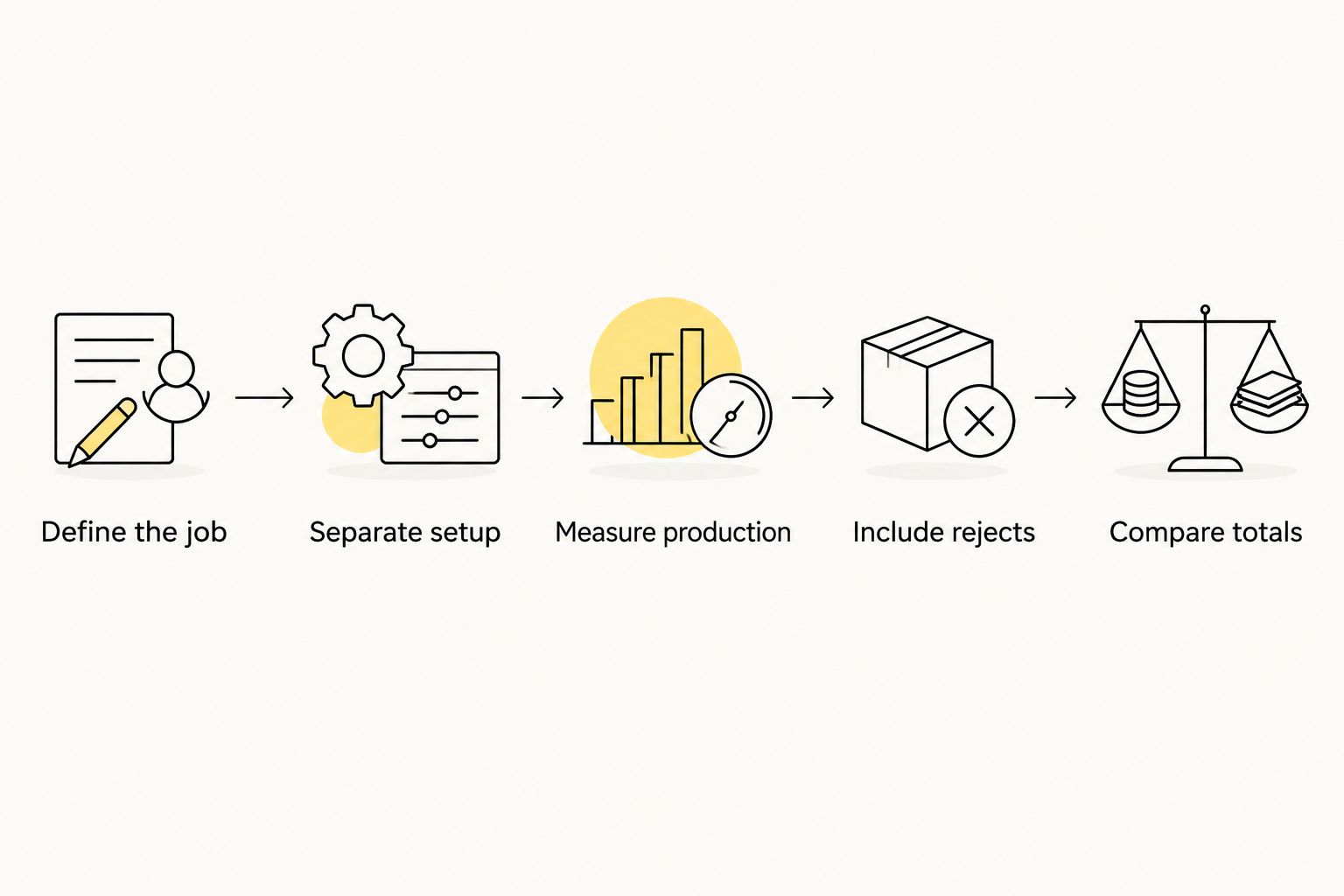
The worksheet also exposes scope differences. If a screen-print quote includes finished garments while a DTF quote includes only transfers, add the missing garment and application work before comparing totals. Do not label an incomplete quote the cheaper option.
Is there a break-even quantity for DTF and screen printing?
The break-even quantity is specific to the job and the shop. It occurs where the complete cost of producing the order by either method is equal. Different artwork, setup requirements, labor, or print locations change that point.
For a simple job with stable production costs, compare each method's setup cost plus its per-garment production cost multiplied by quantity. Use quantities from actual quotes or your measured workflow, not a universal shirt-count rule.
If a quote changes at quantity tiers, calculate the full order at each relevant tier instead. A single straight-line formula does not represent a tiered quote accurately. Keep the comparison tied to the quantity the customer will purchase.
Are DTF gang sheets cheaper than individual transfers?
Gang sheets are cheaper only when their complete usable-transfer cost is lower. Layout efficiency matters, but so do preparation, separation, sorting, and the number of graphics you will actually use.
For decorators buying rather than manufacturing transfers, DTF2GO ready-to-press DTF transfers suit shops that want to handle application without producing transfers in-house. Its PRINT & CUT DTF Transfers are a cut-to-size option for that workflow.
The benefit is receiving transfers already cut to size. The remaining work is garment preparation, accurate placement, pressing, and inspection; buying transfers does not eliminate those tasks. Compare DTF2GO with a sheet-based order on complete preparation and application cost, not the transfer format alone.
Is screen printing cheaper for repeat orders?
Screen printing's repeat-order advantage depends on the setup and production work required for that reorder. Confirm whether the artwork, garment, dimensions, colors, and placements remain unchanged. Then request the applicable repeat-order quote.
Do not price a possible future order into today's margin. For your 2026 quoting worksheet, record confirmed reorder terms separately from assumptions about future volume. That keeps the current job accountable for its own costs.
FAQ
What's cheaper, DTF printing or screen printing?
DTF generally favors short, multicolor runs, while screen printing benefits from repeating identical artwork across longer runs. Compare complete job costs, including setup, garments, application, rejects, and finishing, before selecting the cheaper method.
How much does DTF printing cost per finished shirt?
DTF cost per finished shirt is the complete job cost divided by accepted finished garments. Include the blank garment, transfer, freight, preparation, pressing, inspection, and finishing rather than using the transfer charge alone.
Does adding colors increase screen-printing costs?
Additional screen-printing colors require the corresponding separations and printing setup. DTF does not use a separate physical screen for each color, but you still need a quote for the actual artwork and dimensions.
Is there a fixed quantity where screen printing becomes cheaper?
There is no fixed break-even quantity that applies to every order. Setup, artwork, print locations, labor, and supplier quantity tiers determine the crossover for the specific job.
Does buying ready-to-press DTF transfers remove production labor?
Buying ready-to-press DTF transfers removes transfer manufacturing from your shop, not garment application. You still prepare garments, position graphics, operate the heat press, follow peeling instructions, and inspect the result.
What should I include when comparing DTF2GO with screen printing?
Compare DTF2GO transfers plus your garment and application costs with an equivalent complete screen-printing quote. Match artwork dimensions, quantities per design, print locations, finishing, and acceptance requirements.
Should I buy a DTF printer to reduce decoration costs?
A DTF equipment purchase requires a separate ownership-cost calculation. Include equipment, maintenance, consumables, production labor, and rejected transfers instead of comparing consumable costs alone with outsourced finished transfers.
One last thing
Calculate cost per accepted garment, not cost per attempted print. Rejects consume materials and labor without completing the customer's order. Leaving them out makes either method look more profitable than it is.
Before approving your next 2026 quote, check the denominator in your worksheet. It should represent finished garments the customer can accept—not transfers purchased, blanks loaded, or pieces you intended to produce. That distinction keeps the comparison tied to work you can invoice and deliver.


