


Choose DTF2GO if you need custom cut-to-size, ready-to-press DTF transfers for apparel production; choose DTF Transfers Now if you already have a qualified workflow with that supplier and no production problem to solve. This 2026 comparison separates a clear product-format fit from the pressroom results you should verify before switching.
- DTF2GO vs DTF Transfers Now comes down to cut-to-size requirements versus keeping an already-qualified supplier.
- Choose custom cut-to-size DTF transfers when your production plan calls for individual, ready-to-press designs.
- Choose DTF Transfers Now when your existing orders already meet your artwork, garment, and application requirements.
- Compare gang sheets using the same artwork and quantities; evaluate finished garments before changing suppliers.
Why this matters
A transfer supplier is part of your production process, not just a checkout decision. Your artwork, transfer format, garment construction, and heat-press setup all affect the finished job.
For a decorator building a 2026 workflow around individual designs, PRINT & CUT DTF Transfers match a cut-to-size requirement. For a shop with a proven supplier, changing sources creates a new application-validation task. Switch to solve a defined production problem, not to chase an unverified ranking.
Keep the comparison tied to your actual work. A corporate logo order, a roster with individual names, and a repeated merch graphic create different preparation and sorting tasks, even when all use direct-to-film transfers.
At a glance
| Dimension | DTF2GO | DTF Transfers Now |
|---|---|---|
| Best for | Apparel decorators, promotional product businesses, and print shops seeking custom cut-to-size transfers | Shops already obtaining acceptable results through an established workflow with this supplier |
| Order format | Custom cut-to-size transfers and a 31" DTF Gang Sheet UPLOADER | Confirm the format required for your specific order |
| Standout feature | Custom cut-to-size, ready-to-press DTF transfers | Existing process familiarity, if your shop already uses this supplier successfully |
| Artwork preparation | Match individual artwork or a print-ready layout to the selected format | Confirm file requirements before reusing production artwork |
| Press validation | Qualify the transfer on your actual garment and press | Retain a qualified setup; validate any changed transfer or garment |
| Finished-garment quality | Judge color, detail, adhesion, and hand on a pressed sample | Apply the same finished-garment checks |
| Pricing comparison | Compare a cut-to-size order with the relevant gang-sheet order | Request an equivalent order configuration before comparing totals |
| Supplier changeover | A candidate when custom cut-to-size production addresses a current need | The better continuity choice when an existing workflow already passes your checks |
The table distinguishes a stated product offering from a conditional operating advantage. An incumbent supplier wins continuity only when your own records show acceptable results. That is not a claim that its transfers print better.
DTF2GO fits a custom cut-to-size production requirement
DTF2GO is best for apparel decorators who need custom cut-to-size, ready-to-press DTF transfers. That is a product-fit verdict, not a blanket claim about color accuracy, wash performance, or delivery speed.
Cut-to-size transfers arrive as individual transfer pieces rather than a combined sheet that your shop must separate. That distinction belongs in your production plan. Decide whether you want individual transfers organized for application or a sheet layout managed through your own preparation process.
The advantage is a format that matches individual-design handling. The limitation is that cutting a transfer to size does not establish its performance on a particular garment. You still need correct artwork, placement, and application.
For promotional apparel, write the order around the finished decoration requirement. Specify which graphic belongs on which garment and keep that information with the job. A ready-to-press transfer does not replace a production ticket.
DTF Transfers Now wins continuity for an already-qualified shop
Choose DTF Transfers Now for continuity when your shop already gets acceptable results from that supplier. Your approved artwork, application records, and garment samples are stronger reasons to stay than a generic comparison headline is a reason to switch.
This advantage belongs to the existing relationship, not to an assumed competitor specification. If you have never ordered from the supplier, you do not yet have that continuity advantage. Treat it as a new qualification decision.
The benefit of staying is preserving a process that your team already understands. The drawback is that familiarity alone does not address a changing requirement. A new blank, a more demanding logo, or a different order format deserves a fresh check.
Name the problem before replacing the supplier. If your problem is transfer separation, assess cut-to-size ordering. If it is a color mismatch, compare pressed color samples. If it is placement inconsistency, review your application method rather than assuming a supplier change will fix it.
Gang sheets suit layout-led ordering, not automatic savings
The supplied catalog names a 32" DTF Gang Sheet BUILDER and a 31" DTF Gang Sheet UPLOADER. These are product names, not a basis for calculating usable print area, yield, or a competitor's equivalent capacity.
A builder and an uploader address different preparation routes. Before ordering, confirm whether you are arranging artwork in a builder or submitting a completed sheet layout. Do not assume that a file prepared for one route automatically satisfies the other.
A gang sheet combines designs into a shared layout. Its practical advantage is the ability to organize multiple graphics together; its tradeoff is the preparation and separation work that accompanies that arrangement. Cut-to-size ordering addresses a different handling requirement.
For a fair 2026 comparison, keep the design dimensions and requested quantities constant. Changing graphic size to fit a different layout changes the job you are comparing. Compare equivalent finished transfers, not sheet names alone.
Check orientation, spacing, and the number of usable designs in your submitted layout. A sheet containing the wrong mix of graphics is not a good production choice, regardless of how efficiently the artwork appears to fill the page.
Neither supplier wins artwork preparation by default
A supplier name does not make an unsuitable artwork file production-ready. Confirm the file requirements for the exact order format, then inspect the design at its intended decoration size.
Look closely at small lettering, fine lines, transparent areas, and unwanted background elements. These checks address the artwork itself. They do not require an invented resolution threshold or a claim that one supplier repairs files better.
Best for individual artwork: use the cut-to-size route when you want separate custom transfers. Best for a completed multi-design layout: use a gang-sheet submission route that accepts your prepared file.
Each route has a preparation burden. Individual designs still need correct dimensions and quantities; combined sheets still need a correct layout. Keep a final artwork version with the order so that repeat jobs do not drift between files.
For branded apparel, identify the reference your customer approved. A screen preview is not the finished garment, and a Pantone reference is not proof that either supplier will reproduce a particular color exactly. Approve the pressed result that will represent the customer.
Both suppliers belong behind the same press-validation gate
Use the supplier's current application instructions for the transfer you receive. Do not substitute a generic temperature, pressure, dwell time, or peel method from an unrelated transfer.
For a 2026 supplier qualification, assess 3 garment types if those types represent your actual production mix: cotton shirts, polyester shirts, and blended-fabric shirts. This is a suggested test plan, not a statement that every transfer suits every material. If your shop decorates only one blank, qualify that blank instead.
Keep the sequence simple:
- Artwork check: confirm design size, file version, and intended placement.
- Garment check: identify the actual blank and inspect the application area.
- Press check: follow the transfer-specific application instructions.
- Result check: inspect the finished decoration and record the outcome.
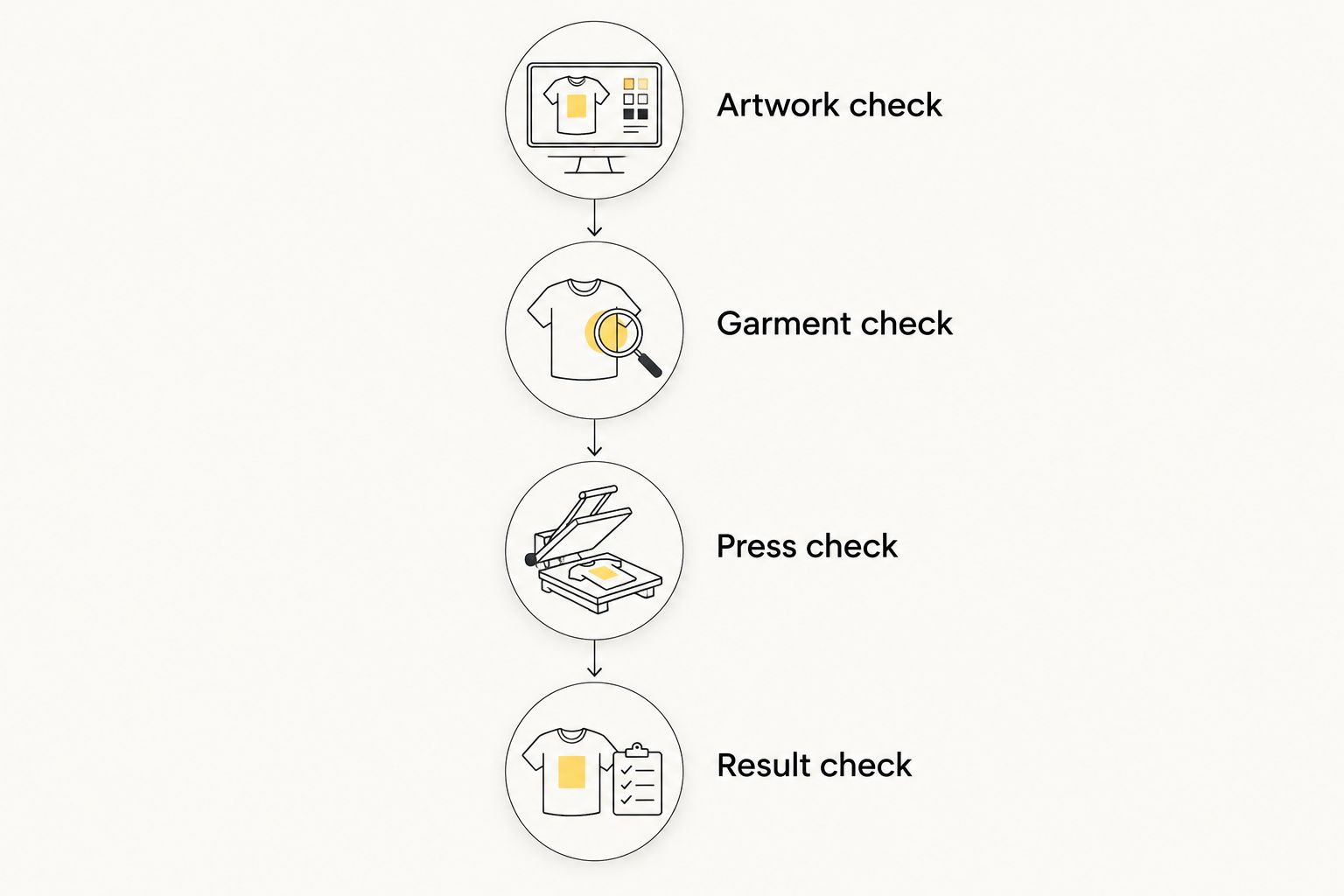
Record the press setup alongside the garment and transfer identification. A result without those details is difficult to reproduce. Use the same inspection criteria for both suppliers, while following each transfer's own instructions.
A supplier earns approval when the finished job meets your requirements. Neither a product title nor an attractive unpressed sample replaces that decision.
Finished-garment evidence wins over durability claims
Neither supplier earns a durability or hand-feel win from this comparison alone. Judge the decoration after application, not just the transfer while it is still on its carrier.
Inspect edge adhesion, fine-detail reproduction, visible color, and the feel of the decorated area. Compare the same artwork on the same blank whenever you want to isolate a supplier difference. Different graphics or garments create a different comparison.
For wash evaluation, follow the applicable care instructions and document the conditions you use. Do not turn an informal sample check into a published wash-life figure. A recorded observation is useful; an unsupported durability number is not.
There are tradeoffs in the artwork as well as the transfer. A large solid graphic and a more open design do not create the same decorated surface. Keep the design constant before attributing a hand-feel difference to the supplier.
Your acceptance criteria should reflect the customer order. Small logo lettering needs a detail check; a prominent brand color needs a color check. Approve what matters for the job instead of assigning a single universal quality score.
Pricing: compare the order configuration and your preparation work
A useful 2026 pricing comparison starts with an identical order specification. List the same artwork, finished dimensions, transfer quantities, and required format before reviewing either supplier's current order total.
The relevant distinction is individual-transfer ordering versus sheet-layout ordering. Those formats distribute preparation work differently. Confirm how each selected product calculates its order total rather than assuming that a product title establishes the billing model.
Cut-to-size ordering matches a requirement for separate transfer pieces. Gang-sheet ordering places multiple designs in a shared layout. Compare the finished transfers you need, not a sheet against an unrelated assortment of individual designs.
Include your own layout, separation, sorting, and application preparation in the decision. Measure that work in your shop; do not assign an invented labor-saving percentage. The purchasing choice should reflect the whole job.
For DTF Transfers Now, request the same configuration you are evaluating through the cut-to-size or gang-sheet route. Confirm quantities, file handling, and order terms directly before committing. An equivalent order is the starting point for a fair comparison.
Final verdict: choose the workflow that solves your actual requirement
Choose DTF2GO if you are a decorator building cut-to-size production
You need custom DTF transfers supplied as individual, ready-to-press pieces for apparel decoration. Your priority is matching that format to a documented production process, then qualifying the pressed result on your blanks.
Winner for this profile: the custom cut-to-size supplier. The offering fits the requirement. Approval for a specific garment still rests on application and finished-garment checks.
Choose DTF Transfers Now if you are an established, satisfied repeat buyer
You already have acceptable pressed results, documented application settings, and an ordering process that supports your jobs. You do not have a format or quality problem that requires a change.
Winner for this profile: DTF Transfers Now. Keep the qualified workflow and reassess when the garment, artwork, or production requirement changes.
One-glance scorecard
| Dimension | Winner |
|---|---|
| Custom cut-to-size requirement | The supplier with the stated cut-to-size offering |
| Existing qualified workflow | DTF Transfers Now, for an already-satisfied repeat buyer |
| Gang-sheet suitability | The format that matches your artwork-preparation route |
| Artwork preparation | No supplier-level winner; verify the selected route |
| Press validation | Same approval standard for both |
| Finished-garment quality | The supplier that passes your documented garment checks |
| Pricing | Compare equivalent current order configurations |
| Changeover decision | Switch only to address a defined requirement |
FAQ
Is DTF2GO better than DTF Transfers Now for custom apparel?
DTF2GO fits apparel decorators seeking custom cut-to-size, ready-to-press DTF transfers. Choose DTF Transfers Now for continuity if your existing workflow with that supplier already produces acceptable finished garments.
Should I switch DTF suppliers if my current transfers work?
Keep your qualified supplier when your current orders meet your production requirements. Evaluate a replacement when you can name a problem or a new requirement, then qualify the replacement on your actual blanks.
Are cut-to-size DTF transfers better than gang sheets?
Cut-to-size transfers are better for a requirement centered on individual transfer pieces; gang sheets suit a combined artwork layout. Compare preparation, separation, and sorting work before choosing the format.
What should I compare before ordering from either supplier?
Compare the same artwork, finished design dimensions, quantities, and garment requirements. Then evaluate the pressed samples using documented application instructions and consistent inspection criteria.
Which supplier has better wash durability?
Select the supplier whose pressed transfers pass your documented wash evaluation on the intended garment. Follow the applicable care instructions and retain the test conditions rather than relying on an unsupported wash-life claim.
How do I compare DTF transfer costs fairly?
Compare equivalent current order configurations and account for your own preparation work. Keep artwork size, design quantities, and required transfer format consistent when reviewing the order totals.
What is the best way to qualify a DTF supplier in 2026?
Qualify a DTF supplier using your production artwork, actual garment blanks, and heat press. Record the application setup, inspect the finished decoration, and retain an approved reference for repeat jobs.
One last thing
Keep the approved garment, not just the artwork file. A physical reference gives your team a target for color, placement, detail, and hand when the job returns.
For your 2026 supplier decision, write down the reason beside that reference: cut-to-size handling, an approved finished result, or continuity with an established process. That reason makes the next reorder a production decision rather than another search for a winner.


