


Choose DTF2GO if you want custom, ready-to-press cut-to-size DTF transfers; choose DTF NC if it already produces customer-approved results for your exact garments and artwork. This 2026 comparison separates a documented ordering fit from the practical advantage of keeping a proven production workflow.
- dtf2go vs dtf nc: choose documented ordering fit over an unsupported quality ranking.
- DTF2GO DTF transfers suit decorators seeking custom cut-to-size, ready-to-press apparel decoration.
- Keep DTF NC when your existing approved jobs justify staying with the established workflow.
- Compare identical artwork, garments, quantities, and finishing work before changing suppliers.
Why this matters
A transfer supplier affects more than the image on the shirt. Your ordering format determines who arranges artwork, who separates transfers, and how operators identify each design at the press.
The wrong comparison starts with a supplier name and ends with a blanket winner. The useful comparison starts with your actual job: garment, decoration size, artwork, quantity, deadline, and approval requirements. For your 2026 purchasing decision, treat print quality, preparation labor, and repeatability as separate questions.
DTF2GO DTF transfers are best for apparel decorators seeking custom cut-to-size, ready-to-press transfers. That is a specific fit, not a claim that another supplier prints worse.
At a glance
| Dimension | DTF2GO | DTF NC |
|---|---|---|
| Best for | Decorators seeking custom cut-to-size transfers | Existing customers whose exact jobs already meet approval requirements |
| Standout feature | Custom cut-to-size, ready-to-press format | An established workflow, if your shop already has one |
| Gang-sheet ordering | Listed builder and uploader products; print-ready DTF gang sheet ordering | Confirm current file and sheet requirements before comparing |
| Artwork preparation | Select the order format that matches your file preparation | Keep approved files and specifications consistent when reordering |
| Color and detail | Approve a physical transfer on the intended garment | Apply the same physical approval standard |
| Application and durability | Validate the complete transfer-and-garment combination | Validate the complete transfer-and-garment combination |
| Repeat production | Establish an approved reference before switching work | Retain the incumbent advantage when production already passes |
| Pricing model | Product-format ordering; compare the configured job | Compare a matched job quotation and its billing basis |
The competitor column deliberately distinguishes purchasing conditions from product claims. An existing approval history is a legitimate reason to stay; it does not establish a universal quality advantage.
Cut-to-size ordering wins when separation is the bottleneck
Choose the cut-to-size route when your priority is receiving individual transfers rather than separating a gang sheet. PRINT & CUT DTF Transfers is the listed product for that format. It fits a shop that wants custom transfers prepared for the next stage of apparel decoration.
The practical benefit is narrow and useful: separation is not another sheet-processing task for your operators. Placement, garment preparation, and correct application remain your responsibility. Ready-to-press does not mean every garment behaves identically.
The tradeoff is layout control. If you prefer arranging multiple designs together and managing their separation internally, a gang sheet is the format to evaluate instead. Do not choose individual transfers merely because the product name sounds easier; choose them because they match how your team handles work.
For a promotional-products business, make that decision at the job level. A mixed order with several decoration sizes needs clear identification regardless of how the transfers arrive.
An approved DTF NC workflow wins on continuity
Keep DTF NC for an established job when its transfers already meet your customer's approval and your production requirements. A proven incumbent has a practical advantage: your shop has a reference for what acceptable output looks like.
That recommendation is conditional on your own production record. It is not a claim about the company's equipment, delivery performance, service policies, or specifications.
Changing suppliers introduces another approval step. Even with unchanged artwork, you still need to check the finished decoration on the intended garment before treating the replacement as interchangeable.
The limitation runs both ways. Familiarity is not evidence that your current process is the best fit for every new job. If sheet separation, artwork preparation, or another task creates a recurring bottleneck, evaluate a different ordering format against that specific problem.
For 2026 repeat orders, keep the approved reference with the job record. A supplier switch should be an intentional production change, not an unnoticed purchasing substitution.
Gang-sheet fit depends on your files, not the widest label
The supplied catalog lists a 32-inch DTF Gang Sheet BUILDER, a 31-inch DTF Gang Sheet UPLOADER, and a 32-inch Dynamic Gang Sheet. These are distinct product listings; their names alone do not establish identical file requirements or usable print areas.
Use the ordering route that matches the work your team has already completed. If your designer supplies a finished gang-sheet layout, investigate the uploader requirements before placing the order. If your artwork consists of separate designs, review the builder's current requirements instead.
Before comparing either route with another supplier, confirm:
- Artwork size: Final decoration dimensions, not just document dimensions.
- Layout spacing: Enough separation for your intended handling method.
- Design quantity: The required count of each graphic.
- File requirements: Accepted format, transparency, and preparation instructions.
- Sheet requirements: The configured dimensions and applicable layout boundaries.
A wider product label is not a complete efficiency comparison. Empty space, mismatched counts, and unnecessary handling still affect the finished job. Compare the layout you will actually order, not an imagined fully occupied sheet.
Both suppliers belong behind the same artwork approval gate
Neither supplier should bypass artwork approval because a file looked correct on a monitor. A screen preview is useful for checking composition, but the finished garment is the relevant production reference.
Start with the same source artwork when evaluating suppliers. Keep the intended decoration size unchanged, and inspect text, narrow gaps, fine lines, solid areas, and gradients where those elements occur in the customer's design.
Do not create an artificially easy comparison graphic. A simple logo cannot answer questions raised by a detailed illustration, and a large chest print cannot establish whether small lettering remains acceptable.
The tradeoff is preparation time. A consistent approval process adds work before release, but skipping it leaves operators to discover problems during production. Your customer should approve the intended result, not a substitute example.
For color-sensitive work, keep the approved physical reference accessible. The goal is a repeatable acceptance decision rather than a memory of how the previous shirt looked.
Neither supplier wins color or durability without a matched check
A useful 2026 comparison separates color and detail from application and durability. They answer different questions: whether the decoration looks right, and whether the complete decorated garment performs as required.
For appearance, compare transfers on matching garments under consistent lighting. Inspect solid fills, edges, visible underbase, fine detail, and the relationship between printed colors and the customer's approved reference.
For application, follow each supplier's current instructions. Do not force identical pressing settings onto different transfers simply to make the procedure look controlled; instead, document the settings used for each sample.
For durability, evaluate finished garments according to the intended care instructions and your customer's acceptance requirements. Do not turn an initial visual inspection into a wash-life claim.
The honest verdict is an equal approval standard, not an invented performance tie. Either supplier must pass your job-specific checks before you assign customer work to it.
A matched trial makes switching a production decision
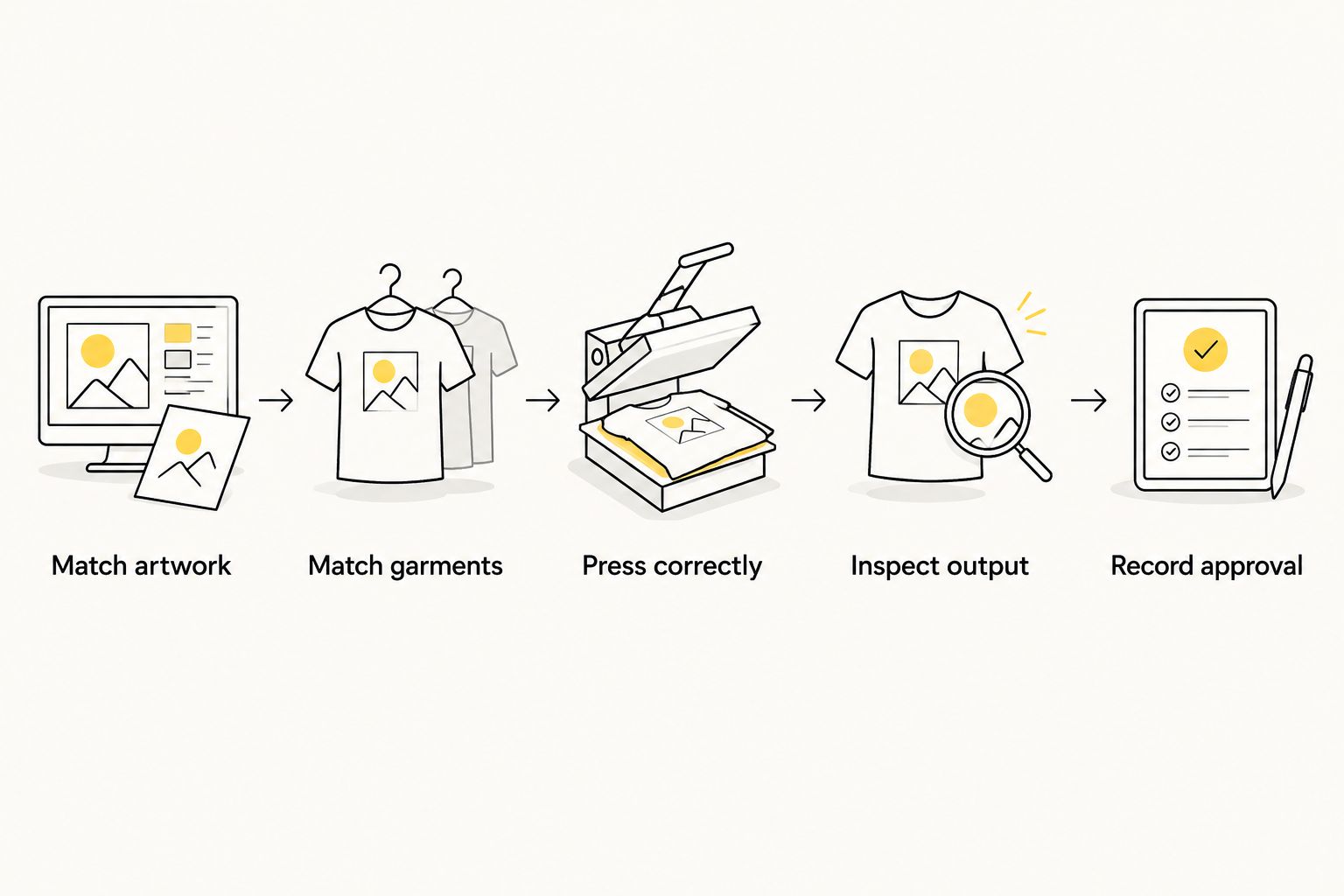
Use this sequence when you have a real reason to evaluate a replacement. It keeps purchasing, artwork approval, and press-floor acceptance connected.
- Match artwork: Use the same customer file and final decoration dimensions.
- Match garments: Use the intended blank, including its fabric and color.
- Press correctly: Follow the applicable transfer instructions and record the settings.
- Inspect output: Check appearance, placement, handling, and the required care performance.
- Record approval: Save the accepted result and the specifications needed to reproduce it.
Keep rejected samples as well as approved ones when they explain a production issue. A written note about the failure helps your team distinguish an artwork problem from an application problem during the next review.
This process also gives the incumbent a fair comparison. A replacement should solve the problem that triggered the trial without creating an unacceptable new one.
Pricing: compare the configured job and its billing basis
Compare complete jobs, not isolated product labels. Product-format ordering gives you different ways to configure the transfer work, but the purchase alone does not describe the labor required to finish the apparel.
For a useful 2026 quotation request, specify the same artwork, decoration dimensions, design quantities, garment application, and required order format. Ask each supplier to identify its billing basis and what the quotation includes.
Then compare the work retained inside your shop:
- Artwork arrangement before submission.
- Sheet separation after receipt.
- Sorting and identifying transfers for each garment.
- Application setup and production handling.
- Inspection and correction of rejected output.
Cut-to-size ordering prioritizes individual transfer preparation. Gang-sheet ordering keeps layout and separation decisions central to the comparison. Neither format is automatically the better economic choice for every job.
Predictability comes from a repeatable specification. Flexibility comes from choosing the format that suits the artwork and production plan. Ask for both quotation structures where relevant, then decide using the finished-job requirements rather than an incomplete comparison.
Final verdict: match the supplier to the production problem
Choose DTF2GO if you are building a cut-to-size workflow
Best for: apparel decorators and promotional-products businesses seeking custom, ready-to-press individual transfers. Start with the documented format advantage, then approve the result on your intended garment.
This is the stronger choice when receiving cut-to-size transfers addresses a real preparation task. Do not extend that recommendation into unsupported claims about faster delivery, better wash performance, or lower total job expense.
Choose DTF NC if your existing jobs already pass
Best for: established customers with approved artwork, garments, and application records. Keep the incumbent when its output meets the job requirements and switching does not solve a defined problem.
Reconsider that decision when the work changes. A new garment, different artwork, or a different ordering requirement deserves its own evaluation rather than automatic reliance on previous approval.
Decision scorecard
| Dimension | Winner |
|---|---|
| Best for | Match the supplier to the named production profile |
| Standout feature | Cut-to-size ordering for individual-transfer preparation; incumbent continuity for established work |
| Gang-sheet ordering | The format that fits the actual file and layout requirements |
| Artwork preparation | Equal approval requirement |
| Color and detail | Winner determined by the matched finished-garment check |
| Application and durability | Winner determined by job-specific validation |
| Repeat production | DTF NC when your existing workflow already passes |
| Pricing model | The matched quotation that fits the complete production plan |
FAQ
Is DTF2GO better than DTF NC for a print shop?
DTF2GO is a fit for print shops seeking custom cut-to-size, ready-to-press DTF transfers. Keep DTF NC for established work when your existing output already meets customer approval and production requirements.
Should I change transfer suppliers for repeat customer orders?
Change suppliers only after approving the replacement on the intended garment. Keep the source artwork, decoration dimensions, application record, and accepted physical reference together.
Are cut-to-size transfers better than gang sheets?
Cut-to-size transfers are better when you want individual transfers without separating a gang sheet. Gang sheets are the format to evaluate when your shop wants to arrange designs together and manage separation internally.
Which supplier produces more accurate colors?
A matched physical comparison is required to choose a color-accuracy winner for your job. Compare the same artwork on matching garments against the customer's approved reference.
Can I use the same heat-press settings for both suppliers?
Follow each supplier's current application instructions rather than assuming identical settings. Record the settings used on the garment you approve.
How should I compare transfer quotations?
Request quotations for matching artwork, dimensions, quantities, and order formats. Include your internal layout, separation, sorting, application, and inspection work in the purchasing decision.
What should I check before ordering a gang sheet?
Check final artwork dimensions, design counts, spacing, file requirements, and the configured sheet specifications. Do not assume a product's width label describes every layout boundary.
One last thing
Change the supplier without changing the artwork and garment at the same time. Otherwise, a different result leaves you with several possible causes and no clean comparison.
Keep the first approved replacement garment beside the incumbent reference. That physical pair is more useful for your next purchasing decision than a general claim that either supplier is better.


