


Choose DTF2GO if you want custom cut-to-size, ready-to-press DTF transfers or a gang-sheet ordering workflow; choose DTF Center if its transfers already meet your documented production requirements and switching offers no demonstrated improvement. This 2026 comparison separates confirmed ordering options from the press-floor checks that should decide your supplier.
- DTF2GO vs DTF Center: choose cut-to-size ordering for individual transfers; retain a proven supplier when switching adds no demonstrated benefit.
- DTF2GO DTF transfers suit apparel decorators buying custom, ready-to-press graphics.
- Compare gang sheets by usable artwork output and handling work, not sheet dimensions alone.
- Approve color, adhesion, and garment compatibility before committing customer production.
Why this matters
DTF2GO DTF transfers are a fit for apparel decorators who want custom graphics supplied cut-to-size and ready to press. That is a specific purchasing advantage, not proof that every transfer will outperform a competitor on every garment.
Your supplier decision reaches beyond the printed image. Someone must prepare artwork, separate designs, sort placements, press garments, and approve the finished order. Compare those steps before treating two transfer quotes as equivalent.
Start with the format your shop actually needs: individual cut-to-size DTF transfers suit an order organized around separate graphics rather than a combined sheet. For your 2026 supplier review, use the same artwork and garment specification throughout.
At a glance
| Dimension | DTF2GO | DTF Center |
|---|---|---|
| Best for | Decorators seeking custom cut-to-size transfers and gang-sheet options | Existing buyers whose approved production already meets requirements |
| Standout feature | Custom transfers supplied cut-to-size and ready to press | Judge the feature that solves your actual production constraint |
| Artwork workflow | Builder and print-ready uploader products are listed | Confirm the submission method for your intended order |
| Gang-sheet selection | Named builder, uploader, and dynamic gang-sheet products | Confirm dimensions, layout requirements, and finishing directly |
| Color approval | Evaluate a pressed sample against your approved reference | Apply the same approval standard |
| Adhesion and garment fit | Test the intended garment using the supplied instructions | Apply the same garment-specific test |
| Supplier continuity | A new qualification process if you are switching | Advantage when your existing workflow is already approved |
| Pricing model | Compare individual-transfer and gang-sheet order formats | Confirm the billing basis before comparing quotes |
The table is a buying framework, not a laboratory ranking. Ordering options establish workflow fit; pressed samples establish whether the finished decoration meets your requirements. Keep those judgments separate.
Cut-to-size ordering wins when you need separate graphics
Individual transfers make sense when your production order is organized by placement, garment, or customer. You receive the graphics in a format intended for separate application instead of planning around a combined sheet.
That matters for mixed artwork. A shop handling different logos or placement sizes should decide whether it wants to manage a sheet layout and separation step before ordering.
Choose cut-to-size ordering when individual graphics match your production handoff. Do not assume that format automatically produces the lowest total job expense; compare the actual order and the work your team performs after receipt.
The tradeoff is straightforward:
- Pro: Separate transfer units match jobs organized around individual placements.
- Con: You still need an accurate count, placement plan, and garment assignment.
- Best for: Decorators who want custom graphics supplied as individual ready-to-press transfers.
A gang sheet remains a valid alternative. If your team already builds layouts and separates transfers efficiently, changing formats needs a measurable production reason.
A proven DTF Center workflow wins on continuity
For an existing DTF Center buyer, an approved production history is a reason to stay. If your current transfers meet the customer's visual standard, suit the garment, and arrive within the schedule you have confirmed, a supplier change must solve a specific problem.
Choose DTF Center for continuity when your own completed jobs demonstrate that it meets the requirement. This is an incumbent-workflow advantage, not a claim about its equipment, policies, or universal performance.
Switching introduces qualification work. Your team must review instructions, press representative garments, check the decoration, and approve the result before treating a new source as interchangeable.
- Pro: You retain a workflow your team has already qualified, if that qualification exists.
- Con: Familiarity does not establish that the current ordering format is the best fit for every new job.
- Best for: Repeat-order decorators with an approved supplier and no unresolved production issue.
For 2026 repeat programs, write down what must stay consistent. An approved reference is more useful than a general preference for a familiar supplier.
Builder and uploader options suit different artwork workflows
The catalog names distinguish different ordering routes: 32-inch DTF Gang Sheet BUILDER, 31-inch DTF Gang Sheet UPLOADER, and 32-inch Dynamic Gang Sheet. Those dimensions appear in product names; do not treat them as a guarantee of usable printable width or a complete sheet specification.
The practical distinction is artwork responsibility. A builder route is relevant when you need to assemble a layout; a print-ready route is relevant when your team already prepares the combined artwork. Confirm the current requirements before submitting either format.
The print-ready DTF gang sheet is the relevant ordering route to review when your production artist prepares the sheet in advance. Check the accepted file specifications, final dimensions, and layout rules against the actual job.
Choose the workflow that matches where layout work already happens. Moving artwork preparation between your designer and an ordering interface does not remove responsibility for correct scale, quantities, and placement counts.
Check the layout before submission
- Artwork size: Confirm each design at its intended finished dimensions.
- Design count: Match every graphic to the production order.
- Cutting access: Leave the separation space required by the supplier.
- Order identity: Keep a record connecting the submitted artwork to the customer job.
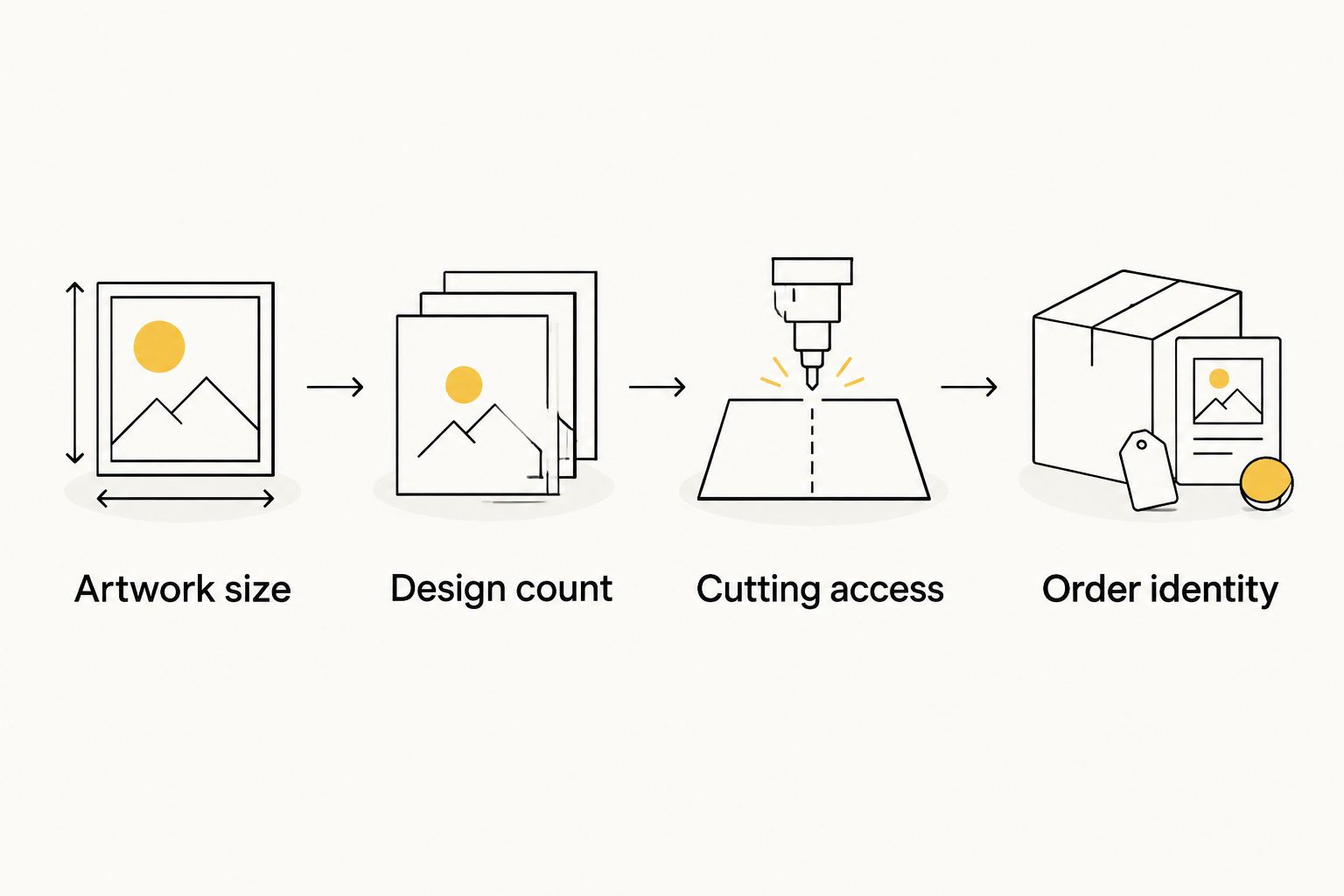
These checks apply regardless of supplier. A correctly printed sheet cannot correct a design that was submitted at the wrong size.
Neither supplier wins color accuracy without a pressed comparison
Color approval belongs on the finished garment. A file on a monitor and an unpressed transfer are not substitutes for the decoration your customer will receive.
Use the same artwork, garment color, and viewing conditions when evaluating competing transfers. If the customer has an approved physical reference, compare against that reference rather than relying on memory.
Treat color as an unassigned category until the samples pass your approval standard. A confident supplier description does not replace a job-specific check.
Record what you are evaluating:
- Solid brand-color areas.
- Fine detail and small lettering.
- Light graphics against dark fabric.
- Gradients and transitions within the artwork.
- The appearance of the approved print after application.
For a 2026 branded-apparel program, retain an approved garment with the job record. That gives your team a physical reference when reviewing subsequent orders.
Neither supplier wins adhesion without the intended garment
Adhesion is a system result: transfer, garment, press setup, and application instructions all matter. Comparing two suppliers on different blanks does not isolate transfer performance.
Press each sample according to its own instructions. Applying one supplier's settings to another supplier's transfer creates a different test and weakens the comparison.
Keep garment compatibility tied to the actual blank, not a broad fabric label. A successful test on one garment does not establish a result for every other garment in your shop.
Check edge adhesion, visible defects, hand feel, and the decoration after the care procedure intended for that order. Record the blank identification and the settings used so that another operator can repeat the application.
If both samples meet the same standard, call this category a tie. There is no reason to manufacture a quality winner when the meaningful difference is order handling or supplier continuity.
Pricing: compare the order basis before the total
Individual-transfer orders and gang-sheet orders organize the purchase differently. Before comparing either supplier, establish whether the quote covers separate graphics, a combined sheet, or another clearly specified unit.
For individual transfers, compare the same design dimensions and quantities. For gang sheets, compare the actual layout and number of usable graphics, not just the sheet's outside dimensions.
Ask DTF Center to identify its current billing basis for the proposed order. Then request an equivalent specification from the other supplier rather than assuming similarly named options include the same work.
The useful comparison is the complete job, including your handling work. A sheet-based order leaves layout and separation decisions to account for; a cut-to-size order still needs counting, sorting, and placement control.
Use a quote checklist:
- Identical artwork and finished graphic dimensions.
- Identical quantities for every design.
- Clearly identified sheet or individual-transfer format.
- Confirmed finishing responsibilities.
- Confirmed production and delivery requirements.
Keep current commercial terms with your 2026 purchase record. Do not carry assumptions from an unrelated order into a new comparison.
Final verdict: choose the production fit, not a blanket winner
Choose DTF2GO if you want cut-to-size ordering or gang-sheet options
Best for: apparel decorators, promotional product businesses, and print shops buying custom ready-to-press transfers. The confirmed catalog includes individual cut-to-size transfers alongside builder, uploader, and dynamic gang-sheet products.
Choose this route when those formats match the work your team needs to hand off. Qualify the finished transfer on the intended garment before committing a customer run.
The limitation is equally clear: the catalog alone does not establish better color, longer durability, or faster delivery than DTF Center.
Choose DTF Center if your approved workflow already meets the job
Best for: existing buyers with documented, satisfactory production results. Retain DTF Center when continuity protects an approved repeat order and no demonstrated improvement justifies a change.
For a new buyer without that history, this continuity advantage does not exist. Compare samples, order requirements, and the complete workflow before selecting either supplier.
The limitation: retaining an incumbent without reviewing a changed garment or artwork specification leaves a new requirement untested.
One-glance scorecard
| Dimension | Winner |
|---|---|
| Best for custom cut-to-size purchasing | Client's confirmed ordering format |
| Standout feature | Cut-to-size, ready-to-press format when separate graphics are required |
| Artwork workflow | Builder or uploader route that matches your artwork preparation |
| Gang-sheet selection | Confirmed catalog options; no comparative performance winner |
| Color approval | Tie until matched samples establish a difference |
| Adhesion and garment fit | Tie until garment-specific testing establishes a difference |
| Supplier continuity | DTF Center, for existing approved workflows |
| Pricing model | Decide from equivalent job specifications and current terms |
FAQ
Is DTF2GO better than DTF Center for custom DTF transfers?
DTF2GO is a fit when you want custom cut-to-size, ready-to-press transfers or its listed gang-sheet ordering options. DTF Center is the continuity choice when your existing, documented production results already meet the job requirements.
Should I choose individual transfers or a gang sheet?
Choose individual transfers when separate graphics match your production handoff; choose a gang sheet when your team wants to manage a combined layout. Include layout preparation, separation, counting, and sorting in the decision.
Does a larger gang-sheet name guarantee more usable artwork?
No. Confirm usable printable dimensions, layout requirements, and the number of finished graphics before comparing sheets. A named outside dimension does not establish the output of your particular layout.
Which supplier has better DTF color accuracy?
Decide color accuracy from matched, pressed samples evaluated against your approved reference. Use the same artwork and garment specification rather than comparing different designs or blanks.
Can I use the same heat-press settings for both suppliers?
Follow each supplier's instructions rather than assuming the settings are interchangeable. Record the settings and garment used when qualifying each transfer.
How do I compare transfer quotes fairly?
Request quotes for identical artwork dimensions, quantities, and finishing requirements. Confirm the billing unit and include the handling work your shop performs before pressing.
Should I change suppliers for a repeat apparel order?
Change suppliers when a qualified alternative solves a documented requirement better than your current workflow. Keep the incumbent when approved results already meet the specification and switching offers no demonstrated improvement.
One last thing
Keep the approved garment, not just the artwork file. The file records what you submitted; the garment records the result you accepted. Store both with the job specification so your next order has a concrete approval target.


