


Yes—heat used to apply DTF transfers can trigger dye migration on polyester, allowing garment dye to discolor the transfer, especially its white and light-colored areas. It is not inevitable, but a clean print immediately after pressing does not prove lasting color stability: qualify the exact garment and transfer combination before production.
- DTF dye migration polyester checks must assess garment dye movement, white-underbase discoloration, and adhesion separately.
- Heat application can mobilize polyester dyes; a white underbase is not automatically a dye blocker.
- Test the actual garment color and transfer together, then inspect again after cooling and holding.
- DTF2GO supplies ready-to-press DTF transfers for decorators; polyester compatibility still requires a garment-specific test.
Does DTF printing cause dye migration on polyester?
DTF application can trigger polyester dye migration; DTF ink is not necessarily the source of the unwanted color. Heat increases dye mobility in polyester, and garment color can move into the applied decoration. Disperse dyes used to color polyester are central to this problem.
Use the location and appearance of the defect to separate migration from other heat-press issues. A tinted transfer, a shiny platen-shaped mark, and a lifting edge need different corrections.
| What you see | What it indicates | What to check next |
|---|---|---|
| White artwork picks up the garment's hue | Consistent with dye migration | Compare against an unapplied transfer and a control garment |
| Fabric darkens or becomes shiny around the design | Heat or pressure marking, not proof of migration | Inspect the undecorated fabric and platen footprint |
| Edges lift without a color shift | An adhesion problem, not proof of migration | Check application instructions, pressure, and fabric compatibility |
| A garment pattern appears within light artwork | Consistent with patterned dye migrating into the decoration | Test that exact printed fabric with a suitable transfer system |
Why this matters
A polyester job has to pass both a bond check and a color check. Strong adhesion does not establish dye resistance, and a bright white print does not establish wash performance.
For your 2026 production checklist, treat fabric composition, garment color, and transfer construction as separate approval fields. The guide to heat-pressing DTF transfers on polyester covers the application side; migration testing determines whether that application also preserves the intended artwork color.
Approve the finished garment, not just the transfer. An acceptable result on a cotton tee does not qualify the same artwork on a polyester jersey.
Why dye migration on polyester varies
Polyester is a fabric category, not a uniform decoration surface. Different garments use different dyes, finishes, and manufacturing processes, so a successful job does not automatically qualify another style or color.
The production variables that matter are:
- Garment dye system. Dye chemistry and how well the dye is fixed influence its movement during heat application.
- Fabric coloration. Sublimated patterns and deeply colored polyester deserve direct testing beneath white or pale artwork.
- Heat exposure. Application temperature, dwell, prepressing, and finishing presses contribute to the garment's total heat history.
- Transfer construction. White ink supplies opacity; a purpose-designed migration barrier serves a different function.
- Artwork contrast. A small amount of garment-colored contamination is easier to see in white lettering than in a similarly colored graphic.
- Inspection timing. Discoloration is not always fully apparent when the carrier first comes off.
Do not turn those factors into a blanket rule that every dark polyester garment fails. Risk identifies what needs testing; it does not replace the test.
Does a white DTF underbase stop polyester dye migration?
A white DTF underbase does not, by itself, establish dye-blocking performance. Its primary role is to provide an opaque foundation so the printed colors remain visible on the garment.
Blocking garment dye requires the appropriate transfer construction. A transfer can look opaque at application and still become tinted if garment dye enters that layer.
When you ask a supplier about a polyester job, distinguish these questions:
- Is the transfer suitable for application to this fabric?
- Has the transfer been evaluated for dye migration on this garment type?
- Does the transfer include a migration-control layer or formulation?
- Which application instructions and testing procedure apply?
For a 2026 qualification record, keep the supplier's answer with the garment style, color, and test result. A general claim about color vibrancy does not answer a question about resistance to garment dyes.
How do you test polyester before a DTF production run?
Use the production garment and production artwork—not an unrelated scrap. Include white or another light area in the test because it makes garment-colored contamination easier to identify.
Start with 1 test garment per unqualified style-and-color combination as an initial screening recommendation, not a statistical sampling standard. Expand testing when the order contains different garment lots, constructions, or suppliers.
- Identify the blank. Record the manufacturer, style, color, fabric composition, and available lot information. Retain an undecorated reference from the same supply.
- Confirm instructions. Obtain the transfer's application requirements and the garment's decoration restrictions. If they conflict, resolve that conflict before pressing.
- Check the press. Verify platen temperature using a method suitable for your equipment. Record pressure and dwell settings rather than relying on memory.
- Press the sample. Follow the approved application sequence, including the specified peel and any required finishing press. Record every heat cycle.
- Inspect the result. Compare the decoration with an unapplied transfer and the garment reference under consistent lighting. Check color and adhesion separately.
- Hold and recheck. Reinspect after cooling and after the hold interval agreed with your supplier or customer. Complete the required laundering evaluation before releasing production.
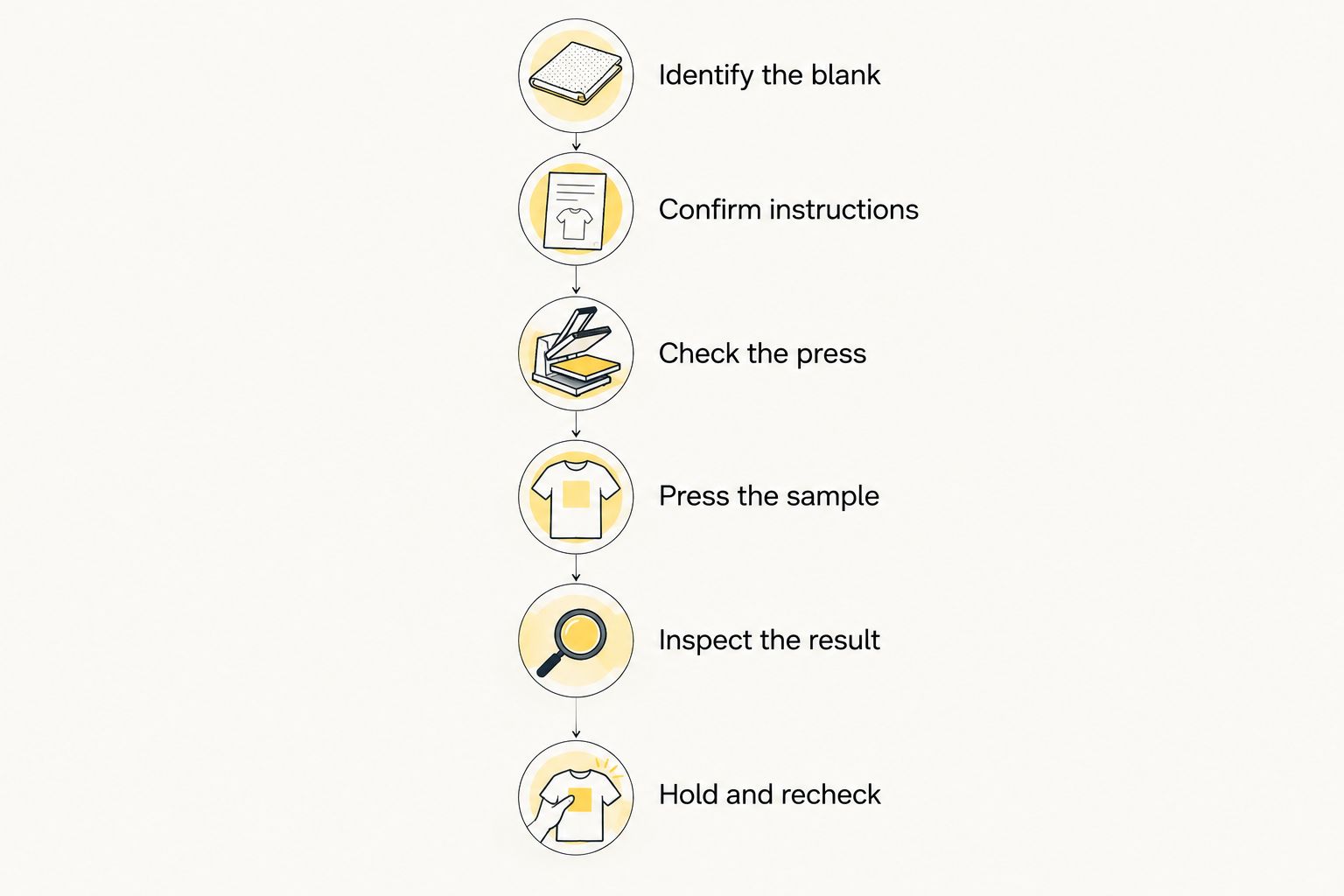
Use 2 inspection stages at minimum in your internal checklist: after cooling and after the agreed hold interval. That is a process recommendation, not a promise that every migration problem will appear within a fixed window.
Keep the failed sample. A physical comparison helps the supplier distinguish garment dye contamination from an artwork, ink, or application defect.
What should you change if the test shows bleeding?
Stop the run and isolate the failed combination. Do not add more heat simply because the decoration looks wrong; additional heat does not remove migrated garment dye.
Choose the correction according to the failure. These approaches address different parts of the process and are not interchangeable.
| Approach | Best for | Benefit | Limitation |
|---|---|---|---|
| Supplier-approved lower-temperature application | A transfer system designed to bond at reduced heat | Reduces thermal exposure | Arbitrarily lowering settings can compromise adhesion |
| Migration-control transfer system | A garment that discolors a standard transfer | Addresses dye movement through transfer construction | Requires supplier confirmation and garment testing |
| Alternative blank | A style or color that repeatedly fails qualification | Removes the problematic garment from the job | Requires customer approval and a fresh decoration test |
| Revised heat sequence | A process with unnecessary repeated pressing | Removes avoidable heat exposure | Does not make an unsuitable transfer dye-resistant |
Change 1 process variable per trial when troubleshooting. That recommendation keeps the result interpretable: if you change the blank, transfer, temperature, and dwell together, you cannot identify which change solved the problem.
Record the successful combination as a complete recipe. Your 2026 press log should identify the transfer, garment, settings, peel method, finishing sequence, and inspection outcome—not simply say that polyester passed.
Is lowering the heat enough to prevent dye migration?
Lowering heat is not a universal fix for polyester dye migration. It helps only when the transfer can still form the required bond under the revised application conditions.
The adhesive needs its specified application window. Pressing below that window to preserve white artwork can exchange a color problem for a peeling problem.
Ask the supplier for an approved low-temperature process or a transfer intended for migration-prone fabric. Then repeat both color-stability and adhesion checks; neither result substitutes for the other.
Do not compensate for a temperature change by inventing a longer dwell. Temperature and time interact, and an improvised adjustment changes the garment's heat exposure again.
Can you fix a DTF transfer after polyester dye has migrated?
Do not treat reheating as a cure for migrated dye. Once garment color has contaminated the decoration, another press does not restore the original white ink.
Covering the defect with another transfer also needs qualification. It adds another layer and another heat cycle without establishing that the underlying dye movement has stopped.
For a customer order, separate salvage testing from approved production. Keep failed garments out of the finished stack, document the defect, and establish a passing blank-and-transfer combination before restarting.
If replacement blanks are required, test them too. A matching catalog color name does not prove that a new garment supply will behave identically under the press.
Choosing ready-to-press transfers for polyester work
DTF2GO is best suited to apparel decorators and print shops buying custom, ready-to-press DTF transfers rather than producing transfers in-house. Its PRINT & CUT DTF Transfers provide a cut-to-size format for that workflow.
The production benefit is straightforward: you receive transfers prepared for heat application instead of printing and cutting them yourself. The limitation is equally important: ready-to-press describes the supplied format, not automatic dye-migration protection for every polyester blank.
When discussing a polyester order with DTF2GO, identify the garment manufacturer, style, color, composition, and whether the fabric is sublimated. Ask which application instructions apply and whether the proposed transfer is appropriate for the migration risk.
Keep the approval specific. Qualification of a white logo on one jersey does not establish a guarantee for every athletic garment in your catalog.
What should your polyester approval record contain?
Build a usable job record, not a collection of press photos without context. A photograph shows appearance; it does not identify the fabric, heat history, or inspection timing unless you record those details alongside it.
For repeat orders in 2026, retain:
- Garment manufacturer, style, color, composition, and available lot details.
- Transfer identification and the supplier instructions used.
- Actual application settings, peel method, and finishing sequence.
- Inspection dates and observations before and after holding.
- Laundering procedure and the resulting color and adhesion observations.
- The approved sample or a clearly identified retained reference.
Requalify when a relevant input changes. A new blank, transfer construction, or application instruction changes the combination you previously approved.
FAQ
Can DTF transfers bleed on polyester even when they stick properly?
Yes. Adhesion and dye migration are separate performance checks: a firmly bonded transfer can still become tinted by garment dye. Inspect both before approving production.
Why did my white DTF print turn pink on a red polyester shirt?
Red garment dye migrating into the white decoration is a likely cause. Compare the applied print with an unapplied transfer and test the exact garment with your supplier's recommended system.
Does every polyester shirt need a dye-blocking DTF transfer?
No. Polyester composition alone does not establish that a garment requires a dye-blocking transfer. Qualify the exact blank, color, transfer, and application process.
What's the safest temperature for pressing DTF onto polyester?
There is no universal safe temperature for every polyester garment and DTF transfer. Use the transfer supplier's approved instructions, confirm the garment's restrictions, and verify the finished result.
Can polyester dye migration appear after the transfer cools?
Yes. A transfer that looks acceptable immediately after pressing can show discoloration later. Include a documented hold and reinspection step rather than approving the job at peeling.
Are DTF2GO ready-to-press transfers automatically dye blockers?
Ready-to-press describes the application format, not verified dye-blocking performance. Confirm suitability for your polyester garment with DTF2GO and test the proposed combination before production.
Can I prevent dye migration by pressing for less time?
Reducing dwell without supplier approval is not a reliable prevention method. Insufficient application can weaken adhesion, so use an approved process and evaluate color stability separately.
One last thing
The most useful migration test is the one that preserves a comparison. Keep an unapplied transfer, an undecorated garment reference, and the pressed sample clearly identified so you can locate where the color changed.
For your next polyester job in 2026, make that comparison part of release approval. A print that looks good on the press table is a promising sample—not a completed qualification.


