


You can screen print over a DTF transfer design only when the screen ink is compatible with the transfer surface and the complete decoration survives curing and laundering tests. Do not treat an applied DTF transfer as an ordinary blank garment: you are printing onto an existing decoration, and the additional curing cycle must suit the transfer, screen ink, and fabric.
- Screen print over DTF transfer designs only after validating ink adhesion, curing compatibility, and wash performance.
- Separate print areas avoid direct ink-on-transfer contact but still require heat compatibility checks.
- DTF2GO DTF transfers suit decorators ordering ready-to-press artwork; they do not establish compatibility with an added screen-printed layer.
- A clean-looking print is not proof that the layered decoration will survive laundering.
Why this matters
A hybrid garment and a layered print are different production jobs. Screen printing a back graphic and applying a DTF chest logo keeps the decorations apart; screen printing directly across that chest logo creates another bonding surface to evaluate.
For your 2026 production plan, distinguish those jobs before approving artwork. The broader DTF printing versus screen printing comparison helps you choose a primary method; combining the methods requires a separate qualification process.
The practical question is not whether a squeegee can deposit ink on the design. It is whether the finished stack remains attached, flexible, and visually acceptable after the entire production and care sequence.
Can you screen print over a DTF transfer design?
Yes, conditionally—not as an assumed production-compatible process. The screen ink must adhere to the exposed DTF print surface, cure according to its manufacturer's requirements, and remain compatible with the underlying transfer and garment.
Use the layout to decide what you actually need to validate:
| Decoration approach | Best for | Advantage | Limitation | Production recommendation |
|---|---|---|---|---|
| Screen ink directly over DTF | A deliberately layered effect with supplier-supported materials | Places the screen-printed element directly on the existing design | Requires validation of ink-to-transfer adhesion and the complete heat sequence | Test before approval |
| Screen print and DTF in separate areas | Artwork that does not require overlap | Avoids direct bonding between screen ink and the transfer surface | Existing decorations still need protection from subsequent processing | Prefer when the layout allows |
| Rebuild the artwork with one decoration method | A unified graphic without a necessary layered effect | Removes the ink-on-transfer compatibility question | Requires revised artwork and a new production setup | Prefer for an unqualified combination |
No table can approve a specific ink and transfer pairing. Approval belongs to the actual combination of materials, equipment, artwork coverage, and processing conditions you intend to use.
What surface does the screen ink touch?
After you apply a DTF transfer and remove its carrier, the exposed decoration is not bare textile. Screen ink deposited over that area contacts the transfer's printed surface rather than the garment fibers.
That distinction changes the adhesion question. An ink described for cotton or polyester is not automatically approved for printing onto a finished DTF decoration, even when that decoration sits on a compatible shirt.
A cured print also does not automatically accept another ink layer. Cure and intercoat adhesion are separate requirements. Ask the screen ink manufacturer about the actual substrate: an applied DTF print, not simply the fabric underneath it.
Direct overlap: qualify the complete print stack
Choose direct overlap only when the design genuinely needs it. A border crossing a transfer edge, a screen-printed accent over a graphic, and a complete overprint are different test conditions because they place ink on different surfaces and boundaries.
Send your ink supplier the transfer information and proposed processing sequence. Request guidance on substrate compatibility, curing requirements, and an appropriate adhesion evaluation; do not substitute a general textile-ink recommendation.
Your 2026 job record should identify the exact ink, any approved additives, the transfer, the garment, and the order of operations. A successful sample with a different blank or ink formulation does not qualify the proposed job.
Inspect the overlap boundary closely. If the screen print crosses from fabric onto the DTF design, evaluate both areas and the transition rather than judging the graphic as a single flat surface.
Separate print areas: avoid the added bonding interface
Keeping screen ink off the DTF design removes the need for that ink to bond directly to the transfer. This is the preferred layout when direct overlap adds no necessary visual effect.
It does not remove the processing question. A transfer already on the garment still experiences any later heat exposure that reaches it, and a cured screen print still needs evaluation if subsequent transfer application exposes it to heat and pressure.
Plan the sequence around the instructions for both decoration systems. Protect existing decoration as directed by its supplier, and check whether your platen arrangement and garment loading keep unrelated areas out of the application zone.
Do not assume that reversing the order solves every problem. Screen printing first changes which decoration experiences the later operation; it does not establish compatibility by itself.
Why screen-print-over-DTF results vary
The result depends on the materials and processing sequence, not on the method names alone. Evaluate these factors before approving a hybrid job:
- Exposed transfer surface: Screen ink must bond to the finished decoration where the artwork overlaps. Fabric compatibility does not answer this question.
- Screen ink chemistry: Plastisol, water-based, and specialty formulations have different processing requirements. Use guidance for the exact ink, not its broad category alone.
- Complete heat sequence: Include transfer application, screen ink curing, flash exposure where applicable, and any specified finishing press. Review the sequence as a whole.
- Garment construction: Fiber content, stretch, surface treatments, and heat sensitivity belong in the evaluation. Use the actual production blank.
- Artwork coverage: A small accent and a broad overprint create different decorated areas. Test the intended overlap and the boundary between methods.
- Care conditions: Judge the finished combination under the intended garment-care instructions. Initial appearance does not establish laundering performance.
There is no universal temperature or dwell time for this combination. Use the material manufacturers' instructions, and do not lower a screen ink's required cure simply to avoid exposing the transfer to heat.
How do you test screen printing over a DTF transfer?
Use a controlled sample process before committing customer garments. For a 2026 qualification run, document the actual materials and processing conditions so you can repeat the approved result rather than rely on memory.
- Confirm materials. Identify the garment, transfer, screen ink, and any ink additives. Ask the relevant suppliers whether the proposed layered use has material-specific support.
- Map the sequence. Write down every application, flash, cure, cooling, and finishing stage that applies. Check the instructions for each material against the complete sequence.
- Print samples. Reproduce the intended artwork coverage, overlap boundaries, garment loading, and equipment settings. Include reference samples of each decoration method alone on the same blank.
- Inspect adhesion. Allow the decoration to cool and follow the applicable evaluation guidance. Check the overprint, transfer edges, fabric transition, flexibility, and visible changes.
- Wash and review. Follow the intended care instructions and inspect the layered sample against the reference decorations. Approve only the tested combination and retain the job record.
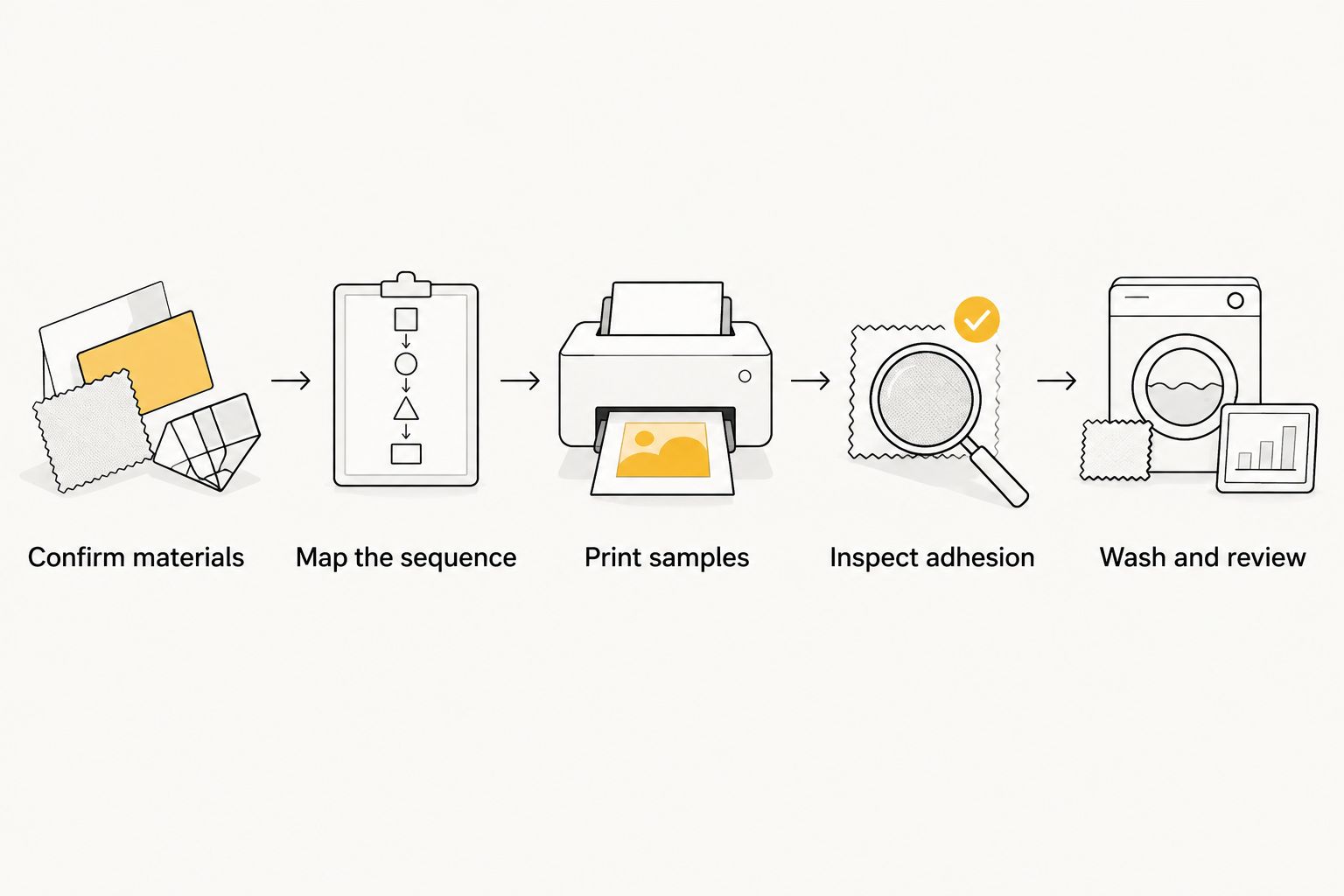
A reference sample helps you isolate the failure. If the screen-printed reference performs acceptably but the overprint separates from the DTF surface, investigate the added interface rather than assuming the fabric is responsible.
If the DTF-only reference changes after the proposed additional heat exposure, investigate that exposure before continuing. Do not compensate for an unexplained failure by changing several settings at once; preserve a clear record of what changed and why.
What should count as a failed sample?
Reject a sample that shows separation between layers, transfer-edge lifting, unacceptable cracking, tackiness, or a visible finish change outside the customer's approved standard. Treat defects at the overlap boundary as production defects, not as an unavoidable feature of hybrid decoration.
A sample also fails qualification when you cannot reproduce its processing conditions. An attractive result without a usable job record is not a repeatable production specification.
Keep the approval criteria in your 2026 job documentation. Changing the ink, blank, transfer, artwork coverage, or sequence calls for reviewing whether the existing approval still applies.
When ready-to-press DTF is the cleaner production choice
If you only need to add a logo, correct artwork, or reproduce a multicolor image, first ask whether a screen-printed overlayer is necessary. Revising the artwork or using separate placements avoids introducing an ink-on-transfer interface solely to rescue the layout.
DTF2GO DTF transfers are best for apparel decorators and print shops that want custom, ready-to-press artwork. Its PRINT & CUT DTF Transfers provide a cut-to-size option; that format does not establish compatibility with screen ink applied afterward.
The advantage is a ready-to-press transfer workflow. The limitation for this particular job is unchanged: choosing a transfer supplier does not qualify an additional decoration layer, and you still need to follow the transfer's application instructions.
For a 2026 reorder, preserve the approved artwork and application record. Do not add an unqualified overprint merely because the underlying transfer order is familiar.
Can I use plastisol ink over a DTF design?
Plastisol is not an automatic approval for printing over a DTF design. Confirm that the exact ink is suitable for the exposed transfer surface and that its required cure is compatible with the complete decorated garment.
Do not judge cure from touch alone or assume that a heat press setting proves the ink reached its required curing conditions. Follow the ink manufacturer's verification guidance.
Can I screen print beside a DTF transfer instead?
Yes, separate placements avoid direct screen-ink-to-DTF bonding. You still need to review the production sequence, because later heat exposure or press contact can affect an existing decoration.
Keep the test representative of the actual layout. Moving the sample graphic away from heat while exposing the production graphic would invalidate the comparison.
Is printing over DTF a reliable way to fix a mistake?
Do not use an unqualified screen overprint as a production repair. Covering an incorrect design adds compatibility and appearance requirements without removing the original decoration.
Compare remaking the garment with revising the decoration plan before attempting salvage. Obtain approval for the actual finished sample rather than promising an invisible correction.
FAQ
Can you screen print over a DTF transfer on a cotton shirt?
Only after qualifying the screen ink on the transfer surface and testing the complete process. A cotton shirt does not make an applied DTF design equivalent to bare cotton.
What is the best ink for screen printing over DTF?
There is no universal ink recommendation for every DTF transfer. Ask the ink manufacturer about the exact applied transfer surface and proposed curing sequence.
Will curing screen ink damage an existing DTF transfer?
Compatibility depends on the transfer, garment, and complete heat exposure. Confirm the materials' processing requirements and test the actual sequence before production.
Can I use water-based screen ink over a DTF print?
Do not assume water-based screen ink is compatible with a finished DTF surface. Obtain formulation-specific guidance and validate adhesion, curing, and laundering on the complete garment.
Should I screen print before or after applying DTF?
Neither order is universally approved. Choose a sequence supported by the materials' instructions, then test how the later operation affects the existing decoration.
Does DTF2GO approve screen printing over its transfers?
A ready-to-press transfer description does not establish approval for screen printing over it. Request material-specific guidance before planning an overlapping decoration.
Does a successful wash test approve every future hybrid print?
No. An approval applies to the tested materials and process; changes to the ink, transfer, garment, artwork, or processing sequence require review.
One last thing
A decoration can remain attached to the shirt while the added ink separates from the decoration. Inspect the interface between the methods, not just whether the overall design stays on the garment.
Before your next hybrid job, mark every place where screen ink touches DTF in the artwork proof. If those overlaps serve no necessary design purpose, remove them before production rather than trying to qualify an avoidable interface.


