


Non-UV DTF transfers can adhere to some wood or metal surfaces, but you should treat the application as a substrate test—not an approved substitute for apparel printing. Heat tolerance, surface finish, adhesive compatibility, and intended use determine whether the result is suitable; a successful film peel alone does not prove durability.
- Non-UV DTF transfers on wood or metal require substrate-specific testing before production.
- Standard DTF uses heat-activated adhesive; UV-DTF uses a different hard-surface transfer process.
- DTF2GO supplies ready-to-press apparel transfers; do not assume those transfers are approved for rigid substrates.
- Test the actual finish, inspect the cooled bond, and validate the intended use before accepting a job.
Why this matters
A graphic that looks correct when it leaves the press can still lift at the edges, separate from a coating, or fail during cleaning. Wood and metal introduce variables that an apparel press recipe does not resolve.
For a 2026 production decision, separate initial adhesion from finished-product suitability. The process discussion in UV-DTF transfers for wood and metal signage concerns a different transfer system; the shared DTF name does not make the materials interchangeable.
Approve the transfer, surface finish, and application method together. A pass on one blank does not qualify every item made from the same base material.
Can non-UV DTF transfers be applied to wood or metal?
Yes, on some surfaces, provided the transfer supplier supports the application and your finished-item testing confirms acceptable adhesion. Standard apparel DTF uses a heat-activated adhesive layer. Wood grain, surface coatings, and the way a rigid blank receives heat and pressure change the application conditions.
Use this comparison to separate a possible test from a production-ready choice.
| Transfer and surface | Best for | Advantage | Limitation |
|---|---|---|---|
| Non-UV DTF on wood | Controlled trials on supplier-supported, heat-tolerant blanks | Uses a heat-transfer workflow | Grain, moisture, and finishes complicate contact and adhesion |
| Non-UV DTF on metal | Controlled trials on supplier-supported, flat blanks | Allows testing of detailed heat-transfer graphics | Metal conducts heat, and coatings introduce a separate bonding surface |
| UV-DTF on suitable rigid surfaces | Hard-surface decoration when the supplier approves the finish | Typical ready-to-apply transfers do not require a heat press | Roughness, contamination, and incompatible finishes still affect adhesion |
The relevant question is not simply whether the graphic sticks. Ask whether the complete decorated item survives handling, cleaning, and the environment you intend to specify.
For your 2026 job records, distinguish an experimental application from a qualified production method. Do not describe an untested wood or metal application as equivalent to the transfer's intended apparel use.
Non-UV DTF on wood: qualify the finished surface
Wood is not a uniform printing surface. Unfinished grain, sanding dust, moisture, paint, and clear finishes each change what the adhesive touches.
A smooth face improves physical contact, but smoothness does not establish chemical compatibility. A sealed panel also presents the sealant—not bare wood—to the transfer adhesive. If the coating releases from the wood, the graphic can come away with it even when the adhesive remains attached to the coating.
Before attempting a transfer:
- Identify whether the face is unfinished, painted, stained, laminated, or clear-coated.
- Confirm that the blank and its finish tolerate the proposed heat and pressure.
- Remove loose dust using a preparation method compatible with the surface.
- Test a matching offcut or spare blank rather than the customer's finished piece.
- Inspect for finish changes as well as transfer adhesion.
Best for: controlled decorative trials where you can verify the exact blank and finish. Main drawback: a result on one wood panel does not establish compatibility with another finish, grain condition, or construction.
Do not add a sealer solely because it appears to make the surface smoother. That creates a new coating system requiring its own compatibility and heat-tolerance checks.
Non-UV DTF on metal: identify the coating first
Metal is a broad category, not an application specification. Bare aluminum, painted steel, and powder-coated blanks present different surfaces to an adhesive.
Metal also conducts heat. Blank thickness, construction, and contact with the press affect the heating process, so a garment recipe does not establish the temperature reached at the adhesive interface. Hollow items and uneven shapes create additional contact problems.
Start by identifying the actual decorated face. Ask the blank supplier about its coating and permitted decoration methods before applying heat.
- Keep curved or irregular objects out of a flat-press trial unless suitable equipment and instructions support them.
- Inspect the finish for oil, residue, corrosion, or loose coating.
- Use only a surface cleaner approved for that finish.
- Check whether pressure leaves an impression or damages the blank.
- Handle heated metal with appropriate protection and follow equipment safety instructions.
Best for: flat, supplier-supported test blanks with known finishes. Main drawback: the metal's heat tolerance does not prove that its paint, coating, adhesive joints, or other components tolerate the process.
A metal object can remain structurally intact while its decorative finish changes. Inspect both.
Why adhesion varies on wood and metal
The adhesive bonds to the surface it touches. That makes surface condition more useful than the generic material name when diagnosing a failed application.
- Surface chemistry: Paint, clear coat, laminate, and bare substrate are different bonding surfaces. Approval must cover the actual finish.
- Surface texture: Grain, pores, and texture interrupt contact. A graphic bridging a recess does not have the same support as one bonded across a flat face.
- Contamination: Dust, oil, wax, and cleaning residue can sit between the adhesive and the blank. Preparation must remove contamination without damaging the finish.
- Heat and pressure: A rigid object receives heat and pressure differently from a garment. Shape and support determine whether contact is even.
- Service conditions: Handling, abrasion, moisture, cleaners, and outdoor exposure place different demands on the finished decoration.
When a trial fails, change a documented variable rather than repeatedly increasing heat or dwell time. More heat is not a general remedy for an incompatible adhesive or unstable coating.
For repeat work in 2026, retain the blank specification and preparation method alongside the transfer instructions. Those details make the trial repeatable.
How do you test non-UV DTF on a rigid blank?
Use a spare blank that matches the production item, including its finish. A test on unrelated scrap answers a different question.
Identify the surface
Record the blank supplier, material, finish, and intended use. Include coating information wherever the supplier provides it, and note whether the graphic area is flat or textured.
Confirm compatibility
Ask the transfer supplier whether the specific transfer is supported on that surface. Confirm the blank's permitted heat exposure separately; transfer instructions do not establish the blank's limits.
Prepare the blank
Follow the blank supplier's cleaning guidance. Avoid introducing an unapproved solvent, primer, or topcoat into the test, because each additional material changes the system being evaluated.
Apply as directed
Use substrate-specific instructions when available. If neither supplier supports the combination, do not turn an apparel recipe into a customer production specification.
Inspect and validate
Follow the transfer's peel instructions, then inspect the finished item after cooling and any supplier-specified waiting period. Check edge lift, visible gaps, coating damage, and resistance to the handling and cleaning the item will receive.
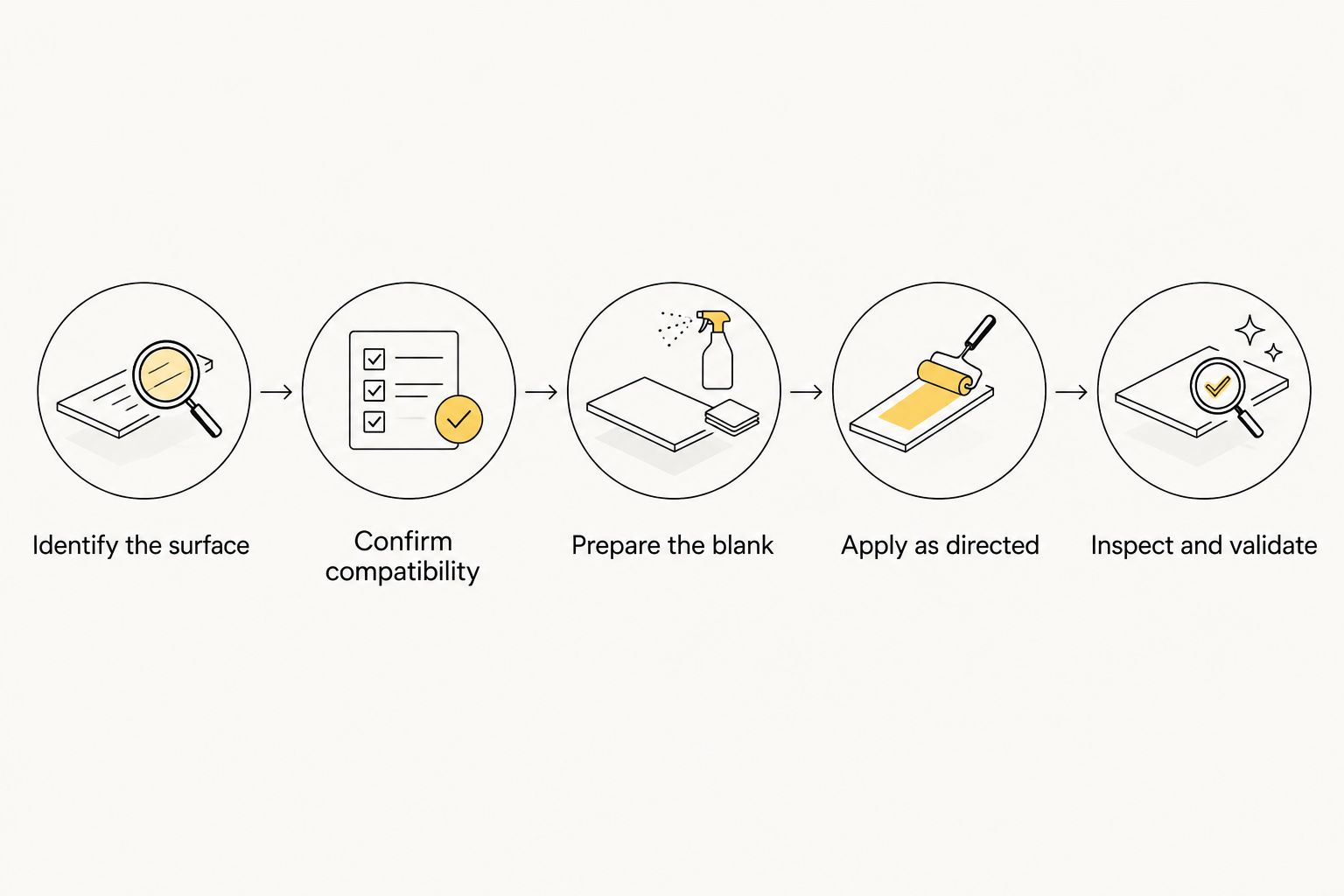
Keep a retained sample and document the result. A photograph records appearance, but it cannot establish bond strength or resistance to cleaning.
Is UV-DTF a better choice for wood and metal?
UV-DTF is the more relevant transfer category to evaluate for hard-surface decoration, but it is not universal. Typical UV-DTF transfers use UV-cured printed layers and an adhesive application process rather than the heat-activated powder adhesive used in standard apparel DTF.
That distinction matters when the blank cannot tolerate a heat press. It does not remove the need for a clean, compatible surface, and it does not make rough wood or textured coatings automatically suitable.
Choose by the finished item's requirements. For an outdoor sign or handled metal item, the distinction between waterproof versus regular stickers illustrates why water resistance alone is not a complete specification: adhesion, abrasion, cleaning, and weather exposure remain separate questions.
Do not treat UV curing during transfer manufacture as proof that the decorated object is qualified for outdoor use. Likewise, do not assume a rigid-surface graphic is dishwasher-safe or suitable for food-contact areas without explicit supporting instructions.
For a 2026 specification, request written application and care guidance for the exact transfer and blank combination. A category name is not a durability rating.
Can you use the same transfer order for shirts and signs?
Do not assume that an apparel transfer order also qualifies for rigid signage. The artwork can be shared, but the adhesive system and application requirements still need to match each substrate.
DTF2GO ready-to-press DTF transfers are best for apparel decorators buying custom transfers for garment decoration. DTF2GO produces custom cut-to-size apparel transfers; that stated purpose does not establish wood or metal compatibility.
The benefit is a transfer format intended for an apparel workflow. The limitation for this project is equally clear: you need separate confirmation before specifying a non-apparel use. Send the substrate, finish, shape, and intended service conditions through the contact page rather than asking only whether a transfer works on metal.
For a mixed order, keep garment decoration and hard-surface decoration as separate production specifications. Matching artwork does not require matching application chemistry.
What should make you reject a test application?
Reject a trial that damages the blank, leaves unsupported edges, or fails the intended handling and cleaning checks. Do not pass it because the central area looks good.
Look for these failure modes:
- The graphic lifts with light handling at an exposed edge.
- The carrier removes part of the design despite following the specified peel method.
- Paint or clear coat separates with the transfer.
- Heat changes the finish, shape, or appearance of the blank.
- The decoration fails the cleaning method required for the finished item.
Record what separated. Adhesive releasing from a coating is a different failure from the coating releasing from the blank, and the remedies are not interchangeable.
Do not cover a failed test with clear coat and call the problem solved. A topcoat adds another material interface and requires its own validation.
FAQ
Can I heat-press a regular DTF transfer onto wood?
Some wood surfaces can accept a regular DTF transfer, but only a supplier-supported application and testing can establish suitability. Confirm the finish's heat tolerance and test a matching spare blank before production.
Will non-UV DTF transfers stick to bare metal?
Do not assume non-UV DTF transfers will form a suitable bond on bare metal. Confirm adhesive compatibility, surface preparation, and application instructions for the specific metal before testing.
Is UV-DTF the same thing as regular DTF?
UV-DTF and regular DTF use different transfer systems. Standard apparel DTF uses heat-activated adhesive, while typical UV-DTF transfers use UV-cured printed layers and an adhesive process for suitable rigid surfaces.
Do I need to seal wood before applying a DTF transfer?
Sealing wood is not a universal requirement or a guaranteed fix for adhesion. A sealer becomes the bonding surface, so its compatibility and heat tolerance need separate confirmation.
What heat-press settings should I use for DTF on metal?
Use only settings supported for the specific transfer, metal blank, and finish. An apparel setting does not establish safe heat exposure or adequate adhesion on a rigid object.
Will a DTF transfer on metal be waterproof or dishwasher-safe?
Do not claim waterproof or dishwasher-safe performance without evidence for the finished transfer-and-blank combination. Water exposure, cleaning chemicals, heat, and abrasion are separate service conditions.
Can I use DTF2GO apparel transfers for wood signs?
Do not assume DTF2GO apparel transfers are approved for wood signs. Confirm the exact wood finish and proposed application with the supplier before testing or accepting production work.
One last thing
You are decorating the outermost surface, not the material name on the invoice. A painted metal sign presents paint to the adhesive; a clear-coated wood plaque presents clear coat.
Make that outer layer the starting point of your next test. Identifying it before pressing is more useful than repeatedly adjusting a garment recipe on an unknown finish.


