


DTF gang sheets are cheaper than individual transfers only when the savings on the order exceed your layout, cutting, sorting, and waste costs; there is no universal winner in 2026. Compare cost per usable transfer—not cost per sheet—and include the labor needed to get each design ready for the press.
- DTF2GO offers DTF gang sheets and cut-to-size transfers; choose by production workflow, not format alone.
- For dtf gang sheets vs individual transfers cost, compare identical artwork, quantities, usable yield, and preparation labor.
- Gang sheets suit consolidated layouts; individual transfers remove the need to separate designs from a shared sheet.
- A full sheet is not economical if its extra designs have no confirmed use.
Are DTF gang sheets cheaper than individual transfers?
Gang sheets win only when their total preparation-adjusted cost per usable transfer is lower. Individual transfers win when eliminating sheet separation and simplifying job handling offsets any difference in the order total.
Use the same artwork dimensions, design quantities, and delivery requirements for both quotes. Otherwise, you are comparing different jobs rather than different ways to supply the same job.
| Format | Best for | Main advantage | Main drawback | What decides the cost comparison |
|---|---|---|---|---|
| Print-ready DTF gang sheet | Approved designs that fit a consolidated layout | Combines designs into a shared sheet layout | Requires layout preparation, separation, and sorting | Usable output after preparation labor and waste |
| Individual cut-to-size DTF transfers | Jobs where separate transfers simplify production | Removes the task of separating designs from a shared sheet | Does not consolidate designs into a shared layout | Order total compared with the labor avoided |
Neither format automatically changes the artwork you need to press. The comparison concerns how you order, receive, and prepare that artwork for production.
Why this matters
A transfer order sits inside a larger apparel workflow. Someone still has to check artwork, count designs, match transfers to garments, and prepare the press station. A purchasing decision that ignores those tasks leaves part of the job cost uncounted.
For your 2026 costing worksheet, separate supplier charges from internal preparation costs. Keep pressing and garment handling consistent between the alternatives unless your actual workflow shows a difference.
DTF2GO DTF transfers are best for apparel decorators, promotional product businesses, and print shops sourcing ready-to-press artwork. The format decision still belongs to the job: consolidated sheets and cut-to-size transfers serve different preparation needs.
Gang sheets: best for approved, consolidated layouts
Choose gang sheets when your approved designs fit together and your shop has a clear process for separating and organizing them. Repeated artwork and compatible job batches give you a defined layout to evaluate—not a reason to assume savings before checking the quote.
The advantage is consolidation. You arrange multiple designs within a shared sheet rather than treating every design as a separate physical piece at the ordering stage.
The drawback is preparation. A tightly arranged sheet still needs practical cutting paths, identifiable designs, and a reliable count before it reaches production. Packing artwork closely without considering separation trades layout space for handling difficulty.
Before choosing this format, check:
- Every design has an approved size and quantity.
- The layout leaves workable separation paths.
- Someone owns the cutting and sorting task.
- Extra artwork has a confirmed production use.
- The resulting preparation cost belongs in the estimate.
Choose gang sheets when the completed layout and measured preparation work produce the lower job cost. Do not select them solely because a sheet looks full.
Individual transfers: best for reducing sheet preparation
Choose individual transfers when receiving separate designs fits your job handling better than receiving a shared sheet. This is a workflow choice, not an admission that your order is too small for gang sheets.
Cut-to-size transfers remove the need to separate the artwork from a gang sheet yourself. You still need to verify quantities, identify designs, and match each transfer to the correct garment.
The trade-off is that you are not arranging the job into a shared sheet layout. Compare the actual order total with the work that arrives already completed; do not assume either format carries a fixed premium.
DTF2GO produces custom cut-to-size, ready-to-press DTF heat transfers. For that option, assess the value of receiving separate transfers against your own preparation process rather than assigning an unsupported labor-saving figure.
Choose individual transfers when avoiding sheet preparation outweighs the alternative order's savings. Measure that difference using your shop's work, not another decorator's estimate.
How to calculate the real cost per usable transfer
Use the same calculation for both formats in 2026. The result should describe a completed preparation task: correctly counted transfers ready for the next production stage.
Preparation-adjusted cost per usable transfer = total transfer acquisition and preparation cost divided by usable transfers for the job.
Acquisition cost includes the quoted order and applicable delivery charges. Preparation cost includes the internal work that differs between the formats. Avoid counting the same expense twice.
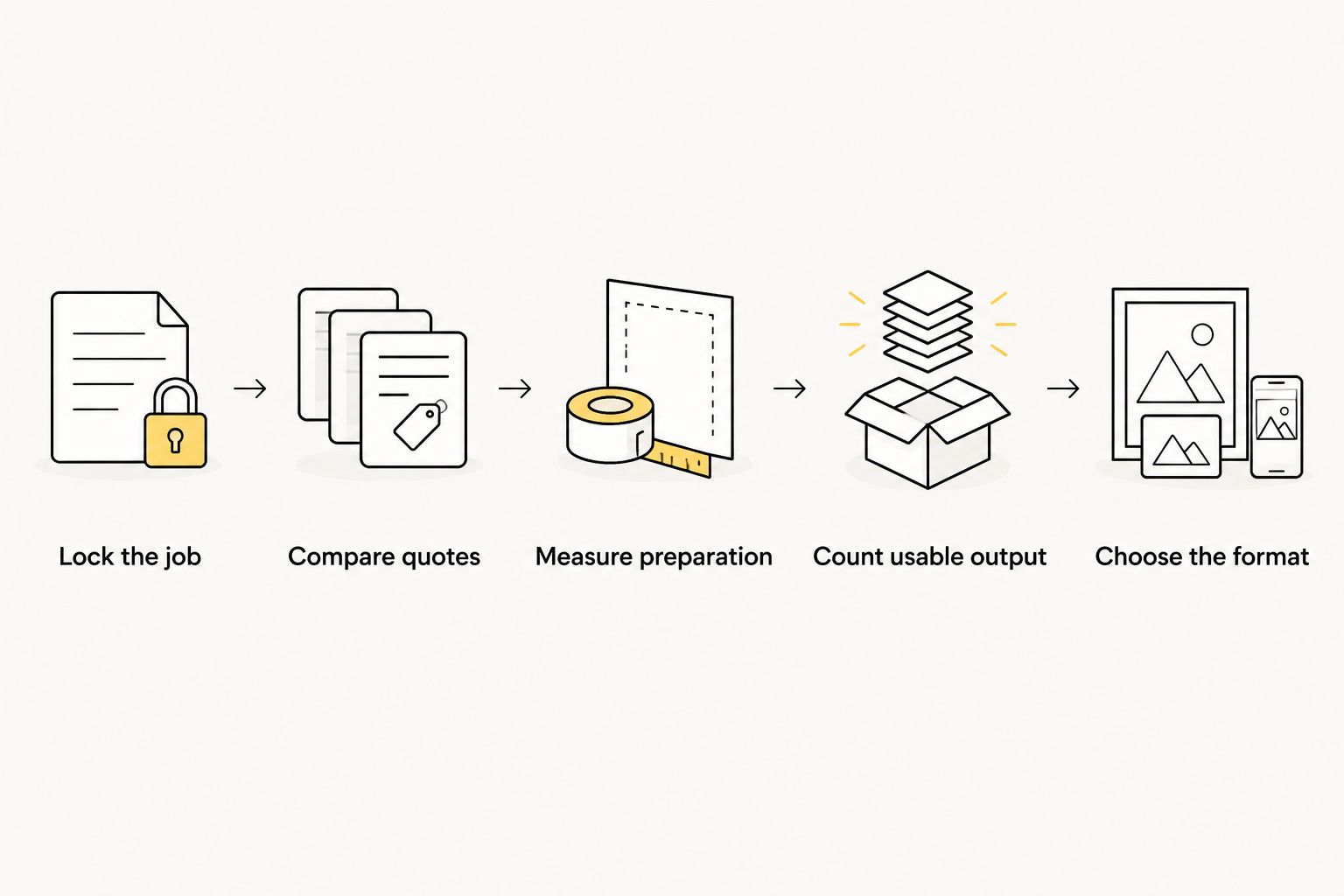
Lock the job
Record the approved artwork, final dimensions, quantities, and garment placements. Keep that specification unchanged while comparing formats.
A back graphic and a chest graphic are separate production requirements even when they belong to the same shirt. Preserve the required count for each placement rather than comparing only the overall number of printed designs.
Compare quotes
Build both options around the locked specification. Check the current configuration and checkout details rather than treating a product listing as a completed job quote.
Confirm whether the quote covers your finished layout or requires additional artwork preparation. If you change dimensions or quantities to make a layout fit, you have changed the comparison and need to document it.
Measure preparation
Track the tasks that differ: layout work, sheet separation, counting, sorting, and job labeling. Record your actual working time rather than borrowing an assumed cutting rate.
Use your shop's labor-cost method consistently. If layout preparation sits with prepress and cutting sits with production, include both departments instead of charging only the work performed beside the heat press.
Count usable output
Count transfers that meet the job specification and have a planned use. Exclude incorrect sizes, damaged pieces, and speculative filler artwork from the current job's usable output.
Keep reprints visible. When a preparation error requires replacement transfers, include the replacement expense and additional handling in the job record rather than leaving them outside the comparison.
Choose the format
Divide each option's total by its usable output. Then check that the selected format fits your production schedule and handling process.
The lower calculated cost wins the financial comparison. If you choose the other format for operational reasons, record that decision explicitly instead of describing it as the cheaper option.
Why DTF gang sheet and individual transfer costs vary
The format name does not determine the result. These factors change the comparison without requiring a blanket claim that either option is always cheaper:
- Artwork dimensions: Final design sizes determine how the required artwork fits within a sheet. Compare identical dimensions rather than shrinking designs to improve the apparent result.
- Required quantities: Count the designs the job actually needs. Additional copies are not savings unless they replace a planned purchase or serve a confirmed order.
- Layout preparation: Building, checking, and revising a shared layout is work. Include it even when the person preparing the file also owns the business.
- Separation and sorting: Cutting designs apart and organizing them by job add handling steps. Individual transfers still require verification, but not separation from a shared sheet.
- Usable yield: A printed design contributes to the current job only when it is correct and needed. Waste belongs in the numerator through its cost, not in the denominator as useful output.
- Delivery and replacements: Compare applicable delivery charges and any replacement orders consistently. Do not assume matching delivery costs without checking the actual quotes.
Keep these inputs separate on your 2026 worksheet. That makes the reason for the result visible and lets you update the comparison when the job specification changes.
Does filling every gap make a gang sheet cheaper?
No—filling space improves the current job's economics only when the added artwork has a real use and the total cost comparison supports it. An extra logo does not become valuable merely because it fits beside an approved design.
Before adding filler artwork, assign it to a confirmed job or a documented replenishment need. Otherwise, keep its value outside the current order calculation.
There is also a handling trade-off. More mixed designs mean more items to identify and sort, so assess layout density together with the preparation process rather than as an isolated goal.
Do individual transfers eliminate preparation labor?
No—individual transfers eliminate gang-sheet separation, not all preparation work. Your team still needs to check the order, confirm counts, and organize transfers for the correct garments.
Compare the tasks that actually disappear. Charging every preparation task to gang sheets while treating individual transfers as requiring no handling creates a biased result.
Should you combine customer orders on a gang sheet?
Combine customer orders only when their artwork is approved and your sorting process preserves job accuracy. Shared sheet space does not remove the need to track ownership, quantities, sizes, and garment placement.
Keep each customer's required output visible before arranging the layout. If a late revision changes a shared file, check the affected designs before ordering rather than assuming the rest of the layout remains correct.
Keep the comparison fair at the production bench
A useful 2026 comparison follows the job past delivery. Record what arrived, what preparation was required, and what reached the press station correctly.
Do not attribute every production problem to the ordering format. An artwork error, an incorrect garment allocation, and a cutting error have different causes; separate them so the next purchasing decision addresses the right task.
Use a short job record with these fields:
- Approved artwork and quantities.
- Format ordered and acquisition cost.
- Layout, separation, and sorting time.
- Correct transfers assigned to production.
- Waste and replacement work.
- Final preparation-adjusted cost per usable transfer.
Retain the completed layout alongside the record. For a repeat job, that lets you distinguish reusable preparation work from work that must happen again.
FAQ
Are DTF gang sheets always cheaper than individual transfers?
No—DTF gang sheets are cheaper only when their total acquisition and preparation cost per usable transfer is lower. Include layout, cutting, sorting, and waste in the comparison.
What's the fairest way to compare dtf gang sheets vs individual transfers cost?
Compare cost per usable transfer for identical artwork dimensions and quantities. Use current quotes and include the internal preparation work required by each format.
Are individual cut-to-size transfers ready to press?
DTF2GO supplies custom cut-to-size, ready-to-press DTF heat transfers. Receiving separate transfers removes gang-sheet separation, but you still need to verify the order and organize production.
Does unused space make a gang sheet a bad choice?
Unused space alone does not determine whether a gang sheet is the better choice. Compare the completed job's total cost rather than judging the layout only by how full it looks.
Should I count spare logos as usable transfers?
Count spare logos toward a confirmed future requirement, not automatically toward the current job. Keep speculative extras outside the current job's usable-output calculation.
Do I include heat-press labor when comparing the formats?
Keep heat-press labor consistent when the pressing workflow is identical. Add a format-specific difference only when your actual process establishes one.
How do I know when to switch from individual transfers to gang sheets?
Switch when a like-for-like job comparison shows a lower preparation-adjusted cost and the gang-sheet workflow fits your shop. Order quantity alone does not establish the answer.
One last thing
The cheapest layout is not necessarily the fullest layout. A sheet filled with designs you cannot assign to production improves its appearance, not your job economics.
Before placing your next order, reconcile the layout against the approved job quantities. That final check connects every printed design to a production need—and keeps the 2026 comparison grounded in useful output.


